Paneuropa – A Project for Peace and Freedom
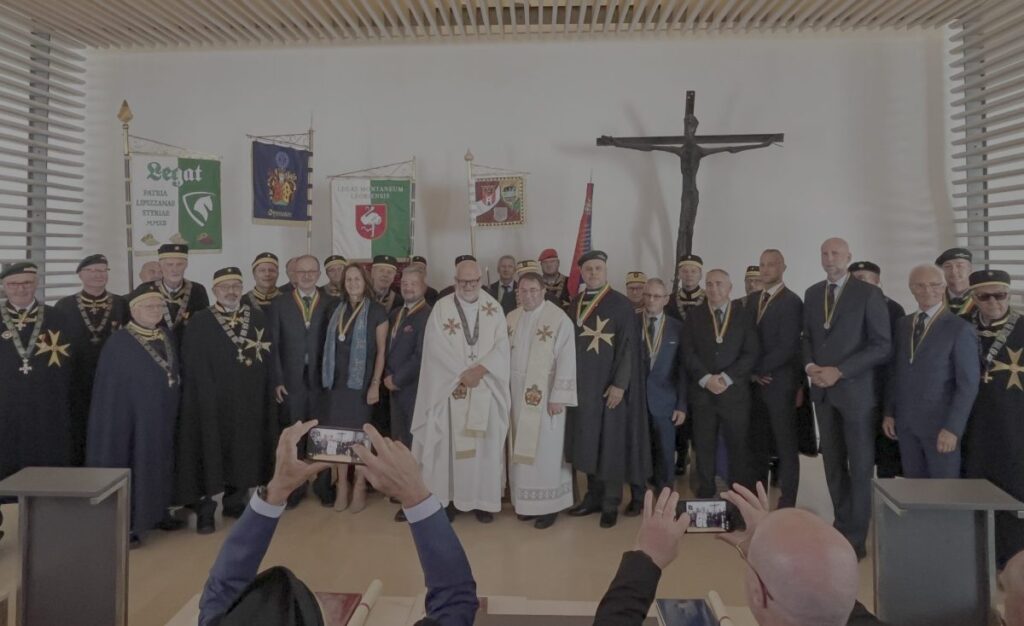
Paneuropa, Richard Coudenhove-Kalergi, Otto von Habsburg: Paneuropa President Rainhard Kloucek spoke about these topics in his lecture for the Knight Academy of the European Order of Wine Knights (Ordo Equestris Vini Europae) at the episcopal castle of Seggau. The Paneuropa concept enables Europe to be capable of effective action on the stage of world politics. That is why it is more relevant today than ever. To survive, Europe must be economically, politically, and militarily united and strong.
Find English version below!
“Towards the end of 1919, as I had done so many times before, I once again spun my globe. I was searching for a formula that would allow the United States to join the League of Nations without abandoning the Monroe Doctrine. Without America, the League of Nations seemed to me nothing more than a fragment, destined to fail. With America, however, it could become the beginning of a new and better era.
Suddenly, my attention was drawn to the straight line that, at that time, separated democratic Europe from the Soviet Union, and which, beyond the Mediterranean, continued as the frontier between British Africa and the colonies of the continental European powers. To the east of this African boundary stretched the British Empire in a vast arc around the Indian Ocean, from Cape Town to Sydney.
This provided me with the key to a regional organization of the world into five great spheres—a structure that could enable both the United States and the Soviet Union to join the League of Nations.
Of these five great spheres, Pan-America was already organized, as was the northern part of the Old World under the Soviet Union and its southern part under the British Empire. In the Far East, Japan was attempting to establish a Mongolian bloc of nations together with China. Only the fifth of these great spheres—Paneuropa—remained completely unorganized. Yet between the Petsamo–Katanga line and the Atlantic lay a clear geographical unit, united by a common culture, history, and tradition.
Would it not be possible to unite these twenty-six European democracies in a federation of states modeled on the Pan-American Union? Such an arrangement would allow the United States of America to join the League of Nations without running the risk of becoming entangled in European conflicts.
Under these same conditions, the Soviet Union could likewise join the League of Nations without fearing interference in its internal affairs. The creation of Paneuropa therefore seemed to me the indispensable prerequisite for the universalization and salvation of the League of Nations.
The more I reflected upon this question, the more irresistibly I found myself drawn to the idea of Paneuropa.
It soon became clear to me that Paneuropa was the only way to prevent a second world war.”
How did Paneuropa come about?
Of course, it was not I who was turning a globe in 1919, but Richard Coudenhove-Kalergi. The passages I have just quoted are taken from the introduction to Chapter 10, “Paneuropa,” in his autobiography “A Life for Europe.”
In just a few paragraphs, this introduction vividly captures the geopolitical situation of the time. The end of the First World War also marked the end of four great empires. The German Empire, although a national empire, lost comparatively little territory. The Ottoman Empire and the Habsburg Empire, both multinational empires, were dismantled and divided into various territories and the so-called nation-states.
The Russian Tsarist Empire had lost the war, and the Communist Revolution replaced the Tsar first with Lenin and later with Stalin. Yet, just as under the Tsars, the Moscow-based empire remained fundamentally expansionist under Communist rule. One need only recall the attempts to reclaim Poland—or at least parts of it. These ambitions were thwarted by the Miracle on the Vistula. Polish forces, aided by Ukrainian units, succeeded in defeating the Red Army. Tragically, however, the promised support for the young Ukrainian state in defending itself against Russia never materialized. Ukraine was eventually crushed by Moscow, culminating under Stalin in the Holodomor—a genocide carried out through deliberate starvation.
The British Empire remained intact, but it was already showing unmistakable signs of decline. The new global superpower was the United States. Its entry into the war sealed the fate of the old empires. Yet after the war, America withdrew once again from European affairs.
Coudenhove-Kalergi described this world in terms of the great powers: the United States, Japan—or Asia more broadly—the British Empire, and the Soviet Union.
Some contemporary historians on the political left criticize him for viewing Africa primarily as a continent ruled by European colonial powers. At the same time, however, the European continent—that western peninsula of Asia, as Coudenhove-Kalergi would later describe it—was itself in a state of chaos.
Fragmented into small states, a number of former colonial powers still imagined themselves to be great powers, but this was increasingly wishful thinking rather than political reality.
The Destruction of a Large Internal Market
The decisive issue, however, was not merely the decline of the European powers, but also the collapse of a vast common economic area. Austria-Hungary and Germany had formed a customs union, creating what amounted to an internal market stretching from the Baltic Sea to the Adriatic and from what is now western Ukraine to the Atlantic.
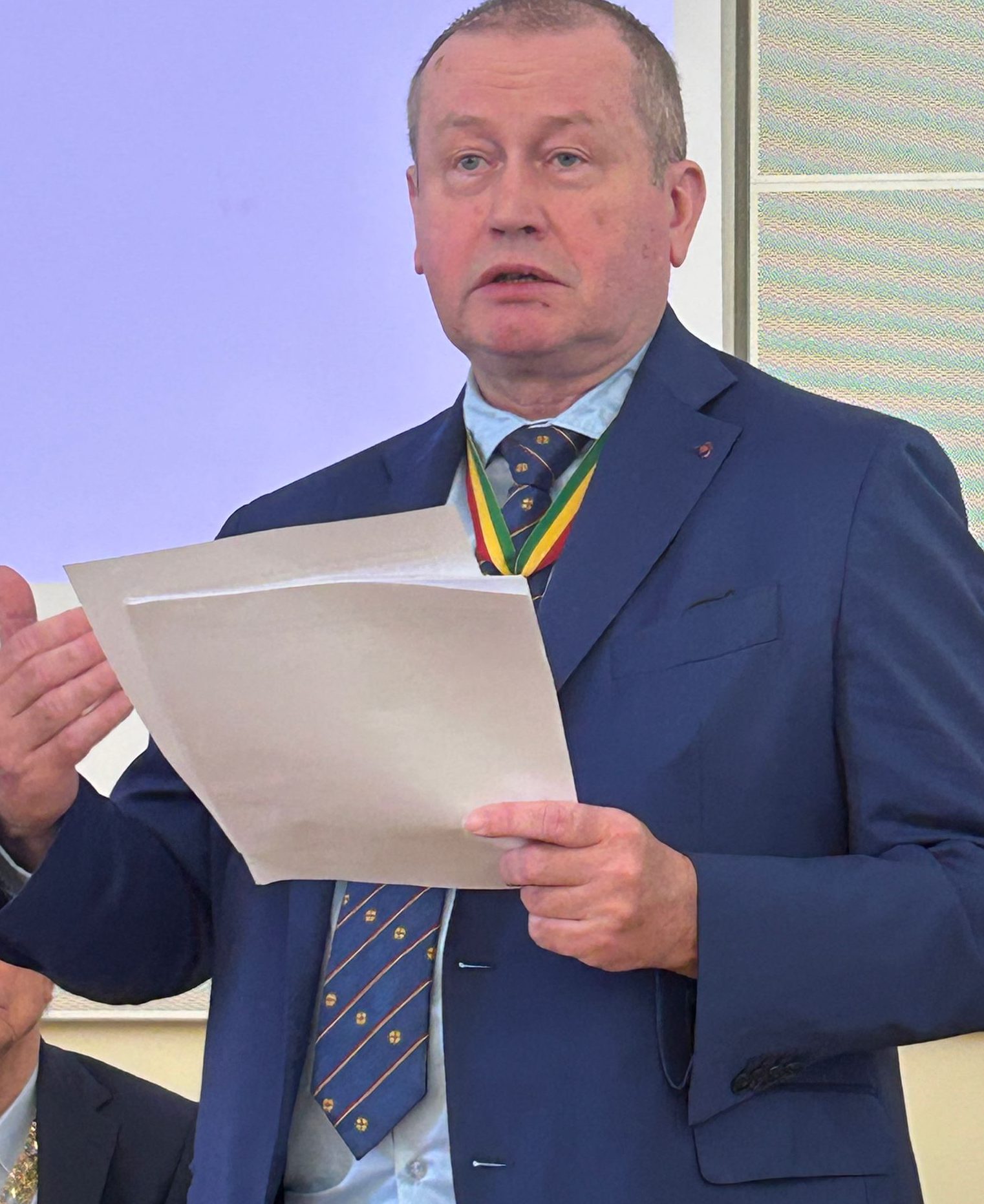
Rainhard Kloucek during his lecture at the Knight Academy of the Ordo Equestris Vini Europae.
Each of the newly created small states attempted to export its economic problems through tariffs. The result was not a solution but rather the fragmentation of the market, the obstruction of free trade, and the worsening of economic difficulties. Combined with the fact that many ethnic groups within the new nation-states did not belong to the nationality of the majority population, this created an explosive political situation.
The numerous armed conflicts that erupted between the two world wars form an integral part of what we call the interwar period—leading some historians to regard the First and Second World Wars as two phases of a single prolonged conflict.
But that is another story. Today, our focus is Paneuropa and its founder, Richard Coudenhove-Kalergi. My aim is to leave enough time for discussion afterwards, so I would encourage you to note down any questions, comments, or points of criticism as we proceed.
So who, then, was this Richard Coudenhove-Kalergi—the “Prophet of Europe,” as he has often been called? He was undoubtedly a remarkable and charismatic personality, and he remains a deeply polarizing figure to this day. In his own time, he was regarded as an enemy by racists, nationalists, and revanchists—that is, by what we would broadly call the political right. (I use this term reluctantly, since I consider the traditional left–right distinction increasingly outdated, but for the sake of simplicity I will remain within that framework for now.) Today, by contrast, some voices on the political left accuse him of having been a racist and a colonialist himself.
Many of these judgments are based less on a careful reading of his work than on ideological preconceptions. They frequently rely on isolated quotations or passages taken out of context, from which conspiracy theories have subsequently been constructed.
One example is the so-called “Kalergi Plan.”
How conspiracy fantasies emerge
How Conspiracy Theories Arise
Nor was Richard Coudenhove-Kalergi an advocate of erasing the identities of Europe’s peoples. Quite the contrary. He was simply describing developments that he observed and projecting them into the future.
His own life provides perhaps the best illustration of this. When he arrived in Europe with his parents, there were only two Japanese women living in Vienna: his mother and the wife of Julius Meinl. Marriages across national and cultural boundaries were common among Europe’s high aristocracy, but they were extremely rare among the general population, which was far less mobile.
It was precisely the unprecedented increase in mobility across national borders that later made such relationships commonplace. Earlier generations simply had little opportunity to meet people from distant countries. When the Coudenhove family traveled from Japan to Europe, the journey by ship and rail took several weeks. By the time Richard Coudenhove-Kalergi wrote about these developments, commercial air travel had already become a reality.
Let us return to the facts of his life. Richard Coudenhove-Kalergi left behind an extensive literary legacy consisting of books, documented speeches, memoranda, and numerous essays. In 1922 he published “Paneuropa: A Proposal,” although several of the underlying essays had already appeared earlier. He died in 1972. This means that for roughly half a century—from the end of the First World War to the height of the Cold War—he remained an active public intellectual, commenting on an era marked by profound geopolitical transformations.
Some of what Coudenhove-Kalergi wrote naturally reflects the assumptions and circumstances of his own time and may sound unfamiliar today because history took different paths. Yet much of his work has retained its relevance. I am thinking in particular of “The Totalitarian State and the Total Man,” but also “Stalin & Co.” and, of course, “Paneuropa.”
Richard Coudenhove-Kalergi was born in Tokyo, Japan, on November 17, 1894. Alongside the name Richard, he also bore the Japanese name Eijiro. Owing to the time difference, it was still November 16 in Europe. He died on July 27, 1972, in Schruns, in the Austrian province of Vorarlberg.
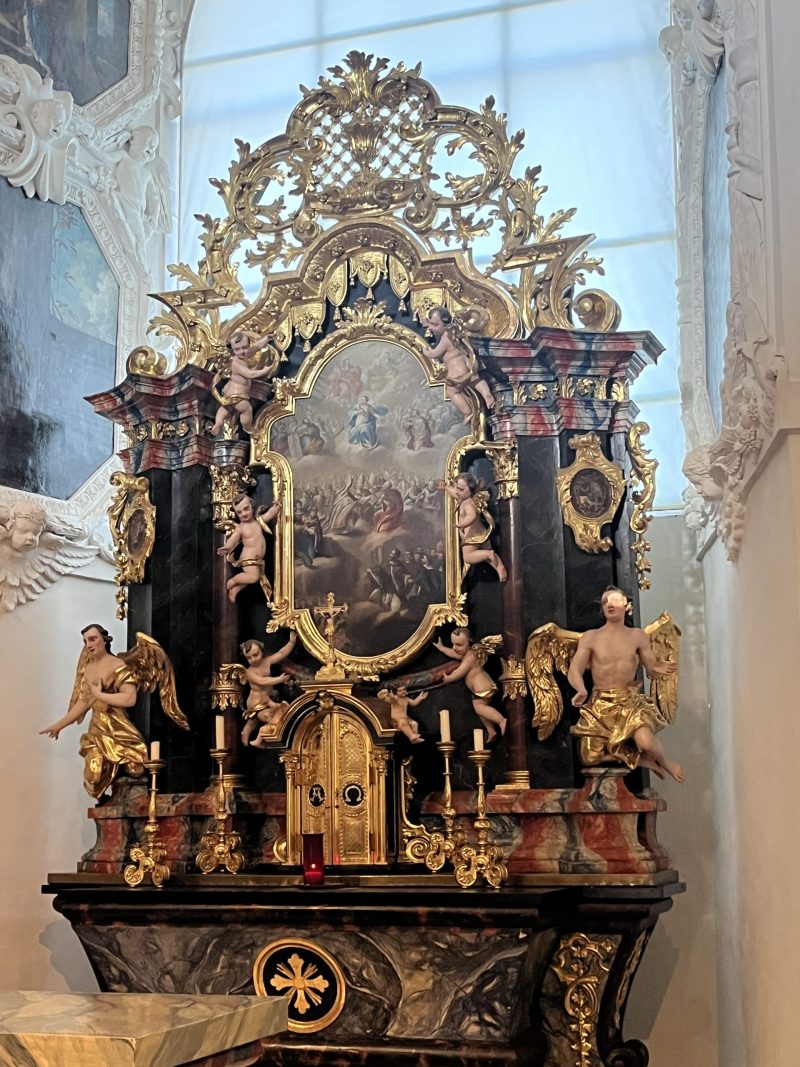
The Knight Academy took place at Seggau Castle, the bishop’s residence. The picture shows the altar in the Chapel of Mary. The spiritual foundations of Europe are just as important for the Ordo Equestris Vini Europae as they are for Paneuropa.
His father was Heinrich Coudenhove-Kalergi, who represented the Habsburg Monarchy in Japan as the envoy of the Austrian Emperor. He was an exceptionally well-read and cultivated man who had studied, among other places, in Czernowitz. The family’s ancestry reached into virtually every corner of Europe. Their ancestral castle stood at Ronsperg in Bohemia, not far from the Bavarian border.
His mother was Japanese. Heinrich had met and married her while serving in Tokyo. In 1896 the family returned to Europe and settled at Ronsperg Castle.
The Cosmopolitan Island in Bohemia
Ronsperg Castle, where young Richard grew up, was something of a cosmopolitan island. It contained an extensive library, and his father regularly welcomed guests from many different parts of the world. The aggressive nationalism that was already spreading across Europe was virtually unknown within the family. Richard later recalled only one occasion on which he himself became a nationalist—as a child. While discussing with his brother Heinrich how the family’s estates, located in different parts of the Habsburg Monarchy, might one day be divided, one brother jokingly became a Hungarian nationalist, the other a Czech nationalist. It was nothing more than a childhood game.
Richard thought in terms of continents rather than nation-states. His father represented Europe; his mother represented Asia. Because he had been born in Japan and only later came to Europe, many scholars believe he was able to perceive Europe as a single civilization rather than merely as a collection of independent states.
He even spoke of a European nation that embraced the many nations of Europe because they shared common cultural foundations.
After the Second World War, he maintained close contacts with French President Charles de Gaulle. De Gaulle liked to speak of a “Europe of Fatherlands.” Coudenhove-Kalergi responded by speaking instead of “Mother Europe.”
The concept of Paneuropa, as Richard Coudenhove-Kalergi developed it one hundred years ago, was fundamentally geopolitical in nature. Its objective was not the harmonization of tax rates, nor the creation of a Europe-wide redistributive welfare state. Rather, it sought to establish a new European order—not by attempting the unrealistic restoration of the old order, but by creating a political structure capable of restoring Europe as a decisive actor in world affairs, instead of allowing it to become a pawn of non-European powers.
A Geopolitical Concept
Three priorities therefore lay at the heart of his vision. First, a common European foreign policy, enabling Europe to act independently on the global stage instead of being dominated by others. Second, a common European security policy, ensuring that Europe would neither become dependent on external powers nor once again descend into wars among its own nations. Third, the complete removal of customs barriers within Europe.
Today, we would describe this as a genuine European single market—a continent-wide area of free trade. Coudenhove-Kalergi also envisaged a common currency, which in his own time would naturally have been based on the international gold standard, as well as a European federal court, resembling what today is the European Court of Justice.
Individual liberty, personal responsibility, and a state whose primary role is to establish the legal framework of a constitutional democracy formed another essential pillar of his vision for European unity.
Above all, however, Paneuropa was conceived as a peace project. European integration was intended to prevent future wars between the nations and peoples of Europe.
In 1926, the first Paneuropa Congress was held in Vienna, where participants discussed practical steps toward European unification. Reading the documents from that congress today and comparing them with current debates leaves one with the striking impression that we continue to face many of the same challenges. Petty bureaucratic thinking still too often prevents meaningful progress.
One need only consider the single market and the remarkable creativity with which national bureaucracies continue to invent new forms of protectionism.
The ideal of peace also became the guiding principle behind the practical realization of European integration after the Second World War. The close cooperation between the former arch-enemies France and Germany was essential if future wars were to be avoided.
It was therefore entirely logical that the Franco-German partnership became the engine of European integration. Whenever these two countries reached agreement, it usually created the conditions for the other member states to follow.
This worked relatively smoothly when the European Community consisted of six, then nine, and later twelve members, since these countries were broadly similar in their historical experiences and political development. Subsequent enlargements, however, made consensus more difficult. Even the countries that joined in 1995 brought with them distinct historical experiences as neutral states during the Cold War.
The accession of many countries from the former Soviet bloc fundamentally transformed the Union once again. Nearly half a century under Moscow’s domination had inevitably left lasting political and cultural legacies.
The Franco-German Directorate
This is not a criticism of enlargement itself. Rather, it is a criticism of those Western European governments that assumed the enlarged Union could continue to function exactly as before. The notion of a Franco-German directorate—an expression once used by French President Jacques Chirac—remained too deeply rooted in ideas of political hegemony to succeed in a much larger and more diverse Europe.
Nevertheless, the peace project itself has undoubtedly been successful. Despite all the difficulties involved in reaching political decisions, war between member states of the European Union has become virtually inconceivable. The Union remains so attractive that many countries continue to seek membership.
Yet this peace project was directed almost exclusively inward. It never developed a corresponding foreign or security policy capable of projecting stability beyond the Union’s borders. In matters of defense, Europe relied overwhelmingly on the United States and NATO.
This became painfully clear during the breakup of Yugoslavia. Only the intervention of the United States and NATO against the attempted genocide of the Kosovo Albanians by the Serbian war criminal Slobodan Milosevic finally brought the Balkan wars to an end.
The European Union failed to draw the necessary lessons from that experience. Instead, it concentrated on enlargement while continuing to believe that large-scale wars of the kind Europe had known in the past had become impossible.
Thus, the internal dimension of the European peace project succeeded, while its external dimension remained underdeveloped. Following the end of the Cold War, Europe succumbed to a dangerous illusion of lasting peace. It steadily reduced—and in some areas effectively dismantled—its own defense capabilities. The so-called peace dividend appeared highly attractive. Yet developments beyond the European Union have demonstrated that wars of conquest and imperial ambitions have by no means disappeared from history.
For that reason, Europe must now give its peace project an effective external dimension. The European Union requires a genuine common foreign and security policy. The long-serving President—and now Honorary President—of the Austrian Paneuropa Movement, who is also Protector of the Ordo Equestris Vini Europae, Karl von Habsburg once expressed this vision in a speech on Europe’s future:
We Need a European Foreign Policy
“European foreign policy means far more than coordinating the foreign policies of twenty-seven member states through the High Representative for Foreign Affairs and Security Policy. It requires a genuine European Ministry of Foreign Affairs, headed by a European Foreign Minister.
To achieve this, we need a core European constitution that clearly assigns responsibility for foreign policy to the European Union. Incidentally, this would fully comply with the principle of subsidiarity. Just as every national foreign minister is accountable to the parliament of his or her own country, a European Foreign Minister would be accountable to the directly elected European Parliament.
This concerns precisely the question of sovereignty, which many national egoists are so fond of discussing. For sovereignty, ladies and gentlemen, in this specific case means the ability to act and to shape. A European foreign policy would, in terms of its potential, bring a clear added value compared to a purely national foreign policy.”
Thus, 100 years after the founding of the Paneuropa Union, this geopolitical concept remains valid. Precisely because it has not yet been fully realized, an organization like Paneuropa is needed.
Alongside this geopolitical approach, the principles of freedom and the rule of law form the foundations of Paneuropa. The rule of law protects rights and freedom; it does not enforce personal—ideological—notions of happiness or welfare through state coercion.
The Soul of Europe
Richard Coudenhove-Kalergi once called freedom the soul of Europe. Otto von Habsburg, who led Paneuropa for over three decades, described freedom as civilization’s greatest achievement.
I would like to conclude this lecture with two quotes from these two great Paneuropeans, which address freedom, the state, and the tasks of politics.
Richard Coudenhove-Kalergi in “The Totalitarian State and the Total Man”
“Man is a creature of God.
The state is a creature of man.
Therefore, the state exists for the sake of man—and not man for the sake of the state.
Men without states are conceivable—states without men are inconceivable.
Man is an end: not a means.
The state is a means: not an end.
The value of a state is as great as its service to man: insofar as it serves the development of man, it is good—as soon as it hinders the development of man, it is bad.”
Otto von Habsburg, quoted from “Courage for Duty”
Civilization’s Greatest Achievement
“If we wish to develop a guideline and a program for the future, it is above all necessary to clarify the deeper meaning of politics. This is not the preservation and exercise of power, as most contemporary bureaucrats believe, but service to the eternal values, which are: justice, freedom, and humanity. Their safeguarding is the essence and justification of the state. Politics exists to serve these ideals. This is the perspective into which the means, ways, and programs of politics must be placed. These have no absolute, but merely a relative value. The means does not carry its justification within itself; it is neutral, neither good nor evil, and can only be judged in relation to its purpose. If it serves the correctly understood idea of the state, then it is good; if it does not, it is bad. It must therefore under no circumstances be overvalued.”
I would like to conclude with a cordial invitation to the Paneuropa Congress, one hundred years after the first Paneuropa Congress: October 1, 2, and 3, 2026, in Vienna.
Photos: Joachim Rodler, Rainhard Kloucek
The featured image was taken after the Order’s service in St. Michael’s Chapel at Seggau Castle.
Paneuropa – a concept for peace and liberty
“Towards the end of 1919, as I had done so many times before, I once again spun my globe.
I was searching for a formula that would allow the United States to join the League of Nations without abandoning the Monroe Doctrine. Without America, the League of Nations seemed to me nothing more than a fragment, destined to fail. With America, however, it could become the beginning of a new and better era.
Suddenly, my attention was drawn to the straight line that, at that time, separated democratic Europe from the Soviet Union, and which, beyond the Mediterranean, continued as the frontier between British Africa and the colonies of the continental European powers. To the east of this African boundary stretched the British Empire in a vast arc around the Indian Ocean, from Cape Town to Sydney.
This provided me with the key to a regional organization of the world into five great spheres—a structure that could enable both the United States and the Soviet Union to join the League of Nations.
Of these five great spheres, Pan-America was already organized, as was the northern part of the Old World under the Soviet Union and its southern part under the British Empire. In the Far East, Japan was attempting to establish a Mongolian bloc of nations together with China. Only the fifth of these great spheres—Paneurope—remained completely unorganized. Yet between the Petsamo–Katanga line and the Atlantic lay a clear geographical unit, united by a common culture, history, and tradition.
Would it not be possible to unite these twenty-six European democracies in a federation of states modeled on the Pan-American Union? Such an arrangement would allow the United States of America to join the League of Nations without running the risk of becoming entangled in European conflicts.
Under these same conditions, the Soviet Union could likewise join the League of Nations without fearing interference in its internal affairs. The creation of Paneurope therefore seemed to me the indispensable prerequisite for the universalization and salvation of the League of Nations.
The more I reflected upon this question, the more irresistibly I found myself drawn to the idea of Paneurope.
It soon became clear to me that Paneurope was the only way to prevent a second world war.“
Of course, it was not I who was turning a globe in 1919, but Richard Coudenhove-Kalergi. The passages I have just quoted are taken from the introduction to Chapter 10, “Paneurop,” in his autobiography “A Life for Europe.”
In just a few paragraphs, this introduction vividly captures the geopolitical situation of the time. The end of the First World War also marked the end of four great empires. The German Empire, although a national empire, lost comparatively little territory. The Ottoman Empire and the Habsburg Empire, both multinational empires, were dismantled and divided into various territories and the so-called nation-states. The Russian Empire had lost the war, and the Communist Revolution replaced the Tsar first with Lenin and later with Stalin. Yet, just as under the Tsars, the Moscow-based empire remained fundamentally expansionist under Communist rule. One need only recall the attempts to reclaim Poland—or at least parts of it. These ambitions were thwarted by the Miracle on the Vistula. Polish forces, aided by Ukrainian units, succeeded in defeating the Red Army. Tragically, however, the promised support for the young Ukrainian state in defending itself against Russia never materialized. Ukraine was eventually crushed by Moscow, culminating under Stalin in the Holodomor—a genocide carried out through deliberate starvation.
The British Empire remained intact, but it was already showing unmistakable signs of decline. The new global superpower was the United States. Its entry into the war sealed the fate of the old empires. Yet after the war, America withdrew once again from European affairs.
Coudenhove-Kalergi described this world in terms of the great powers: the United States, Japan—or Asia more broadly—the British Empire, and the Soviet Union. Some contemporary historians on the political left criticize him for viewing Africa primarily as a continent ruled by European colonial powers. At the same time, however, the European continent—that western peninsula of Asia, as Coudenhove-Kalergi would later describe it—was itself in a state of chaos. Fragmented into small states, a number of former colonial powers still imagined themselves to be great powers, but this was increasingly wishful thinking rather than political reality.
The decisive issue, however, was not merely the decline of the European powers, but also the collapse of a vast common economic area. Austria-Hungary and Germany had formed a customs union, creating what amounted to an internal market stretching from the Baltic Sea to the Adriatic and from what is now western Ukraine to the Atlantic. Each of the newly created small states attempted to export its economic problems through tariffs. The result was not a solution but rather the fragmentation of the market, the obstruction of free trade, and the worsening of economic difficulties.
Combined with the fact that many ethnic groups within the new nation-states did not belong to the nationality of the majority population, this created an explosive political situation. The numerous armed conflicts that erupted between the two world wars form an integral part of what we call the interwar period—leading some historians to regard the First and Second World Wars as two phases of a single prolonged conflict.
But that is another story. Today, our focus is Paneuropa and its founder, Richard Coudenhove-Kalergi.
My aim is to leave enough time for discussion afterwards, so I would encourage you to note down any questions, comments, or points of criticism as we proceed.
So who, then, was this Richard Coudenhove-Kalergi—the “Prophet of Europe,” as he has often been called?
He was undoubtedly a remarkable and charismatic personality, and he remains a deeply polarizing figure to this day. In his own time, he was regarded as an enemy by racists, nationalists, and revanchists—that is, by what we would broadly call the political right. (I use this term reluctantly, since I consider the traditional left–right distinction increasingly outdated, but for the sake of simplicity I will remain within that framework for now.) Today, by contrast, some voices on the political left accuse him of having been a racist and a colonialist himself.
Many of these judgments are based less on a careful reading of his work than on ideological preconceptions. They frequently rely on isolated quotations or passages taken out of context, from which conspiracy theories have subsequently been constructed.
One example is the so-called “Kalergi Plan.”
This is one of the most widespread conspiracy theories associated with Coudenhove-Kalergi. It is based on a passage in which he discusses the long-term mixing of peoples. This observation has been falsely presented as though it were a concrete political blueprint that he had designed. According to this narrative, the European Union later implemented this supposed plan by encouraging mass migration, and Angela Merkel was awarded the Coudenhove-Kalergi European Prize because of her refugee policy, allegedly intended to replace Europe’s native populations.
At first glance, this may sound like a coherent story. Upon closer and more serious examination, however, it proves to be nothing more than a conspiracy theory.
Angela Merkel did not receive the Coudenhove-Kalergi European Prize because of her refugee policy. She received it largely because of the vanity of some of those responsible for awarding the prize. I will mention only two people who opposed the decision: Otto von Habsburg—and myself. Others simply wanted a photograph with Chancellor Merkel.
Nor was Richard Coudenhove-Kalergi an advocate of erasing the identities of Europe’s peoples. Quite the contrary. He was simply describing developments that he observed and projecting them into the future.
His own life provides perhaps the best illustration of this.
When he arrived in Europe with his parents, there were only two Japanese women living in Vienna: his mother and the wife of Julius Meinl. Marriages across national and cultural boundaries were common among Europe’s high aristocracy, but they were extremely rare among the general population, which was far less mobile.
It was precisely the unprecedented increase in mobility across national borders that later made such relationships commonplace. Earlier generations simply had little opportunity to meet people from distant countries. When the Coudenhove family traveled from Japan to Europe, the journey by ship and rail took several weeks. By the time Richard Coudenhove-Kalergi wrote about these developments, commercial air travel had already become a reality.
Let us return to the facts of his life.
Richard Coudenhove-Kalergi left behind an extensive literary legacy consisting of books, documented speeches, memoranda, and numerous essays. In 1922 he published “Paneuropa: A Proposal,” although several of the underlying essays had already appeared earlier. He died in 1972. This means that for roughly half a century—from the end of the First World War to the height of the Cold War—he remained an active public intellectual, commenting on an era marked by profound geopolitical transformations.
Some of what Coudenhove-Kalergi wrote naturally reflects the assumptions and circumstances of his own time and may sound unfamiliar today because history took different paths. Yet much of his work has retained its relevance. I am thinking in particular of “The Totalitarian State and the Total Man,” but also “Stalin & Co.” and, of course, “Paneuropa.”
Richard Coudenhove-Kalergi was born in Tokyo, Japan, on November 17, 1894. Alongside the name Richard, he also bore the Japanese name Eijiro. Owing to the time difference, it was still November 16 in Europe. He died on July 27, 1972, in Schruns, in the Austrian province of Vorarlberg.
His father, Heinrich Coudenhove-Kalergi, served as the Austro-Hungarian Emperor’s envoy to Japan. He was an exceptionally well-read and cultivated man who had studied, among other places, in Czernowitz. The family’s ancestry reached into virtually every corner of Europe. Their ancestral castle stood at Ronsperg in Bohemia, not far from the Bavarian border.
His mother was Japanese. Heinrich had met and married her while serving in Tokyo. In 1896 the family returned to Europe and settled at Ronsperg Castle.
The castle where young Richard grew up was something of a cosmopolitan island. It contained an extensive library, and his father regularly welcomed guests from many different parts of the world. The aggressive nationalism that was already spreading across Europe was virtually unknown within the family.
Richard later recalled only one occasion on which he himself became a nationalist—as a child. While discussing with his brother Heinrich how the family’s estates, located in different parts of the Habsburg Monarchy, might one day be divided, one brother jokingly became a Hungarian nationalist, the other a Czech nationalist. It was nothing more than a childhood game.
Richard thought in terms of continents rather than nation-states. His father represented Europe; his mother represented Asia. Because he had been born in Japan and only later came to Europe, many scholars believe he was able to perceive Europe as a single civilization rather than merely as a collection of independent states.
He even spoke of a European nation that embraced the many nations of Europe because they shared common cultural foundations.
After the Second World War, he maintained close contacts with French President Charles de Gaulle. De Gaulle liked to speak of a “Europe of Fatherlands.” Coudenhove-Kalergi responded by speaking instead of “Mother Europe.”
The concept of Paneuropa, as Richard Coudenhove-Kalergi developed it one hundred years ago, was fundamentally geopolitical in nature.
Its objective was not the harmonization of tax rates, nor the creation of a Europe-wide redistributive welfare state. Rather, it sought to establish a new European order—not by attempting the unrealistic restoration of the old order, but by creating a political structure capable of restoring Europe as a decisive actor in world affairs, instead of allowing it to become a pawn of non-European powers.
Three priorities therefore lay at the heart of his vision. First, a common European foreign policy, enabling Europe to act independently on the global stage instead of being dominated by others.
Second, a common European security policy, ensuring that Europe would neither become dependent on external powers nor once again descend into wars among its own nations.
Third, the complete removal of customs barriers within Europe.
Today, we would describe this as a genuine European single market—a continent-wide area of free trade. Coudenhove-Kalergi also envisaged a common currency, which in his own time would naturally have been based on the international gold standard, as well as a European federal court, resembling what today is the European Court of Justice.
Individual liberty, personal responsibility, and a state whose primary role is to establish the legal framework of a constitutional democracy formed another essential pillar of his vision for European unity.
Above all, however, Paneuropa was conceived as a peace project. European integration was intended to prevent future wars between the nations and peoples of Europe.
In 1926, the first Paneuropa Congress was held in Vienna, where participants discussed practical steps toward European unification. Reading the documents from that congress today and comparing them with current debates leaves one with the striking impression that we continue to face many of the same challenges. Petty bureaucratic thinking still too often prevents meaningful progress. One need only consider the single market and the remarkable creativity with which national bureaucracies continue to invent new forms of protectionism.
The ideal of peace also became the guiding principle behind the practical realization of European integration after the Second World War.
The close cooperation between the former arch-enemies France and Germany was essential if future wars were to be avoided. It was therefore entirely logical that the Franco-German partnership became the engine of European integration. Whenever these two countries reached agreement, it usually created the conditions for the other member states to follow.
This worked relatively smoothly when the European Community consisted of six, then nine, and later twelve members, since these countries were broadly similar in their historical experiences and political development. Subsequent enlargements, however, made consensus more difficult.
Even the countries that joined in 1995 brought with them distinct historical experiences as neutral states during the Cold War. The accession of many countries from the former Soviet bloc fundamentally transformed the Union once again. Nearly half a century under Moscow’s domination had inevitably left lasting political and cultural legacies.
This is not a criticism of enlargement itself. Rather, it is a criticism of those Western European governments that assumed the enlarged Union could continue to function exactly as before. The notion of a Franco-German directorate—an expression once used by French President Jacques Chirac—remained too deeply rooted in ideas of political hegemony to succeed in a much larger and more diverse Europe.
Nevertheless, the peace project itself has undoubtedly been successful. Despite all the difficulties involved in reaching political decisions, war between member states of the European Union has become virtually inconceivable. The Union remains so attractive that many countries continue to seek membership.
Yet this peace project was directed almost exclusively inward. It never developed a corresponding foreign or security policy capable of projecting stability beyond the Union’s borders. In matters of defense, Europe relied overwhelmingly on the United States and NATO.
This became painfully clear during the breakup of Yugoslavia. Only the intervention of the United States and NATO against the attempted genocide of the Kosovo Albanians by the Serbian war criminal Slobodan Milosevic finally brought the Balkan wars to an end.
The European Union failed to draw the necessary lessons from that experience. Instead, it concentrated on enlargement while continuing to believe that large-scale wars of the kind Europe had known in the past had become impossible.
Thus, the internal dimension of the European peace project succeeded, while its external dimension remained underdeveloped. Following the end of the Cold War, Europe succumbed to a dangerous illusion of lasting peace. It steadily reduced—and in some areas effectively dismantled—its own defense capabilities. The so-called peace dividend appeared highly attractive. Yet developments beyond the European Union have demonstrated that wars of conquest and imperial ambitions have by no means disappeared from history.
Following the end of the Cold War, Europe succumbed to a dangerous illusion of lasting peace. It steadily reduced—and in some areas effectively dismantled—its own defense capabilities. The so-called peace dividend appeared highly attractive. Yet developments beyond the European Union have demonstrated that wars of conquest and imperial ambitions have by no means disappeared from history.
For that reason, Europe must now give its peace project an effective external dimension. The European Union requires a genuine common foreign and security policy.
The long-serving President—and now Honorary President—of the Austrian Paneuropa Movement, who is also Protector of the Ordo Equestris Vini Europae, Karl von Habsburg once expressed this vision in a speech on Europe’s future:
“European foreign policy means far more than coordinating the foreign policies of twenty-seven member states through the High Representative for Foreign Affairs and Security Policy. It requires a genuine European Ministry of Foreign Affairs, headed by a European Foreign Minister.
To achieve this, we need a core European constitution that clearly assigns responsibility for foreign policy to the European Union. Incidentally, this would fully comply with the principle of subsidiarity. Just as every national foreign minister is accountable to the parliament of his or her own country, a European Foreign Minister would be accountable to the directly elected European Parliament.
This concerns precisely that issue of sovereignty about which so many national egoists like to speak. For sovereignty, ladies and gentlemen, means the ability to act and to shape events. A genuine European foreign policy would offer a clear added value compared with twenty-seven separate national foreign policies.”
One hundred years after the founding of the Paneuropean Union, this geopolitical vision remains as relevant as ever. Precisely because it has not yet been fully realized, there is still a need for an organization such as the Paneuropean Movement.
Alongside its geopolitical vision stands another fundamental principle: freedom under the rule of law.
The rule of law exists to protect justice and liberty. It is not the task of the state to impose ideological concepts of happiness or welfare upon its citizens by coercion. Richard Coudenhove-Kalergi once described freedom as the soul of Europe. Otto von Habsburg, who led the Paneuropean Movement for more than three decades, called freedom the greatest achievement of civilization.
I would therefore like to conclude this lecture with two quotations from these two great European thinkers. Both address the relationship between freedom, the state, and the true purpose of politics.
Richard Coudenhove-Kalergi wrote in The Totalitarian State and the Total Man:
“Man is a creation of God.
The state is a creation of man.
Therefore, the state exists for the sake of man—not man for the sake of the state.
Human beings without states are conceivable; states without human beings are not.
Man is an end, never a means.
The state is a means, never an end.
The value of a state is measured solely by the service it renders to humanity.
To the extent that it enables human beings to develop and flourish, it is good.
The moment it hinders human development, it becomes bad.”
And Otto von Habsburg, quoted in The Courage to Fulfil One’s Duty, wrote:
“If we are to develop guiding principles and a program for the future, we must first ask ourselves what the true purpose of politics is.
It is not the preservation or exercise of power, as so many contemporary bureaucrats believe. Rather, it is service to the enduring values of justice, freedom, and humanity.
To safeguard these values is both the essence and the justification of the state. Politics exists to serve these ideals.
It is within this perspective that all political instruments, methods, and programs must be judged.
None of these possesses absolute value; their value is only relative.
A political instrument does not derive its legitimacy from itself. It is neither inherently good nor inherently evil. It can only be evaluated in relation to the purpose it serves.
If it serves the true idea of the state, it is good. If it does not, it is bad. It must therefore never be regarded as an end in itself.”
Allow me to conclude by extending a warm invitation to the Paneurope Congress, marking one hundred years since the First Paneurope Congress:
Vienna, October 1–3, 2026.



