23 Years After Thessaloniki, Europe Is Still Not United
In 2003, the European Union promised the Western Balkan states a European future. Many of them are still in an eternal waiting room. Nevertheless, EU enlargement policy is an important instrument with justified hope for the future. By Georg Lundström-Halbgebauer
23 years ago, at the Thessaloniki Summit on June 21, 2003, the European Union and the Western Balkan states jointly and explicitly reaffirmed the region’s European future for the first time. The EU clarified that Albania, Bosnia and Herzegovina, Croatia, North Macedonia, as well as Serbia and Montenegro, could join the Union upon fulfilling the political, economic, and legal requirements. With the “Agenda for Thessaloniki,” the summit thus became the starting point for the accession promise to the Western Balkans that remains valid to this day.
Enlargement Policy as a Strong Political Lever
Enlargement policy is currently the European Union’s strongest peaceful transformation instrument. No other offer can bind states as profoundly and permanently to democracy, the rule of law, and the common European market and security order. Enlargement policy is therefore more than foreign policy: the EU not only exports rules but also expands the area in which these rules apply directly. However, the attractiveness of enlargement policy stands or falls with the credibility of the accession promise.
Population in the Western Balkans Largely Optimistic
The majority of people in the region have a positive attitude towards the EU. In Montenegro (60 percent), North Macedonia (65 percent), and Bosnia and Herzegovina (56 percent), more than half of the population views the EU favorably and can imagine joining. Even in Serbia, 38 percent of the population has a positive basic attitude towards the Union. However, there is currently no majority for EU accession there, primarily due to the unresolved Kosovo issue from a Serbian perspective, but also due to a perceived lack of interest from Brussels. Frustration is also evident in the fact that about 57 percent of Serbs believe that EU accession will not happen for at least 15 years, or perhaps not at all. Overall, however, optimism prevails in the region.
Croatia: A Model Country?
Croatia illustrates the many advantages of EU integration: While its purchasing power-adjusted economic output per capita was still at 61 percent of the EU average in 2014, it has now risen to 78 percent. EU funds finance infrastructure and investments. Since 2023, the Euro has eliminated exchange rate risks, reduced transaction costs, and facilitated trade, tourism, and financing. Politically, Croatia now has a seat at the table instead of waiting outside the door. However, many experts argue that Croatia was a special case: its economic output was relatively high even before accession, its institutions were sufficiently stable, tourism and trade ensured ties to Western Europe, and ethnic fragmentation played a lesser role compared to other Southeast European states. From this perspective, the country is not representative of the region.
The Same Rules Must Apply to Everyone
Recently, Ukraine and the Republic of Moldova opened the first negotiation cluster. Montenegro is the furthest along; Albania has made significant progress; however, political blockades, weak institutions, or stalled reforms are hindering progress in Serbia, Bosnia and Herzegovina, and North Macedonia. Therefore, responsibility does not lie solely with Brussels: those who wish to join must implement the rule of law, combat corruption, and uphold democratic standards. Conversely, the Commission must never give the impression that Ukraine is being waved through for geopolitical reasons. The same rules must apply to everyone. Otherwise, the EU loses credibility.
Central Europe as an Opportunity, But Hungary Remains Hungary
The fact that the first cluster of accession negotiations with Ukraine could even begin is also due to Hungary’s realignment under Péter Magyar’s TISZA. While the days of fundamental blockades are probably over, Hungary remains Hungary. At his first participation in a European Council (colloquially, an EU summit) in June 2026, Magyar made it clear that Hungary had concerns about immediately opening further chapters with Ukraine. He stated he was in favor of an accession process based on the actual performance of the candidate countries. While fair, this is by no means the progressive shift many dream of.
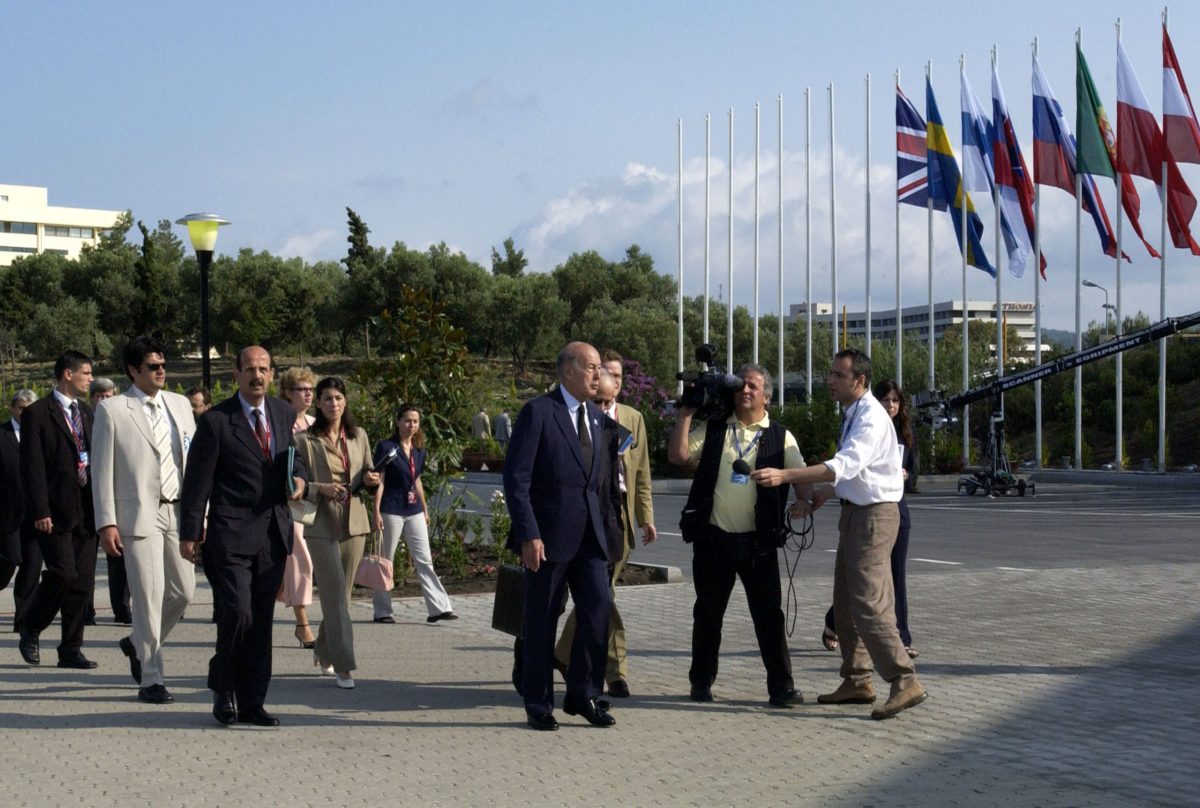
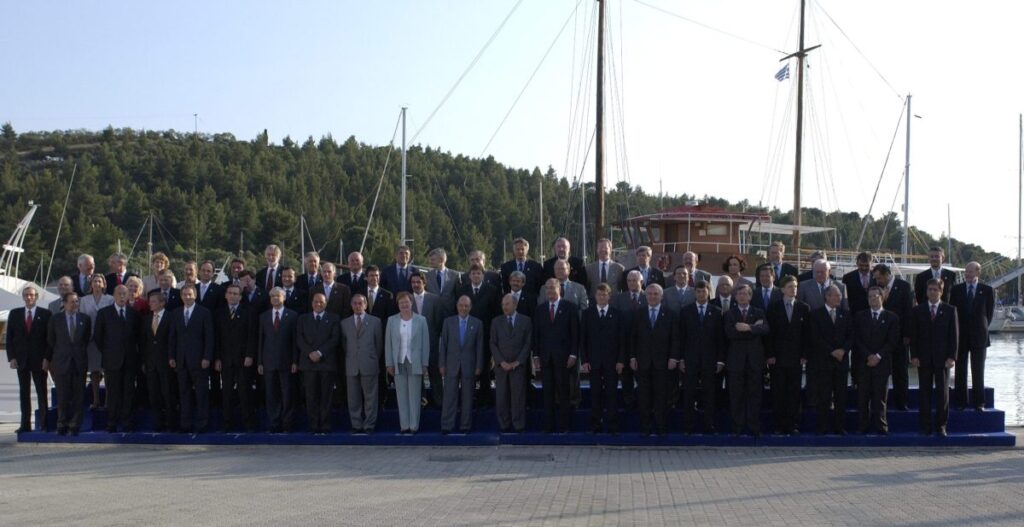
Arrival of Valéry Giscard d’Estaing at the Thessaloniki Summit 2003. The featured image shows the group of assembled EU representatives.
Magyar’s vision of a “return of Central Europe” carries the risk of being exploited by nationalists as anti-Brussels. During his state visit in May, Magyar offered Austria inclusion in the Visegrád Group. Austria is already involved in the Slavkov Group (Austria, Slovakia, Czech Republic) and the “Central 5” (Austria, Slovakia, Slovenia, Czech Republic, Hungary). So why not in the “Schönbrunn 6“? Austria’s pro-European government could provide a counterweight: to Fico’s pro-Russian course in Slovakia, the Eurosceptic stance of the new Slovenian Prime Minister Janez Janša, and the integration-critical policy of Czech right-wing populist Andrej Babiš. In doing so, Austria could fulfill its historical responsibility towards the Western Balkan states, emphasized for decades, lobby with its economic power for a unified Ukraine position within the group, and thus help create a truly united Europe. It would be high time.
c Photos: European Community 2003 Fernand Wauthy