The Paneuropa Congress 2016
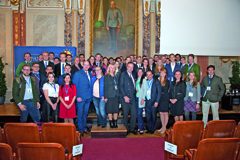
28 speakers, six moderators from several European countries and Africa, including the three state presidents from Macedonia Gjorge Ivanov, Kosovo Hashim Thaci and Albania Bujar Nishani, ministers, members of the Austrian National Council from various parties, as well as around 300 guests from 20 European countries and the USA: that is the Paneuropa Congress in brief figures, which took place from October 6 to 9, 2016, at the Haus der Industrie in Vienna. 90 years earlier, from October 3 to 6, 1926, the first Paneuropa Congress took place in Vienna. For the Paneuropa Movement, it was a reopening of the congress, because just as in 1926, “the questions about the appropriate methods for realizing this common goal” are highly topical, as many politicians and political observers are already speaking of a looming break in Europe. Just as topical as 90 years ago is the “question of the position of England and Russia toward Paneuropa.”
Topics discussed included “European values and virtues in the 21st century” – presented by the Ethiopia-born author Prince Asfa-Wossen Asserate, who now lives in Germany –, European economic policy – with a very clear appeal for more economic freedom and less state regulation –, all the way to the question of EU enlargement. In two lectures, historical Paneuropa aspects from the founding period of the Paneuropa Union were illuminated.
 The current refugee and migration crisis was discussed by a high-caliber panel with speakers from several countries, including the responsible EU expert Prof. Rainer Münz. The future of the labor market, education, and digitalization were the subject of a panel organized by the Paneuropa Youth.
For the topic of EU enlargement, the Paneuropa Movement Austria (the congress was organized in cooperation with the Paneuropa Movement Slovenia and with the help of the Europe-wide Paneuropa network) was able to win over the state presidents of Albania, Kosovo, and Macedonia. They not only emphasized the importance of the EU accession perspective for their countries but also broke a lance for the youth. “The young do not want to live with the ethnic enmities of the past. They want a better life in democracy, peace, and prosperity” in the EU, Hashim Thaci emphasized. The Kosovars are glad that the chapter of ethnic wars is over. Gjorge Ivanov explained: “Young people want open spaces. An open mind is the result of an open space.” Bujar Nishani noted that Albania is a young state, both politically and demographically. “We must direct this energy in the right direction.”
From Austria, the two candidates for the office of Federal President, among others, were invited. One candidate declined, Norbert Hofer came and criticized, among other things, the media’s tendency to always look only for the negative headline regarding Europe.
Laris Gaiser, President of the Paneuropa Movement Slovenia, said in his speech that there was good news and bad news regarding this congress. The good news is: Paneuropa still exists. The bad news: Paneuropa still exists. With this, he alluded to the current situation in Europe, where one can get the impression that not much has really moved forward since 1926.
The keynote speech was given by the President of the Paneuropa Movement Austria and Vice President of the Paneuropa Union, Karl von Habsburg. He spanned the arc from the situation Europe was in at the time of the historical congress of 1926 to the current situation of Europe, to state: “The relevance of Paneuropa is not exhausted.” Among other things, he emphasized the rule of law, the commitment to private property, and the principle of subsidiarity as one of the basic principles of Europe that created the prosperity that led Europe to its greatness. In his remarks on foreign policy, he placed a special focus on Russia’s war of aggression against Ukraine and the further areas of tension arising from it. Europe, so his call, must put itself in a position to react quickly to further threats. The common foreign and security policy, which was already formulated as a goal at the beginning of European unification, must finally take concrete form.
In issue 6 of “Paneuropa Österreich,” which will be published at the beginning of December, a more comprehensive report on the congress will appear. Documentation of the three-day conference is in preparation.



