Commitment to Value-Based Politics
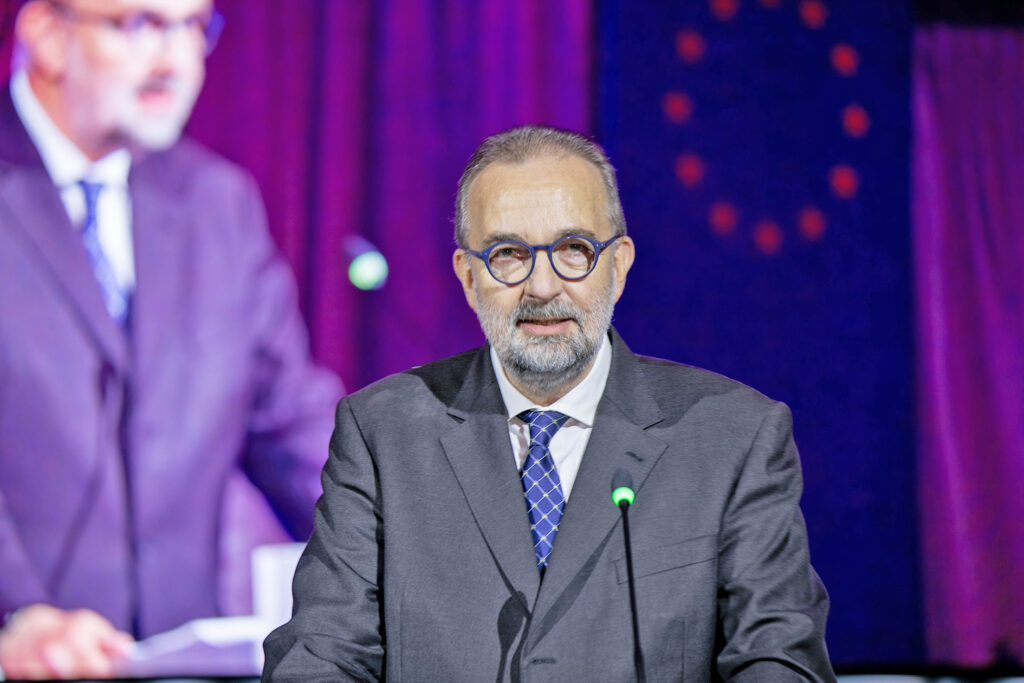
During a reception marking 750 years of the Habsburgs, Karl von Habsburg drew political, historical, and character-based parallels from then to now. Click here for the twelve-minute video of Karl von Habsburg’s speech.
With a history spanning more than 700 years, a single year hardly matters. Strictly speaking, Rudolf of Habsburg was elected German King as early as 1273. An event commemorating this date, and thus the beginning of the Habsburg era in Central Europe, should have taken place last year. However, the current head of the family, Karl von Habsburg, was then diagnosed with cancer. Following a successful operation and recovery, a celebration combining a party and a political event was held on 13th June at Palais Ferstel in Vienna’s city centre.
The Original Falco Symphonic Orchestra provided the party atmosphere. The political part of the evening was manifested, among others, by guests such as Austrian EU Commissioner Johannes Hahn and former Vice-Chancellor Susanne Riess-Hahn, as well as the newly elected Members of the European Parliament Reinhold Lopatka and Lukas Mandl. A short film specially produced for the anniversary celebration reviewed 750 years of the Habsburgs and simultaneously offered insights into the future of the House of Austria.
Its head, Karl von Habsburg, made it clear in his speech that this celebration was not just about looking back, but primarily about drawing lessons from history for today’s politics in Europe. When Rudolf was elected German King, the princes had to apply for the re-enfeoffment of their fiefs. Only one did not: the Bohemian King Ottokar. In August 1278, the Battle of Dürnkrut and Jedenspeigen took place, from which Rudolf emerged victorious. Karl von Habsburg drew a comparison to the present day and Russia’s war against Ukraine, which some believe can be ended through appeasement towards Putin. For Rudolf, appeasement would have meant giving in to Ottokar, perhaps even ceding further territories to him.
Characteristic of Rudolf were his modesty, his humility, his straightforwardness, and his associated determination. He had ‘the courage to take responsibility’, as Karl von Habsburg put it. Precisely this determination is needed in politics today concerning Putin. Europe must finally define a clear goal for this war. The head of the Habsburgs named three such goals: restoration of Ukraine’s territorial integrity (within internationally recognised borders), reparations from Russia to Ukraine, and regime change in Moscow.
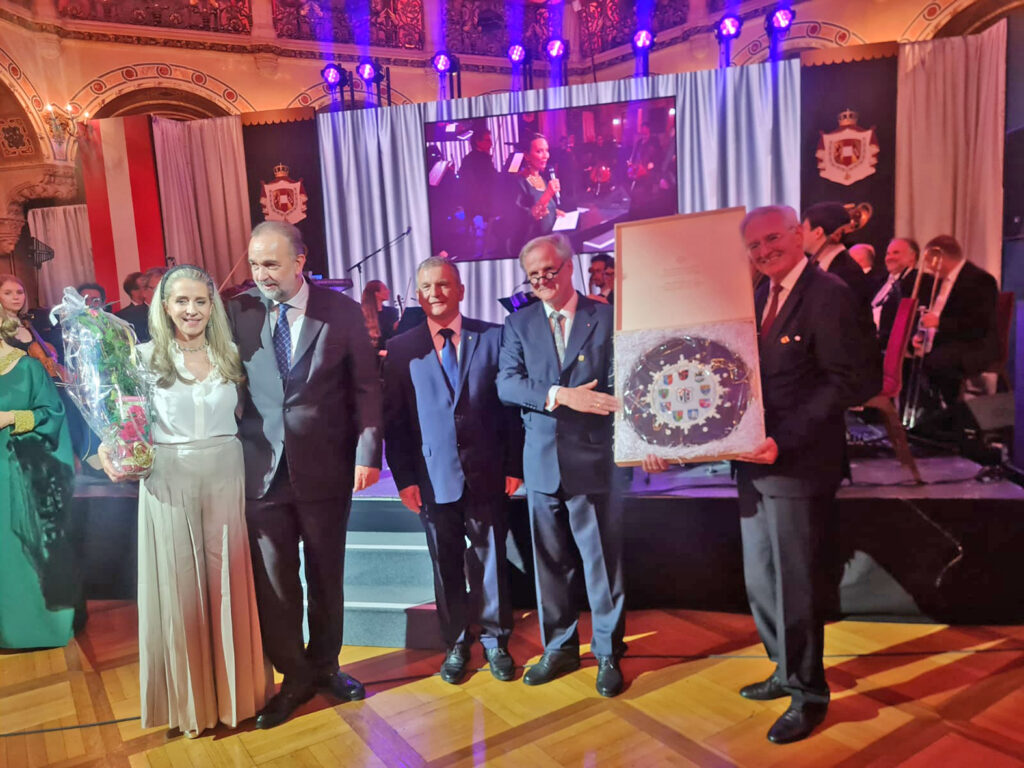
The Association of German-Speaking Old Austrian Compatriot Associations (VLÖ) presented Karl von Habsburg with a cake bearing the coats of arms of the Old Austrian associations from all parts of the former Habsburg Monarchy. His wife, Christian Reid, received a rose bush named Habsburg. Pictured: Christian Reid, Karl von Habsburg, Norbert Kapeller (President of the VLÖ), Rüdiger Stix (Chairman of the Sudeten Germans), and Gerhard Schiestl (Chairman of the Danube Swabians). c VLÖ
He briefly touched upon the results of the European elections on 9th June in his speech, noting that MEPs in the European Parliament are not representatives of national governments but bear responsibility for the whole. This also includes enlargement policy, the broadening of the rule of law to countries such as Ukraine, Georgia, and Kosovo.
The concept of empire, as practised by the Habsburgs, could in turn serve as a model for today’s European Union. The concept of empire refers to the idea of a supranational order.
Karl von Habsburg drew another historical parallel from the Order of the Golden Fleece to today’s European Council. The founder of the Order of the Fleece, Duke Philip of Burgundy, gathered the rulers of his neighbouring countries in the Order and transferred sovereign rights to the Order, such as the decision over war and peace. Decisions must also be made jointly in the Council.
He described a clear value-based policy, thinking in larger dimensions, and acting from a knowledge of one’s own position (geographically and substantively) as characteristic of Habsburg politics. In today’s politics, the centre defines itself through the (extreme, radical) wings, no longer from within itself. The massive polarisation is a consequence of this development. He named the rediscovery of this value-based policy, the commitment to the rule of law and subsidiarity as foundations for the successful next 750 years.
c Featured image: Newcleus / Matthias Dolenc



