The European Politician Otto von Habsburg
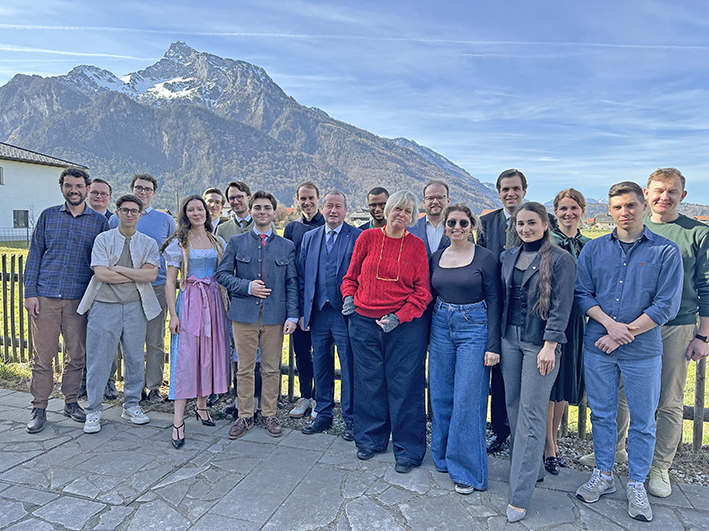
Against the wonderful backdrop of the Untersberg, at the Mostwastwirt, a Paneuropa Youth Seminar took place in early March 2025 under the title ‘Otto von Habsburg – European Integration and International Understanding’. The seminar was sponsored by the Otto von Habsburg Foundation. The President of the Paneuropa Movement Austria, Rainhard Kloucek, spoke about the European politician Otto von Habsburg. The lecture is documented here.
From 1979 to 1999, Otto von Habsburg was a member of the European Parliament. During that time, much of his European political activity naturally took place within and through this European representative body. However, he was active in European politics both before and after that period. From 1973 to 2004, he was President of the Paneuropean Union, having already served as Vice-President of the Paneuropean Union as early as the late 1950s.
Particularly from the end of the Second World War, following his return to Europe, he could be described as a foreign and security politician with a focus on Europe and European integration. The commitment to freedom was one of the guiding principles of his policy, as was a clear commitment to what can be called the fundamental values of Europe, its Christian character.
Even then, this was not necessarily a given, but during the Cold War, one could still speak of a kind of fundamental European consensus. The liberal German Federal President Theodor Heuss once spoke of the three hills on which Europe is built. He was not the only one to do so.
This referred to the Acropolis, Golgotha, and the Capitol. The Acropolis as a symbol of Greek philosophy, Golgotha for Christianity or the Judeo-Christian roots of Europe, and the Capitol for Roman Law, as the root of the principle of the rule of law.
Otto von Habsburg’s political work began as early as the 1930s, before the Second World War. At that time, it was much more strongly influenced by Austrian concerns. However, the commitment to freedom—that is, the struggle against totalitarian ideologies—was already a core point of his engagement. He knew very clearly that Hitler would mean war, a realization that already linked him with the Paneuropa founder Richard Coudenhove-Kalergi.
Commitment to Peace and Freedom
His commitment to an independent Austria was therefore not only a family and dynastic obligation, but also a commitment to peace and freedom. This was an engagement that continued during his exile in the USA. Europe was to be liberated from Hitler, and Austria was to re-emerge as an independent country on the map of Europe.
He had to acknowledge the division of Europe by the Iron Curtain. But his commitment always consisted in the will to one day be able to tear down this Iron Curtain and thus lead the peoples of Central Europe back to freedom.
His political work was not limited to Europe. He regularly undertook lecture tours to the USA, travelled frequently in Asia and Africa, and processed his experiences in his weekly articles, which appeared in numerous media outlets worldwide.
He belonged to various political organisations that worked against the spread of communism. One of these was the World Anti-Communist League, abbreviated as WACL. In Europe, he worked with other foreign policy experts on integrating post-Franco Spain into European structures.
This was, incidentally, a clear commitment to expanding the zone of democracy, the rule of law, freedom, and the market economy—one of the goals of European integration.
A fundamental remark on the European policy of that time, independent of Otto von Habsburg, is permitted here. Spain, Portugal, and Greece were ruled by military regimes for years. After their end, the EC politicians of the time aimed to integrate these countries into democratic Europe, precisely to further spread democracy, the rule of law, freedom, and the market economy. The European Commission, as the guardian of the treaties, argued at the time that the countries were not ready for accession talks. The Council made a political decision.
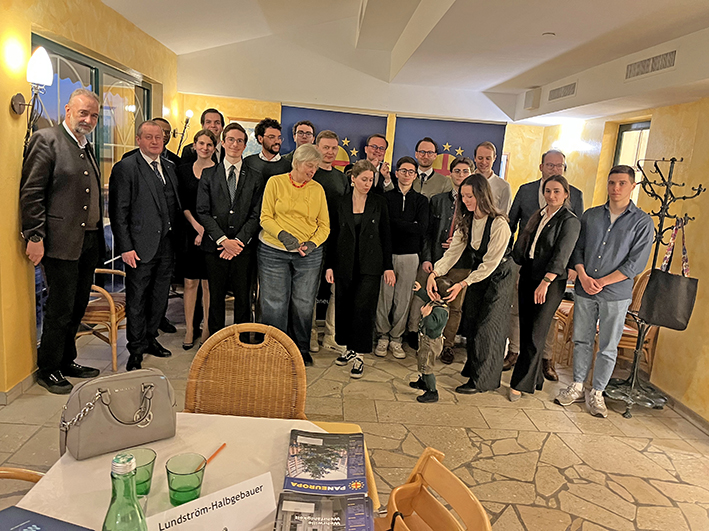
Participants at the Paneuropa Youth Seminar with the Vice-President of the Paneuropean Union, Walburga Habsburg Douglas, and the Honorary President of the Paneuropa Movement Austria, Karl von Habsburg.
Today, we often see the opposite. The Commission and the European Parliament say we should begin accession talks, for example with the countries of the Western Balkans, but in the Council, there is always at least one government that exercises a veto. We saw the same with the Schengen expansion to include Romania and Bulgaria, or with visa liberalisation for the Republic of Kosovo. It is as if the understanding of a united Europe has been lost within governments.
The Paneuropa Concept for European Integration
When we as Paneuropeans speak of European integration and evaluate it, the Paneuropa concept serves as the basis. That is, the concept that Richard Coudenhove-Kalergi developed more than 100 years ago, and which, in our view, still forms the basis for European integration.
At that time, it was not about the standardisation of tax rates or caps on plastic bottles, but about establishing a European order in which Europe would not become a plaything for non-European powers.
This Paneuropa concept follows a geopolitical approach.
The focus of these reflections was, firstly, a European foreign policy—so as not to be dominated by others on the stage of world politics; secondly, a European security policy—so as not to be dependent on and thus dominated by others in this matter, or to be drawn into a new internal European war; and thirdly, the removal of all internal European customs barriers. Today, this would be called a free internal market, or Europe as a free trade zone. Furthermore, Coudenhove already had a common currency in mind, which in his concept was based on the gold standard still in existence at the time, as well as a European Federal Court—what we know today as the European Court of Justice.
The freedom of citizens, individual responsibility, and a state that, as a constitutional state, limits itself to setting the framework conditions, were further foundations of his reflections on European integration at that time.
In this concept, priorities were naturally set according to the challenges and the political situation. During the Cold War, this was clearly the overcoming of the Iron Curtain and the establishment of freedom in Central Europe.
After 1989, it was the question of EU enlargement, a position that remains a priority today. Otto von Habsburg coined the beautiful saying: The further we push the borders of freedom to the east, the safer the centre becomes.
The significance of this sentence for Europe, in light of the current Russian attack on Ukraine and thus also on Europe, hardly needs to be mentioned.
For Otto von Habsburg, another principle applied, about which he also wrote a book: the ‘Reichsidee’. This is a term that can hardly be translated into another language, because, for example, ‘imperial idea’ is more reminiscent of India as a colony, or ‘idée impériale’ of Napoleon, rather than what is actually meant by ‘Reichsidee’.
Namely, a supranational order. It is a kind of counter-thesis to the nation-state, which presumes to be the state of one nation and defines the state and thus its sovereignty based on belonging to that nation.
The Reichsidee recognises structured responsibilities, as are also anchored, for example, in the principle of subsidiarity.
Reichsidee: A Supranational Order
The contradiction to the Reichsidee is formulated by nationalists in relation to the European Union, among other things, by denying the European Union democratic legitimacy. This stems precisely from the false assumption that only the nation-state can create democracy.
If we are honest, this nation-state has never existed in Europe, certainly not in Central Europe, which is characterised by its diversity of peoples in a small space. In practically all European states, there are ethnic groups that do not belong to the majority nation. One should speak of multi-national states rather than nation-states.
For the European Union and European integration, this Reichsidee is in any case a point of orientation or an orienting idea, as it is about locating competences at the right level in the sense of subsidiarity. This can also mean raising classic nation-state sovereignty—such as foreign and security policy—to the European level, because there it can be effective not only in theory but also in practice.
The European politician Otto von Habsburg was characterised on the one hand by comprehensive historical, political, and geographical knowledge, combined with a firm foundation of values; on the other hand, he had a talent for making gestures that went beyond the jurisdiction of the body in which he was currently active, and he was also able to assess a situation almost spontaneously and develop a long-term political perspective from it.
I would now like to explain this claim using a few concrete examples.
Let us start with his comprehensive knowledge. An example of this is a passage from his book ‘Idee Europa’, published in 1977. I quote:
‘When the central space, Europe, was shattered as a result of two civil wars and the powerful Chinese Empire was only at the beginning of a new ascent, world politics, and thus the fate of humanity on an ever-shrinking earth, was determined by the United States and the Soviet Union. The expression of this reality was the Yalta Agreement, in which the two greats agreed on the future life or death of almost all peoples without asking them for their opinion in the slightest. The presence of a Winston Churchill at the side of Roosevelt and Stalin had no decisive political significance. The great English statesman was included because of his name, but not as a representative of his country—a convenient alibi to avoid showing the betrayal of the principles of the Atlantic Charter for all to see.
Russia has become what Napoleon warned the world about in conversations during his final years. A Tsar appeared in the Kremlin who not only embodies the eternal dream of Muscovite hegemonism but also gave this imperialism a powerful dimension and dynamism by taking up social demands and the longing for a new philosophy. For Russia, communism is nothing other than the fulfilment of the programmes of Ivan the Terrible and Peter the Great. It is no coincidence that in the literature of the neo-Stalinist youth today, the old Great Tyrant appears less as a representative of Bolshevism than as the third in the league of rulers who created the Russian Empire. Since Moscow combines the right-wing radical tradition of Tsarism with the striking power of the extreme left, it possesses a fullness of power such as has hardly ever been recorded in the course of history. Moscow was not only the new Byzantium, as in the days of the imperial autocrats, but also the Rome of the new counter-church of Marxist materialism, which is primarily a philosophical statement and only secondarily an economic programme.’ End of quote.
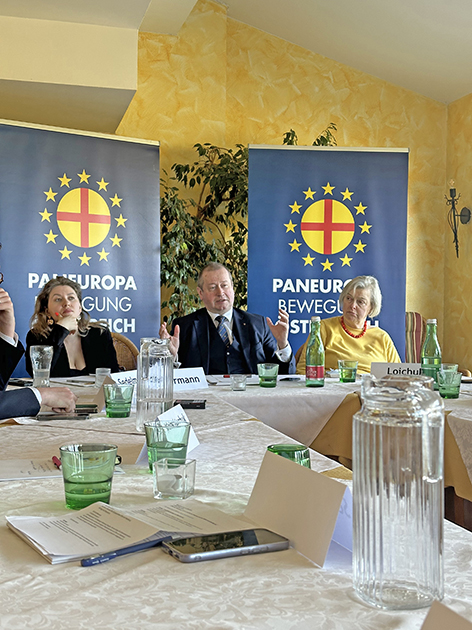
Rainhard Kloucek during his lecture at the Paneuropa Youth Seminar. To his left, Anna Pattermann from Unlimited Democracy; to his right, Walburga Habsburg Douglas.
Having read this, one is no longer surprised that Otto von Habsburg warned about Putin early on. As early as 1977, he addressed a phenomenon that we encounter anew every day in talk shows about Russia: a united front between the left (old socialists and communists) and the right (nationalists and populists), who stand together on Putin’s side to destroy free Europe as anti-Europeans.
This is also supported by a Moscow imperialism and colonialism, which shows us that the state entity calling itself the Russian Federation is in reality only a Moscow colonial empire. In the age of decolonisation, as Otto von Habsburg predicted, this colonial empire will also come to its end. Unfortunately, it has not reached that point yet.
With this background knowledge, he then used the stage of the European Parliament from 1979 onwards to launch corresponding initiatives.
In 1979, the European Parliament was directly elected for the first time. It had few competences. But it had committees and it had a good name. For instance, there was a subcommittee for decolonisation in the Parliament. Otto von Habsburg, as a member of the Foreign Affairs Committee, became a member of this subcommittee. It was actually intended to process and address the colonial past of Europeans. For him, however, Russia was also a colonial empire. So he produced a report that focused on Russian colonial policy towards Estonia, Latvia, and Lithuania. The so-called Baltic Report. The report was also adopted. The foreign ministers of the EEC countries at the time were supposed to bring the matter before the UN Decolonisation Committee.
They did not do so, of course. Crucially, however, this message spread among dissidents, who then knew that there was someone else taking up their cause.
He launched similar initiatives for the countries of the former Yugoslavia. Within the Paneuropean Union, an Alps-Adriatic circle was founded. In the EP, he initiated a Central Europe Intergroup. This allowed him to invite politicians, dissidents, and freedom fighters from these countries to Strasbourg. He was able to offer them a stage and obtain first-hand information, while simultaneously influencing these countries with information.
He thus built early friendships, for example, with Ibrahim Rugova, who later became President of an independent Kosovo, or with France Bučar, who became the first President of a freely elected Slovenian Parliament.
Struggle for the Freedom of Central Europe
When the EC began to intensify trade with the Comecon countries and there were Comecon-EEC negotiations, he adopted a different strategy. Negotiations with the EEC should not be conducted via Comecon and thus via the headquarters in Moscow, but with the individual countries themselves. This was intended to give the countries more independence and thus the possibility of breaking away from Moscow.
Another initiative that also originated from him and Paneuropean friends in the European Parliament was the ‘Empty Chair’. In every debate concerning the countries behind the Iron Curtain, an empty chair, symbolically offering space for these countries and peoples, was to be set up. Incidentally, it took years for this initiative to pass. The overcoming of the Iron Curtain as a political goal for Europe was not at all widespread.
Seen in this light, it was probably no coincidence that the Iron Curtain began to fall on 19 August 1989 at that Paneuropean Picnic which he had co-initiated.
These are examples of how he used existing institutions—even if, like the EP at the time, they had few competences—to create momentum for a certain policy: for a free Europe and against all forms of totalitarianism and imperialism.
He rejected all forms of centralism. He saw the danger that automatically exists when politicians, from their own ‘frog’s-eye view’ (the term he used), invent regulations that they believe will bring the very best for people, but which at best bring paternalism and at worst totalitarianism.
‘Centralism, on the other hand,’ he once said, ‘is nothing other than the seizure of power by the bureaucracy in all areas of life, and it leads not only to the loss of freedom but also to monotony. A piece of music consisting of only one note is unbearable in the long run; beauty and harmony stem from diversity.’
For this reason, he always advocated for a decentralised European integration. In general, he saw the state as a unit that can only fulfil its tasks well if it is organised decentrally in the sense of subsidiarity. He once explained this using the example of Switzerland:
‘At the same time, however, Switzerland also shows that integration, in order to be lasting, has as a precondition the broadest possible internal decentralisation. Every larger merger endangers freedom. It is only to be evaluated positively if its basic law states: In politics as in economics, the larger unit must never take over tasks that the smaller unit can fulfil satisfactorily itself. The success of the Swiss experiment proves that the formula works.’ End of quote.
And it was also clear to him that European integration has limits. In the west, north, and south, these limits were or are determined by geography, but in the east, this border must be drawn politically.
During his time as President of the Paneuropean Union, it also defined a border for European integration. In a declaration of principles from the 1990s, the commitment to admitting Central and Eastern European countries to the EU was clearly formulated, while at the same time speaking of an intended partnership with neighbours. Turkey and Russia were specifically named at the time.
In the case of Turkey, this positioning was necessary because it still wanted to join the EU at that time. In the case of Russia, the need for action was not so urgent, as there were no efforts by Moscow to join the EU—apart from exceptions on both sides.
On the subject of Russia, I can now also provide the missing example of spontaneous situational assessment.
Chechnya declared independence after the end of the Soviet Union. This then led to the Chechen War. Otto von Habsburg was still a Member of the European Parliament at the time, belonging to the EPP Group. The war was a topic in the meeting and was actually supposed to be dismissed as an internal matter for Moscow. Along the lines of: it’s none of our business.
But Otto von Habsburg did not accept this; he took up the debate and turned the mood around. Thus, at least within the group, a position was taken in favour of the right to self-determination and for Dzhokhar Dudayev (former USSR Air Force general and then President of independent Chechnya).
European Foreign and Security Policy
I mentioned at the beginning that Otto von Habsburg was primarily a foreign and security politician. Despite all the emphasis on subsidiarity, all the rejection of centralism, and all the scepticism towards the EU Constitutional Treaty, he always advocated for a genuine European foreign policy—which is more than just a coordination of foreign policies—and a European security policy.
Europe must be capable of acting in terms of foreign and security policy. To this end, he repeatedly demanded the creation of appropriate structures.
This included, for example, European protection of external borders when the Schengen Area was created. In other words, not always pushing everything onto the country at the border, but a European border guard, or whatever one calls it.
In foreign and security policy, he always warned against too great a dependence on the USA. Not because he had fallen prey to anti-Americanism, but because he was of the opinion decades ago that the USA would orient itself away from the Atlantic towards the Pacific. A development that was, incidentally, already foreseeable after the end of the Second World War.
Europe, however, according to his motto, must be capable of acting itself and must be able to provide for its own security. This was not a rejection of a partnership with the USA, but only a commitment to one’s own strength within that partnership.
If I now attempt to summarise Otto von Habsburg’s world of ideas on European policy, I would like to do so in a few keywords:
- Paneuropa is the whole of Europe. Enlargement policy is part of a strategic European foreign policy. Every European country has the right to participate in European integration.
- European foreign and security policy.
- Europe instead of nationalism, or a supranational order in the sense of the Reichsidee.
- Freedom instead of totalitarianism.
- The rule of law instead of political arbitrariness.
- Subsidiarity or decentralised order.
- And: Europe will be Christian or it will not be.
I have only hinted at this last point with a few statements, but there was never any room for interpretation with a man like Otto von Habsburg anyway.



