Stance. Guidance. Hope.
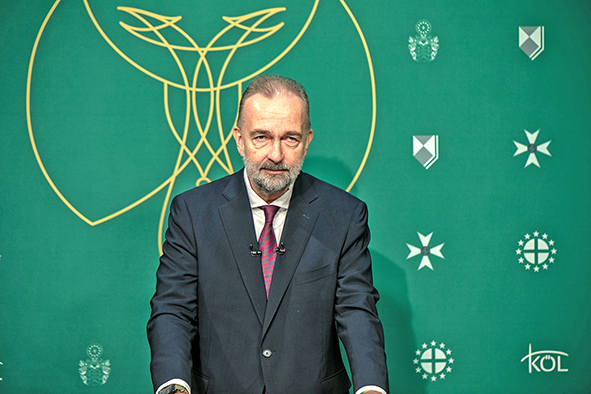
This year’s speech on the future of Europe was delivered by Karl von Habsburg under the motto: Stance. Guidance. Hope. In the speech, which he gave on his birthday (11 January) during an online matinee, he strongly advocated for the defence of the rule-based order, the rule of law, and a regulatory policy (in the sense of economic policy). This includes, among other things, a clear commitment to defending Ukraine. Europe, the EU, needs a genuine European foreign and security policy.
We live in exciting times. This was probably also demonstrated by the remarks of Prime Minister Andrej Plenkovic, for which I would like to express my sincere thanks, because he also clearly highlighted how important European unity is for all of us. Undeniably, however, exciting times offer many opportunities, both for improvement and for deterioration.
It will largely depend on how willing we are to actively shape the future. At least we in Europe have the chance, the opportunities, to do so. Because despite all the diagnoses about the increasing polarisation of politics, about the pseudo-solutions presented to us by sympathetic or rabid populists, we live in democratic systems where it depends on how much we engage ourselves, how willing we are to influence the shaping of the future.
Of course, one can lean back and tell oneself – and the rest of the world – ‘What’s it to me? I have my secure income, and if not, the welfare state will provide for me, so I don’t have to make an effort.’ Whether Donald Trump actually ends the war in Ukraine in 24 hours, as he announced, or not, I don’t care. And if Putin conquers Ukraine as quickly as possible because we stop support, then at least there will be peace, and we won’t have to listen to news of cruel attacks every day and look at images of destruction and all the human suffering.
You know that this is not my attitude. Stance. Guidance. Hope are three keywords I chose as the title for this speech, and which should also serve as a motto, a common thread, for various organisations in which I hold leadership positions this year.
Whoever has a stance stands for something. For principles, for engagement, for values. Whoever shows a stance will neither be discouraged by political polarisation nor seduced by populists and false ideologies. Whoever shows a stance can also provide guidance, can serve as a role model for others. Where there is guidance, hope also lives, hope of achieving a goal well.
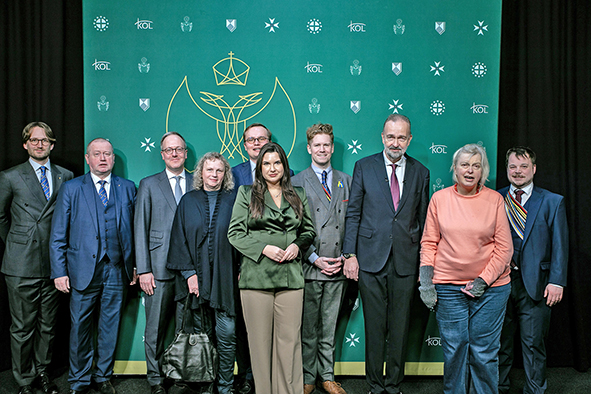
The Honorary President of the Paneuropa Movement Austria, Karl von Habsburg, with representatives of the Paneuropa-Union, such as the Vice-President of the Paneuropa-Union Walburga Habsburg Douglas (his sister) or the Austrian Member of Parliament (Neos) Dominik Oberhofer (third from left).
There’s no need to invent anything new for this. Because European culture, which has undoubtedly shaped us all, and which may be a little dusty today but not outdated, provides us with the necessary foundation. This culture is based on the so-called Judeo-Christian values. This also includes reason, which allows us to recognise that these values, regardless of how intensely one follows faith in God, are fundamental for good and peaceful coexistence.
European Culture Stands for Law and Freedom
It is no coincidence that the rule of law, which has made Europe a role model for other continents, developed within this Christian-influenced culture. The rule of law does not mean that the state enforces a specific idea of happiness or welfare by force, but rather that the state protects law and freedom.
It sets general rules within which we can live our freedom, our personal idea of happiness, without disturbing the freedom of others.
In economics, this would be called regulatory policy, the concept that once enabled the German and thus also the Austrian economic miracle, because it allows for a genuine market economy. And if we now venture onto the international, global stage, then we are talking about what we call the rule-based order.
None of this is self-evident, as we hear, see, and read in the news every day. But precisely if we live the stance outlined above, it gives rise to our duty to commit ourselves to ensuring that these very principles, which are by no means self-evident, become guidance and thus hope for shaping exciting times into a good future.
When I say that none of this is self-evident, it is also an indication that these elements of a stance had to develop, partly from very brutal experiences that our ancestors had to go through, and today we stand at a crossroads: can we still take the right steps in time, or do we allow ourselves to end up in a hole again, where not the rule of law but the law of the stronger, or rather the law of the more brutal, applies?
First Globalisation before the First World War
To describe it with an economic example. Before the First World War, we had a first phase of globalisation in the sense of world trade. This had many advantages for general development. It then took about 70 years until we reached this level of world trade again, with all its benefits.
In between lay a period of wars, whether fought on battlefields or a Cold War. Thankfully, some lessons were learned from this.
Let’s think of 11 March 1938. Hitler marched into Austria and annexed the country. The rest of the world applauded. Only Mexico protested. It was believed that if Hitler was given the small Austria, where Germans supposedly lived anyway, it would satisfy his hunger for new conquests. His true programme, which he had laid out in ‘Mein Kampf’, was hardly known or hardly taken seriously by anyone.
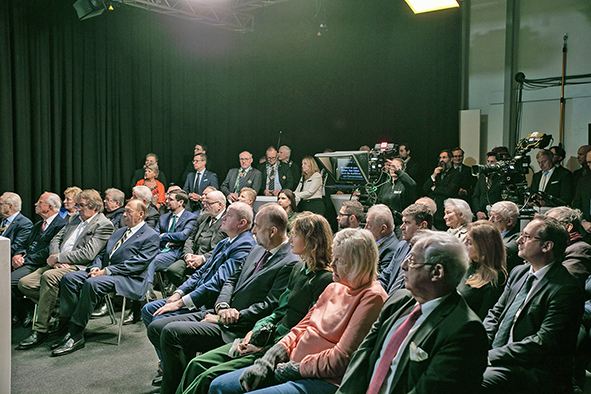
Why is Karl von Habsburg sitting in the audience during his ‘Speech on the Future of Europe’? Because Croatian Prime Minister Andrej Plenkovic sent a video message as the second speaker of the online matinee.
But then came the Sudetenland, the whole of Czechoslovakia, the pact with Stalin for the division of Europe, and finally the attack on Poland.
Only then did Great Britain and France begin to honour their guarantees. Millions of men and women had to sacrifice their lives to bring the tyrant to his knees. Germany, which had been seized by the brown criminal gang, was able to develop into a constitutional state, a democracy, after the regime change, as it would be called today, i.e., after the military defeat.
The parallels to the present day are unmistakable. Putin first broke the peace with Chechnya. That was already in 1999, shortly after he became Prime Minister. He invaded parts of Georgia and seized territories from the country. He invaded Crimea and annexed it. The rest of the world took note.
Because, many argued, Crimea had always been Russian. People who claim this have nothing to do with general knowledge, but the main thing is that they have an opinion. Anyone who remembers the invitation to Putin to Vienna, directly after the annexation of Crimea and the invasion of Donbas, can only feel ashamed for the representatives of this country who made silly jokes with the tyrant from Moscow.
Illusion Triumphed Over Reason
Here too, illusion triumphed over reason. People wanted to believe that they could appease the tyrant from Moscow if they just gave him a part of the neighbouring country and otherwise continued to do business with him as normal. Hundreds of thousands of people have paid for this error with their lives so far. Sometimes I wonder how those people who joked with Putin in the Chamber of Commerce back then can still sleep with a clear conscience.
24 February 2022 once again proved the lesson of history. Anyone who believes they can appease a tyrant in his lust for subjugation with spoils has not understood one of the fundamental rules of politics.
In 1945, lessons were learned from 11 March 1938. The United Nations, the UN, was founded. The UN Charter was formulated much more strongly than the statutes of the League of Nations had been.
Article 2, Paragraph 4 of the UN Charter states: ‘All Members shall refrain in their international relations from the threat or use of force against the territorial integrity or political independence of any state, or in any other manner inconsistent with the Purposes of the United Nations.’
Prohibition of Aggression and Right to Self-Defence
This formulation is generally known as the prohibition of aggression. That is, a very clear prohibition against attacking and conquering another country.
Many articles later, namely in Article 51, the right to self-defence is enshrined. Individually and collectively. Individual self-defence means that every country that is attacked has the right to defend itself. Collective self-defence means that all states have the right to come to the aid of the victim of aggression. This ranges from the supply of weapons to logistical and intelligence support, and even to the deployment of troops.
This right to self-defence exists until the United Nations Security Council decides on further or other measures. This provision is currently virtually dead law, as the Security Council cannot function. The aggressor has a veto right in this Security Council.
Ladies and Gentlemen!
The cited articles of the UN Charter are the foundations of what we today call the rule-based order or international law. This rule-based order is, at a global level, what we call the rule of law at a national level. It is the clear opposite of what is called the law of the stronger. Or perhaps we should rather speak of the law of the more brutal, even if it has nothing to do with law.
That is where we stand now: democratic, constitutional Europe, the democratic, constitutional free West, the Western community of values, faces the question of whether this rule-based order still applies and should continue to apply. The community of tyrants from Pyongyang to Beijing and Moscow, and their other allies, does not face this question.
Because for the tyrants, the law, or rather the violence, of the more brutal applies.
This, incidentally, is their greatest weakness. For any such alliance of major criminals is based on blood-soaked aggressive potential. That they do not fall upon each other is solely due to an ideology of terror, in which each of these tyrants knows that the other is equally ready for mass bloodshed without batting an eyelid.
When Man is Only Cannon Fodder
Man, in his familiar dignity, counts only as potential cannon fodder and as a producer of more cannon fodder.
Please, ladies and gentlemen, do not take offence at the somewhat more drastic language chosen here.
We must face the challenges; we must recognise them and set clear points of guidance to overcome them.
We must know where we stand, and we must ask ourselves the very simple question: do we want to preserve the rule-based order? Then we must defend it. Or do we not care? Then we can do what Chamberlain did in 1938, or Scholz – and many others – from 2022 until today.
However, not only in 1945 were the right lessons learned from history with the prohibition of aggression and the right to self-defence, but also in 1989 after the fall of the Iron Curtain.
European integration, which began in Western Europe with six states and grew to a community of twelve by 1990, could now for the first time be extended to Central Europe. First, the three states of Austria, Sweden, and Finland joined, then in 2004, eight states that had been controlled by Moscow until 1989, as well as Cyprus and Malta. Bulgaria, Romania, and Croatia followed over the next decade.
EU Enlargement Was Always a Success Story
As late as 2003, there was a desire to continue this enlargement process, and the so-called Western Balkan states were promised that the path to the European Union would be open to them. However, after 2004, enlargement fatigue set in, from which Europe still suffers today.
Yet, enlargement policy is one of the most successful projects of European integration. After all, it is about extending democracy, freedom, market economy, and the rule of law to a larger area. The sentence ‘the further we push the borders of freedom eastward, the safer the centre becomes’, which came from my father and thereby underlined the essential component of enlargement, still holds true today.
However, shortly after the collapse of the Iron Curtain, a dangerous mistake was made due to a false interpretation of events. In 1991, the Soviet Union was dissolved. In the West, people spoke of the end of the Cold War, the end of history, the definitive victory of Western values, of liberal democracy over totalitarianism.
But in Moscow, history was interpreted differently. There, especially in KGB circles, but also among many USSR functionaries, the end of the Soviet Union was not seen as the end of the Cold War, but merely as a lost battle in that war.
At the latest with Putin’s rise to power, it became clear that Moscow’s old goal of expanding the empire westward, across Europe, had not been forgotten but was experiencing a renaissance. Even under Yeltsin, this goal had not disappeared, even if Moscow’s internal weakness at the time did not permit corresponding advances.
Search for Security in NATO and EU
The Central Europeans, who were under Moscow’s rule from 1945 to 1989, knew well that Moscow would only keep its hunger for conquest under control for a while. The desire to join NATO and thus have security against renewed aggression from Moscow is therefore more than understandable.
It was not a strategic policy of the USA or NATO to expand eastward, but rather the well-founded desire of the now truly free countries to find security and economic development in the free West.
Ladies and Gentlemen, dear friends!
We humans tend towards comfort. We have grown accustomed to a certain lifestyle, to a comfort that our accumulated prosperity offers us. But we must also be aware that this prosperity must be re-earned again and again, that life in freedom and security is based on a political, economic, and social framework.
Now I repeat myself: none of this is self-evident. The rule of law is indeed threatened by polarisation and ideological blindness. The rule-based order is very concretely threatened by totalitarian and dictatorial states that openly threaten aggression against neighbouring countries and implement this aggression with military and hybrid attacks.
We stand at a crucial turning point. More than ten years after the start of Moscow’s war against Ukraine, almost three years after the beginning of the destructive invasion, we face the question of how we can manage to end this war by enforcing the rule-based order.
Europe Does Not Decide on the US President
In a few days, a new, and at the same time old, US President will be sworn in in Washington. We Europeans cannot decide whom the majority of American citizens elect as their president. We can only influence how we in Europe align our policies so that we, as a continent, still play a role on the stage of world politics and are not dominated by non-European powers.
There is much speculation about what Donald Trump will do as US President. We all know his pronouncements, from ending the war against Ukraine within 24 hours to his famous deals or the statement that the wars would never have happened if only he had been president. Let’s put it kindly: he does not lack self-confidence.
I want to address one speculation, and also a very concrete threat to Europe from a President Trump. You all know his statements about NATO, and that countries that spend too little on defence would not be protected by the USA, even threatening that the USA would leave NATO.
Of course, he cannot simply leave NATO, and if the US nuclear umbrella no longer applies to European partners, then the question also arises as to what that would mean for further nuclear armament, which is not necessarily in the interest of the USA.
But President Trump could go straight to the White House after his inauguration and sign an executive order recalling NATO’s military command structure in Europe. This is led by an American whom the President can de facto recall.
What then? Are we in Europe prepared for this? Are there scenarios for how a new military commander for NATO in Europe would be appointed within the next few hours? Above all: who would that be, and from which country would they come? From Germany, which certainly has capable soldiers but is politically unable to act? From France, which sees itself as Europe’s leading power anyway, but does not only have friends? Quite apart from the fact that France is rhetorically very present in supporting Ukraine through its president, but the actual assistance provided is surpassed by many other European states. Or perhaps from Poland, which is currently investing the most in its defence capabilities among European NATO countries?
As I said, we do not know whether Trump has already prepared such an executive order and will sign it. At least I do not know if there are plans for such a scenario. But I do know that responsible politics must be prepared for such possibilities!
Will There Be a Tariff War with the USA?
What we must assume, however, is a new tariff war. Trump already threatened us with this during his first term. But the Biden administration has also taken measures that do not exactly fall under the heading of free and fair trade. Back then, during Donald Trump’s first term, a tariff war could still be prevented because the EU acted unitedly. The then Commission President Jean-Claude Juncker was able to make it clear to the boss in the White House, as a representative of the entire EU, that the united EU is already an economic power with which one should not necessarily start a real trade war.
The EU is still an economic power, even if there are major challenges to maintain this position. In a comparison of bureaucracy, we are already world champions, but we should not value this title.
Even with trade agreements, protectionist forces repeatedly cause obstruction. The wrangling over the trade agreement with the Mercosur states, which has now lasted a quarter of a century, is just one example. Responsible politics does not fear free trade but uses its opportunities. Narrow-minded prejudices, which are also presented with false figures but very sensationally, are not the seed on which we can build our European future.
Here in the EU, we need to return to a sensible regulatory policy, which clearly includes a massive reduction in bureaucracy. The fact that no government politician had the courage to stop, for example, the Supply Chain Act, does not exactly testify to a high understanding of economic, political, and social contexts.
However, someone who believes that an aggressor can be appeased through appeasement shows absolutely no understanding, ladies and gentlemen, dear friends, of political contexts and facts. I have already given some historical examples of this, and we see it practically every day since Russia’s destructive invasion of Ukraine.
In this war, there is only one country that is permanently escalating, and that country is Russia. This ranges from attacks on kindergartens and hospitals to civilian infrastructure, to the deployment of soldiers from North Korea, from child abductions to other war crimes.
Speak Softly and Carry a Big Stick
Europe, on the other hand, pursues a permanent appeasement policy, although Europe is precisely affected by this war. I do not mean to call for martial language now; soft words, if used correctly, can certainly be sensible. I am reminded of an old proverb that former US President Theodore Roosevelt liked to quote: ‘Speak softly and carry a big stick; you will go far.’
Europe, the European Union, simply must relearn the principles of power politics. But we do not have much time for this. We should not be afraid of power either. For power itself is not a bad thing. It can be misused or abused, but that is precisely not the goal of European integration.
Diplomatic protest that is not accompanied by measures only leads to further escalation on the part of the aggressor.
Yes, it is true that Russia is a focal point in this speech. I do not intend to neglect the other problems affecting our future. But things are interconnected.
In mid-December, a small conference of the ‘Post War Russia Forum’ took place in Vienna, in which the Paneuropa Movement also participated. There, a participant from Ukraine made the statement: ‘Big Russia brings big problems, small Russia makes small problems.’ Strictly speaking, he spoke of the Moscow colonial empire.
Today’s Russia is indeed a classic colonial empire, ruled by Moscow. This begins with the economic exploitation of the colonies and continues to the oppression of the peoples of this colonial empire, even to the attempt to use their men as cannon fodder in the colonial war against Ukraine.
A Europe interested in the security of its citizens should, as soon as possible, begin to develop scenarios for a disintegrating Moscow colonial empire.
What if the Moscow Colonial Empire Collapses?
Well, now you might say to me: pull yourself together, there are really no signs of that.
Honestly: I don’t see these signs at the moment either. But that doesn’t mean one shouldn’t still deal with this question.
If someone had told me on St. Andrew’s Day last year that less than 14 days later the Syrian dictator Assad would have fled into Moscow exile, I would probably have had some doubts about that scenario too.
With that, I’m back to what I said earlier: everything is connected.
You remember, in 2015 Assad was already backed into a corner. Russia, which has military bases in the country, including a port, intervened on his side. Putin, to put it casually, bombed his way back onto the stage of world politics. Without Russia, that was the situation at the time, there was no solution to the conflicts in the Middle East. A clever politician would probably have used this role, would have done good business with the raw materials of his country with the Western world, and could probably have been sure that hardly anyone would worry about human rights in his country.
The imperialist, however, sought to further enlarge his colonial empire. A step that triggered, or at least enabled, dynamics in other regions of the world that he probably had not considered. If Moscow were to lose its military bases in Syria, that would be a severe, indeed a devastating blow, even if it might not seem so at first glance. However, one should consider the entire logistics for Putin’s intervention troops in Africa.
China Closely Monitors the Impact of Sanctions
As I said, everything is connected. China has set up an inter-agency group that is closely examining how the sanctions imposed by the EU and other states are affecting Russia. We should interpret this as a clear signal that China is reviewing its plans for an annexation of Taiwan, partly based on developments in Russia, specifically the outcome of Russia’s destructive war against Ukraine. If Russia succeeds with its plans, that would likely be an encouragement for China to invade Taiwan.
This is neither in the interest of the EU nor the USA.
Incidentally, China is also considering scenarios for how it can secure certain areas in the current Russian Federation if this empire breaks apart.
The biggest current threat from Moscow to Europe, however, is the disinformation war. This is nothing new. Already during the Cold War and even before that in Tsarist times, Moscow conducted massive disinformation campaigns to undermine Europe. Moscow has improved and expanded this expertise and linked it with the new technical possibilities of social media.
However, we must not only look at social media. We have political parties that openly propagate for Putin. Also, in various established media, journalists and commentators regularly write whose support for Moscow is undeniable. This fifth column of Moscow extends into academia.
The real goal of disinformation is not to make one believe something very specific, but to make one ultimately believe nothing at all. Once someone reaches that point, they become a welcome victim of any arbitrary rule.
Hannah Arendt, the well-known fighter against National Socialism and other totalitarian systems like Communism, once put it into words: ‘The ideal subject of totalitarian rule is not the convinced Nazi or the convinced Communist, but people for whom the distinction between fact and fiction, between true and false, no longer exists.’
One last remark about Russia, if I may. It is often said that we must support the other Russia. Yes, we must. At the same time, we must be fair enough to acknowledge that we no longer find the other Russia within Russia itself. The war to conquer Ukraine is not just Putin’s war.
Recent surveys also show that, on the one hand, there is a majority in Russia for a ceasefire or even peace with Ukraine. That sounds quite good. However, as soon as one asks whether this might also involve renouncing the occupied or annexed territories, this approval shrinks to a small group. Imperialism is therefore not only a characteristic of Putin but is deeply rooted in Russian society.
Even if I view the thesis of collective guilt with scepticism, we should take to heart the words of the Soviet prosecution at the Nuremberg War Crimes Tribunal and apply them to the Moscow colonial empire. ‘All Germans are responsible for the crimes of the Germans, on the same level as the country’s leadership – because it was they who elected their government and did not stop it when it committed a crime against humanity.’
How Do We Achieve Peace in Ukraine?
Ladies and gentlemen, of course, the question arises of how we can achieve peace in this war. At the beginning of this speech, I spoke of the rule of law, regulatory policy, and a rule-based order in world politics, in combination with the UN Charter.
From this arises a clear duty for all who wish to preserve Europe as a continent of freedom, and the Western community of values for future generations: to give Ukraine what it needs to defeat the Russian soldiery and its allies. And we must also allow the Ukrainians to use these weapons without restrictions.
In connection with the Iranian missile attack on Israel, someone commented: ‘We spent billions shooting at the arrows and not at the archers.’
Ukraine must be given the opportunity to destroy those bases from which the tyrant from Moscow attacks and targets civilian infrastructure. Regimes like Putin’s only understand strength and determination, a clear stance. Soft tones without a big stick only encourage such regimes – and I’m not just referring to Moscow – to further aggression.
A few days ago, ladies and gentlemen, dear friends, we marked the thirtieth anniversary of Austria’s accession to the EU. Much has happened since then; much of what is now considered EU policy can and, in part, must be criticised.
Europe Needs a European Foreign and Security Policy
However, despite all criticism of excessive bureaucracy and other shortcomings such as ideologisation, we should not forget that European integration began out of a security policy motive. Given the geopolitical situation and the challenges we face, it is time for the European Union to develop its own foreign and security policy identity. By this, I mean not just a coordination of 27 viewpoints, but a genuine European foreign and security policy, headed by an EU Foreign Minister.
We must also measure Austrian politics against these challenges, regardless of which government constellation emerges, or indeed if new elections are called.
We live in exciting, tough times. Exciting, tough times require a clear stance to provide guidance again and thus hope for the further shaping of a free Europe.
We must commit ourselves to this!



