The Picnic and its Significance for Freedom
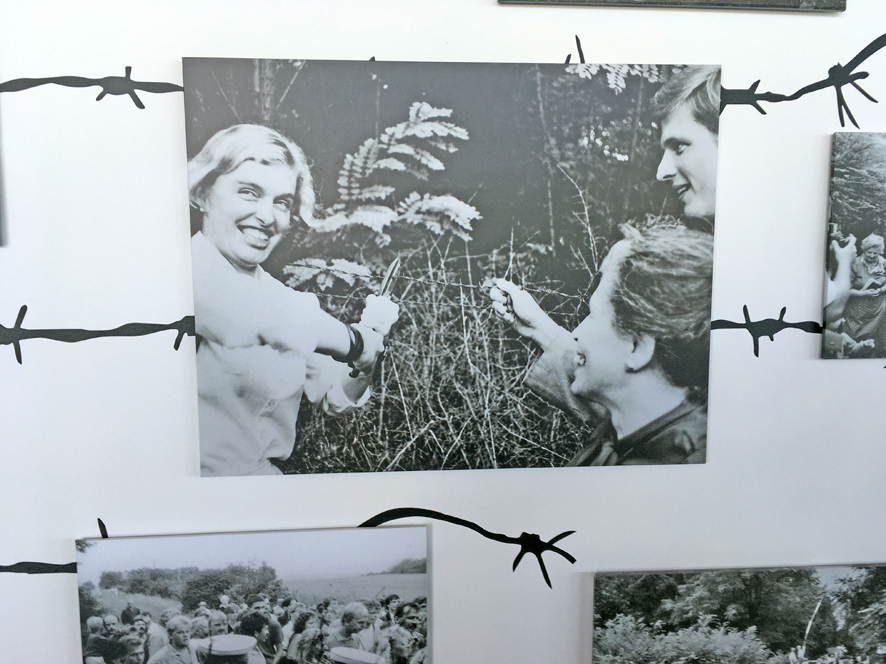
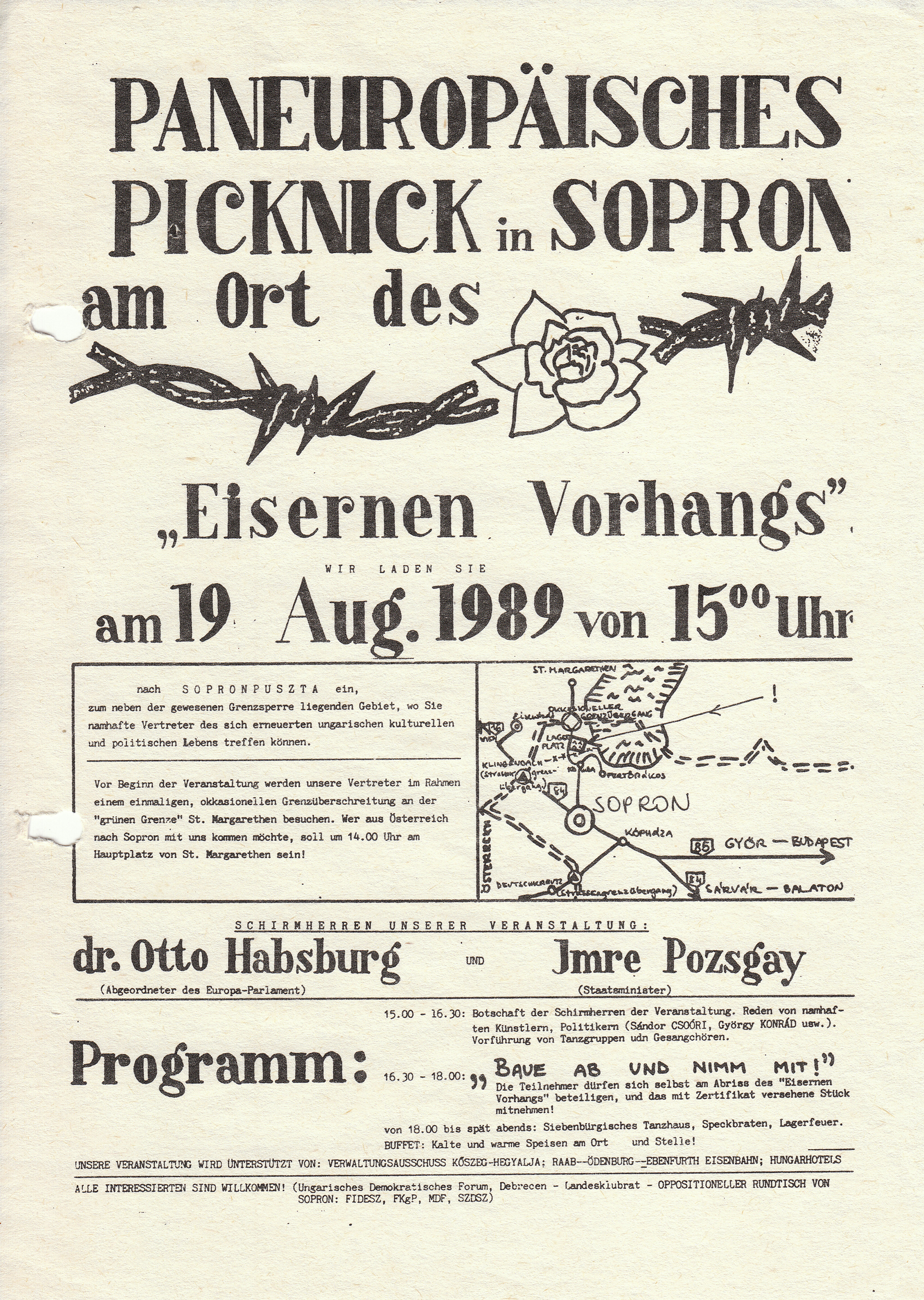
The Paneuropean Picnic is a historical event in two respects. On the one hand, it happened a long time ago, but on the other, it changed the course of European history. It overcame totalitarianism in Central Europe and sent out a clear message of freedom. This message is still valid today and has become highly relevant again due to the Russian attack on Ukraine. A lecture by Rainhard Kloucek, President of the Paneuropa Movement Austria, as part of the Paneuropa Symposium on the 35th anniversary of the Paneuropean Picnic on 18 August 2024 at Cafe Central in Eisenstadt.
Thirty-five years is a period in which an event truly becomes historical. Historical in the sense that it lies so far in the past that only the older generation can still remember it, and in the meantime, a new generation has grown up that has no living memory of the event and the time immediately preceding it.
However, this article will not focus on this understanding of the historical, but rather on an event that should be described as historical because it changed the course of history, because it had significance for the further development of European unification, and because, in this specific case, it also influenced world history. And because very clear messages were associated with this picnic.
But because the picnic is historical in the sense of ‘it happened a long time ago’, many circumstances that led to it, and indeed some knowledge about the global political situation, have been forgotten or suppressed. Therefore, it is important to present these connections when considering the events of 1989.
It was, of course, an exaggeration when one of the speakers at the picnic, Klaus Lange, then regional chairman of the Paneuropa Movement Lower Austria, compared this small festival on the border between Austria and Hungary, between St. Margarethen and Sopron, on the old Pressburg Road, to the discovery of America. But if we consider the event of that time, and also include the intentions of the actors who led to this picnic, then it was certainly a turning point.
The current German Chancellor, Olaf Scholz, used this term in spring 2022 to allude to the destructive invasion of Ukraine by the Russian Federation and the associated consequences for the future course of history. The turning point of 1989 was a good one for the further development of Europe. The turning point of 2022 was a negative one for the further development of Europe and the world.
A Turning Point of Peace and Freedom
The difference can also be formulated differently: the turning point of 1989 was one of peace and freedom, while the turning point of 2022 is one of war and despotism.
Even if most observers do not see a direct connection between the two events, one does exist. It is about the question of what happened then, and who interpreted the event and how.
In sober terms, the Paneuropean Picnic was an open-air festival with beer and bacon in the wilderness on the Iron Curtain, which then ran through the middle of Europe. The border gate was to be opened for a short time to allow guests from the Austrian side to cross to the Hungarian side, so they could eat a sausage and drink a spritzer or whatever. That alone does not make news.

Anyone who cut out a piece of the barbed wire received a certificate of authenticity.
The news, and what made this picnic a historical event, were the 661 citizens of the so-called German Democratic Republic who used the picnic to escape from their summer holiday in Hungary (which at that time clearly belonged to the so-called Eastern Bloc) from the real existing socialism that then dominated half of Europe – controlled by Moscow. This came at the cost of leaving behind everything they owned. They could only take what they wore and carried in their hands. This was already news that went around the world.
The further consequences are well known. Although the border between Austria and Hungary was closed again, there was even a tragic incident in which a German, who wanted to cross the border at night, died in a scuffle with a Hungarian border guard, during which a shot was fired from the soldier’s rifle. However, on 10 September 1989, Hungary finally opened its borders. On 9 November of the same year, the Berlin Wall fell. German reunification followed. In 1991, the Soviet Union and the Warsaw Pact were finally dissolved.
The Illusion of the “End of History”
With this outcome, the West celebrated the end of history, as Francis Fukuyama called it, meaning the definitive victory of democracy and the liberal rule of law over totalitarianism. The Cold War, which had dominated world politics for half a century, was over for the West.
However, and we must acknowledge this in light of current events, this interpretation of what followed the Paneuropean Picnic was a one-sided interpretation, not shared by the circles now ruling in Moscow. There, the events from 1989 to 1991 are interpreted as a battle lost in the Cold War, but not as the end of the Cold War.
Hans Graf Huyn, a CSU foreign policy expert, published a book in 1989 titled “Die Doppelfalle” (The Double Trap). In it, he argued that Glasnost and Perestroika, including the opening of the Iron Curtain, were a trap set by the KGB’s inner circle for the West. Recognising that real existing socialism could only lose the arms race initiated by US President Ronald Reagan due to the economic conditions in the Soviet empire, they supposedly decided to open the borders, withdraw themselves, but keep the strings in their hands in the background.
According to Huyn’s thesis of the KGB leadership, the West would then invest in the former Eastern Bloc countries to revitalise them, but the old socialist cadres would regain power after a certain period. Thus, a trap for the West. Of course, this plan could also go wrong, and democracy and the rule of law could prevail everywhere, in which case the plan would have failed. The trap could therefore also snap shut for the cadres in Moscow. Hence the title “Double Trap”.
Who will ultimately be caught in this double trap cannot yet be said with certainty. What is correct in the analysis is that the West pumped a lot of money into these countries, that there were many investments, and that this improved the situation in most of the former Eastern Bloc countries. It is also true that a democratic system could be established in the European countries of the former Eastern Bloc. It is equally true that there were repeated warnings from the region about an aggressive Russia, which, unfortunately, were ignored in the West. Only Hungary and Slovakia, due to their governments, are somewhat too friendly towards the despot from Moscow.
Aid even flowed to Russia, although much of it seeped into the hands of oligarchs and bureaucrats there. Attempts were made to integrate Moscow into Western structures; there was dialogue with NATO, there was EU-Russia dialogue, and numerous other formats in which contacts were maintained. In Austria, this was the Sochi Dialogue on a bilateral level.
These channels remained open even after Putin invaded Georgia in 2008. They remained open when he annexed Crimea and his troops invaded Donbas in 2014. Putin continued to be courted, and gas dependence on Russia further increased. 24 February 2022 brought a partial turning point here. However, it remains to be seen whether the West is prepared to understand that Putin is aiming for a complete change in the world order.
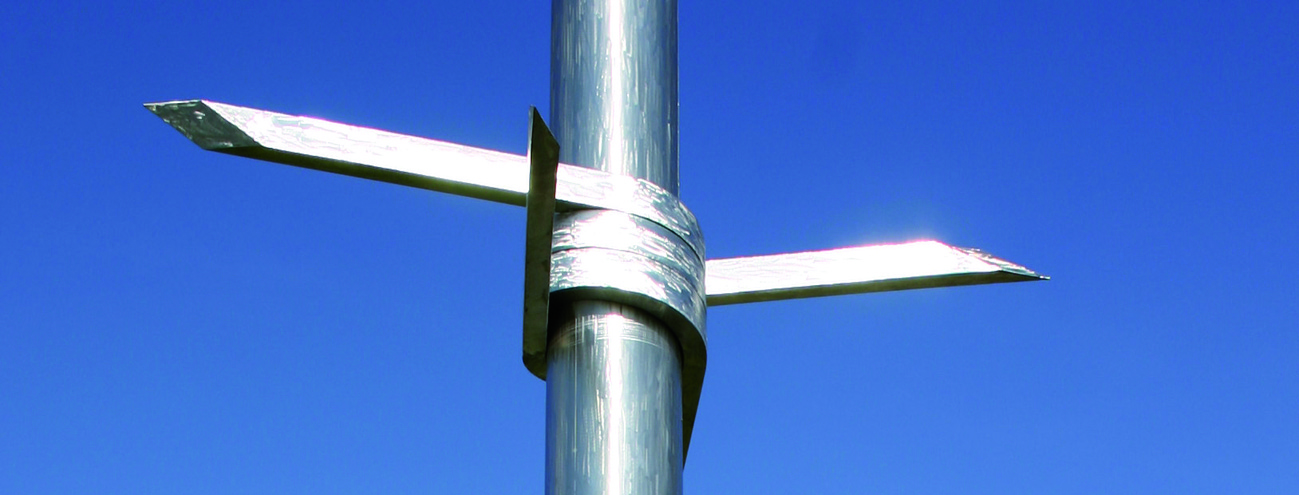
A monument created by Gabriela von Habsburg in Fertörakos symbolises the barbed wire that was cut in 1989.
He did not see the events from 1989 to 1991 as the end of the Cold War, but merely as a lost battle. His statement made as early as 2005, that for him the end of the USSR was the greatest geopolitical catastrophe of the 20th century, is as well known as his statement that he would restore the Soviet Union if he could. In Ukraine, he is currently attempting this with a war of annihilation. In Georgia, he is attempting it with an oligarchic regime. In the Republic of Moldova, he is attempting it with the occupation of part of the country.
We see across Europe that the old communist networks are still functioning and unequivocally taking sides with Putin’s war. In addition, there is another network of so-called right-wing parties. They call themselves patriots and thus misuse this term. However, for some of these ‘patriots’, the connection to the old communist networks is clear. Andrej Babis, for example, from the Czech Republic, was an employee or informant of the communist secret police in the CSSR.
To continue with the image of the double trap: these networks from both the left and the right are working to ensure that the trap snaps shut for the West, meaning that the plan hatched in Moscow – if it indeed existed in that form – comes to fruition.
For Moscow, the Cold War continued; only one battle was lost
To put it differently: if the West, and particularly the countries of the European Union, provide Ukraine with everything necessary to win the war militarily, then the double trap will most likely snap shut for Moscow. However, for this to happen, Europe would also need the courage to work towards a regime change in Moscow. Only when this regime change occurred in Germany in 1945 could the country develop democratically and under the rule of law. If Putin and his system remain in power, the double trap for the West remains open.
In connection with the events of 1989 to 1991, another important point must be mentioned, which repeatedly appears through various disinformation channels: the so-called NATO eastward expansion. It is claimed that at the time, during the negotiations on German reunification, Gorbachev was promised that NATO would not expand. The statement by then US Secretary of State James Baker, “not an inch”, or a remark by then German Foreign Minister Hans-Dietrich Genscher, are repeatedly cited to prove that this promise was made.
We are talking here about the negotiations for German reunification. This was completed on 3 October 1990. The negotiations therefore took place before that. It concerned the status of the so-called GDR, which was, among other things, part of the Warsaw Pact. But the latter still existed at that time. It was dissolved, like the USSR, only at the end of 1991. Therefore, such a promise could not have been made, because due to the existence of the Warsaw Pact, such an expansion of NATO was not even a topic of discussion, indeed it could not have been. It would also be completely unusual for an agreement of such significance not to have been recorded in writing.
Quite apart from the fact that it would have violated international treaties. Already in the CSCE Final Act – signed by Moscow – the freedom of alliance of countries was enshrined. In the Charter of Paris for a New Europe in 1990 – also signed by Moscow – this freedom of treaty was again enshrined. There was also no NATO strategy of expansion. What there was, was the desire of the states that had become independent – not just on paper – to find protection in NATO from a return of the Moscow regime. As we see today: that desire was justified.
What there was, was a promise by NATO not to station nuclear weapons in the former Eastern Bloc countries. This has been kept to date.
But now back to 19 August 1989 and the prehistory of the picnic. In Hungary, so-called Goulash Communism prevailed. The will to turn away from Moscow was manifested, among other things, by the agreement to shape new laws to be as compliant with the EC as possible. The orientation towards European unification was clear.
The economic situation was dire. The state was, strictly speaking, bankrupt. The border installations were dilapidated. False alarms were commonplace. Mostly, the alarms were then ignored. There was no money for repairs or even a complete renewal of the Iron Curtain. So, the very pragmatic decision was made to dismantle the border installations. This began on the border with the then CSSR.
Prime Minister Miklos Nemeth, the Reformer
The political responsibility for this lay with the then Hungarian Prime Minister Miklos Nemeth. He was an economist, knew the situation, and therefore became one of the most important reformers. His role is documented, among other things, in a confidential report from the British Ambassador in Hungary to London.
On 27 June 1989, there was the famous photo opportunity at the border near Klingenbach, where the foreign ministers of Austria and Hungary, Alois Mock and Gyula Horn, cut through the border fence. The photo went around the world and was probably a motivation for many Germans from the so-called GDR to take a summer holiday in Hungary. There were even separate refugee camps for GDR citizens in Hungary because so many had come, hoping to reach freedom via Hungary.
Another historical event occurred the day after. On 28 June 1989, St. Vitus Day, the Serbian tyrant Slobodan Milosevic delivered his famous speech on the Field of Blackbirds. This was the prelude to ten years of war in the Balkans. The example shows how events sometimes occur almost simultaneously, yet try to push history in opposite directions.
However, it was not only Hungary that broke away from Moscow, but above all Poland. Lech Walesa, many others, and the Solidarity trade union movement were already world-renowned. Even though martial law was still imposed in Poland, the end of the communist regime in the country was only a matter of time. In the West, however, there was not complete conviction that this marked the beginning of the end of the Eastern Bloc. The Austrian Trade Union Federation (ÖGB) firmly maintained its official contacts with the communist regime’s trade union in Poland.
On 4 June 1989, free elections were held in Poland. Solidarity won 99 out of 100 Senate seats and all 160 freely elected seats in the Sejm, the Polish parliament. For security, however, the communists had previously reserved 300 seats in the Sejm. Two months later, Tadeusz Mazowiecki became the first non-communist Prime Minister in Poland after the Second World War. Incidentally, there had also been an uprising against the communists in Poland in 1956. The Hungarian uprising of the same year is better known in this country.
President Ronald Reagan and Pope John Paul II
In this context, we must not forget the then US President Ronald Reagan with his clear anti-communist policy and his famous speech at the Brandenburg Gate in Berlin, in which he called on Mikhail Gorbachev to tear down that wall. We must also mention Pope John Paul II, who, with his famous exclamation “Be not afraid” during a visit to his homeland, still communist Poland, encouraged the people behind the Iron Curtain.
In the mid-1980s, an initiative for direct talks between the EC and Comecon originated from Moscow. Otto von Habsburg, then President of the Paneuropa-Union and a Member of the European Parliament, was one of the main proponents of a different strategy. The talks should not be with Moscow via Comecon, but directly with the individual countries. This was intended to give the satellite states of the Soviet Union more autonomy.
In 1988, Habsburg was able to travel to Hungary for the first time again. It was exactly 13 July. Hungary had already agreed to establish diplomatic relations with the EC. Habsburg was, logically, part of the relevant negotiating delegation in the EP.
However, the first visit to Hungary was not official, but private. Hungary had advised him not to enter under his own name, but under another name. He did so. As his daughter Walburga, who accompanied him, once recounted, it was clear to the officials at the border upon entering the country who was really arriving. In Budapest, people flocked to him wherever he went. Of course, the press was also interested in him. And he explained that his visit was about enabling the peoples of Central Europe to participate in European unification through the right to self-determination. In September 1988, official relations between Hungary and the EC were then established.
One of the reasons for Otto von Habsburg’s massive popularity in Hungary was a documentary film about him, produced by the well-known Hungarian director Peter Bokor. The communists banned its broadcast on television. However, the film was shown in cinemas.
In February 1989, a delegation from the Hungarian Parliament (still communist) came to Strasbourg. At the end of February, Otto von Habsburg travelled to Hungary with a delegation from the European Parliament. Among other things, he spoke at the “Karl Marx University” there. Karl Marx, incidentally, was present as a large bust during the speech.
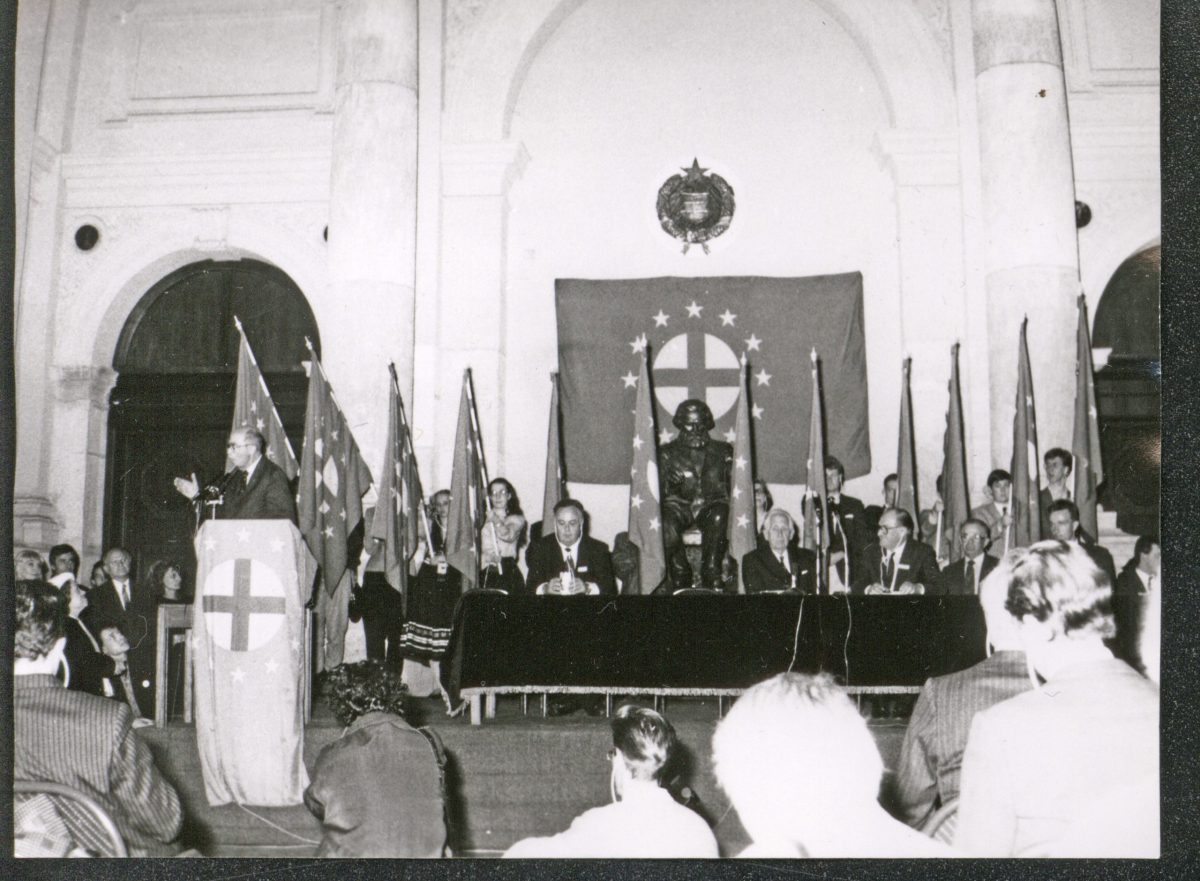
“Behind us Marx, before us the future”. Otto von Habsburg during his lecture at Karl Marx University in still communist Budapest. c Habsburg Otto Alapitvany
In June 1989, he was in Debrecen. This was already after the European elections. And he spoke about the significance of the European elections for the future of Hungary and about Hungary’s rapprochement with the EC. During a discussion after an event, the question of what could be done by the Hungarian side to move towards Europe was also raised. In this conversation, the idea of the “Paneuropean Picnic” then developed. At a picnic on the border, it should be possible to open the border for a short period without much further formality, so that people could come from the Austrian side to the Hungarian side for the picnic.
The Patrons Sent Representatives
The patrons of the picnic were Otto von Habsburg and Minister of State Imre Pozsgay. Both decided not to attend the event themselves. Otto von Habsburg sent his daughter Walburga, who was in Hungary at the time. Pozsgay sent his colleague Laszlo Vass. The official reason why both patrons did not come to the picnic was that they did not want to further inflame the delicate political situation by the presence of these two well-known and prominent personalities, and that they did not want to provoke Moscow.
Otto von Habsburg had a completely different motive for not coming. He had seen how his visits to Hungary turned into, at times, nostalgic gatherings. He would have been the centre of attention. He wanted to avoid that; he was concerned with the message of this “Paneuropean Picnic”. And he formulated this message in the greeting, which Walburga Habsburg Douglas delivered. (See the reprint of the greeting for details.)
In a written interview that Otto von Habsburg probably gave to a Hungarian journalist in 1993 (the pages containing the questions and answers have no date, only the cover letter from Pöcking is dated 15 September 1993), he wrote in response to the question of whether he had known what the consequences of the picnic would be and who was involved in its organisation:
“Of course, I could not have known what the effects would be, but one had the feeling that this was a moment that absolutely had to be seized. In this regard, Minister Pozsgay has also said crucial things in his soon-to-be-published memoirs. The picnic itself was organised by the Paneuropa Union, represented by me, or my daughter Walburga, and the Austrian Paneuropa Union on the one hand, and the Democratic Forum of Debrecen on the other. However, we worked in constant contact with the government.”
It must be added that the Democratic Forum Sopron also carried out very important work for the organisation of the picnic, especially on site: from official permits to the stage.
In the same interview, Otto von Habsburg was also asked whether he saw a connection between the 1956 uprising and the 1989 picnic. He said: “Undoubtedly, the Paneuropean Picnic was the second step. 1956 broke international communism. The Paneuropean Picnic brought about the end of tyranny in Central Europe.”
A Choice Between Totalitarianism and Freedom
At that time, not only did the Iron Curtain fall, but so did a totalitarian system of government. It was a choice between freedom and totalitarianism. “We must recognise that a long-term coexistence between freedom and totalitarianism is impossible. We must resist totalitarian temptation, under whatever mask it may come.” The Paneuropa-Union formulated these words in a statement of principles as early as the 1970s.
The struggle for freedom has been one of the central themes of Paneuropa’s work since the organisation’s founding in 1922. “Without freedom, Europe would be a body without a soul, an artificial and fragile construction,” Richard Coudenhove-Kalergi unequivocally stated in his 1923 book “Paneuropa”. Connected with freedom is always responsibility, human dignity, and the duty to act according to an informed conscience.
Closely linked to this commitment to freedom was Paneuropa’s commitment to European unification. The slogan “Paneuropa is all of Europe” shaped Paneuropa’s work for several decades. European unification, if taken seriously, cannot be limited to Western Europe; it must be open to all European countries.
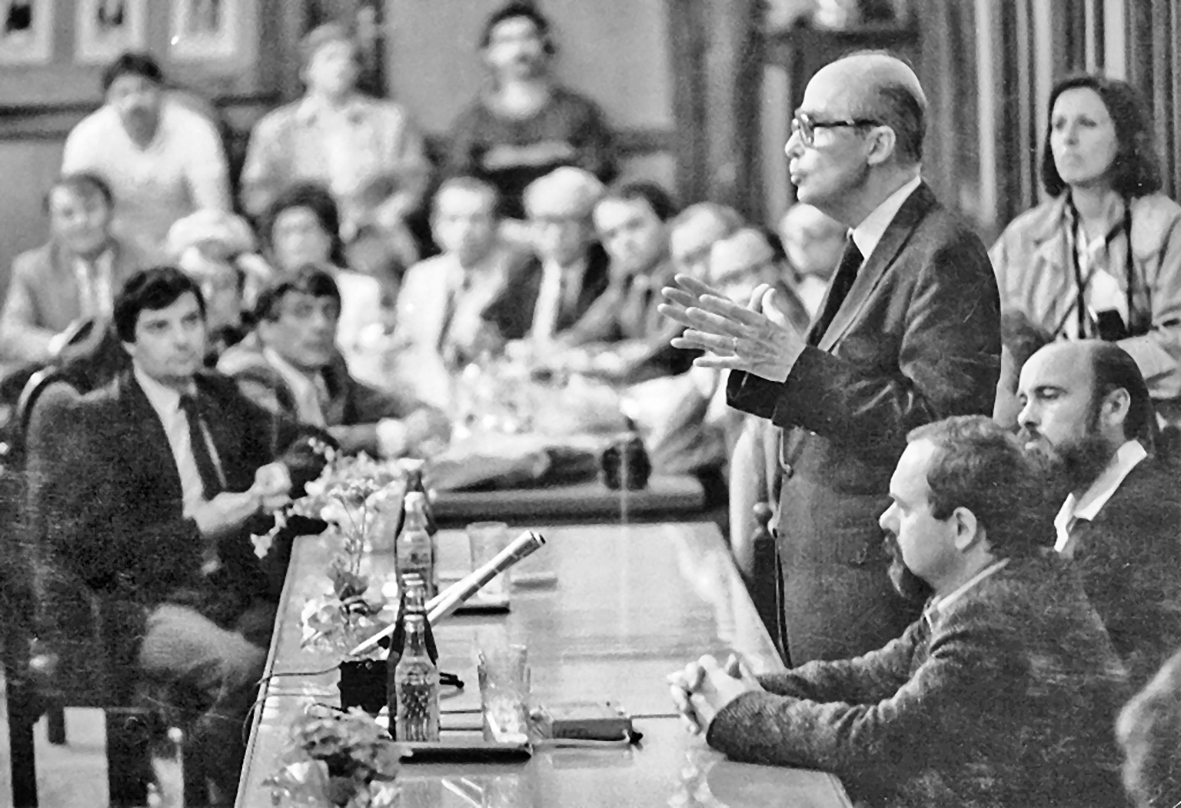
Otto von Habsburg during his lecture in Debrecen. Following the event, he suggested organising a picnic on the border during a conversation with opposition representatives. c Gabor Turi
This possibility was provided by the Paneuropean Picnic and the subsequent definitive opening of the border. Accession to the European Union also became the declared goal of the newly liberated countries of Central and Eastern Europe. Politicians seized the opportunity. Accession negotiations were opened with several countries. In a major enlargement round, Estonia, Latvia, Lithuania, the Czech Republic and Slovakia (which had separated in 1993), Poland, Hungary, and Slovenia were finally able to join the EU on 1 May 2004. The Mediterranean countries of Malta and Cyprus also joined.
Romania and Bulgaria followed in 2007, Croatia only in 2013. But from 2004 onwards, a certain enlargement fatigue set in. However, the fact that a country like Great Britain has since left the EU has had no negative impact on the attractiveness of the European Union for numerous other states. As early as 2003, the remaining countries of Southeast Europe (now called the Western Balkans in EU jargon) had been offered the prospect of EU membership. In Albania, Bosnia-Herzegovina, Kosovo, North Macedonia, and Montenegro, this desire for accession is also rooted in the population, most strongly in Kosovo.
Serbia, which also belongs to these Western Balkan countries, is playing at least a double game. Being simultaneously the best friend of Moscow and Beijing and negotiating EU accession does not fit together. In addition, in Belgrade, people from the old Milosevic regime still de facto dominate politics. The EU’s lack of a foreign policy strategy is evident here.
A Clear Message of the Picnic Was EU Enlargement
For many years, a larger enlargement of the EU was ruled out with the so-called Neighbourhood Policy. Countries such as Ukraine, Georgia, Moldova, and others were affected by this. It was therefore a clear demand of the Paneuropa-Union to replace this Neighbourhood Policy with an Enlargement Policy. To shake up the responsible politicians, Russia’s war of annihilation against Ukraine first had to begin.
Meanwhile, Ukraine, Georgia, and Moldova have candidate status. The opening of accession negotiations has been decided by the EU. However, the brakes have been applied again with regard to Georgia, because an oligarchic regime is in power there that clearly plays for Moscow. Elections will be held in Georgia this year, which will decide whether the country falls back under Moscow’s control or returns to the European path. In the Republic of Moldova, presidential elections and a referendum on the path to the EU will take place in the autumn.
From a European strategic perspective, Armenia should also be included in the circle of countries eligible for EU membership. Armenia is the oldest Christian state. There, too, there are strong aspirations away from Moscow towards the EU. The desire is particularly pronounced among the younger generation.
To pick up on a thought from Karl von Habsburg in his speech on the future of Europe: In this region, i.e., Ukraine, Georgia, Armenia, Moldova, the future neighbourhood relationship between Russia and the EU will develop. These countries could become the border region between freedom, democracy, and the rule of law on the one, European side, and despotism and totalitarianism on the other.
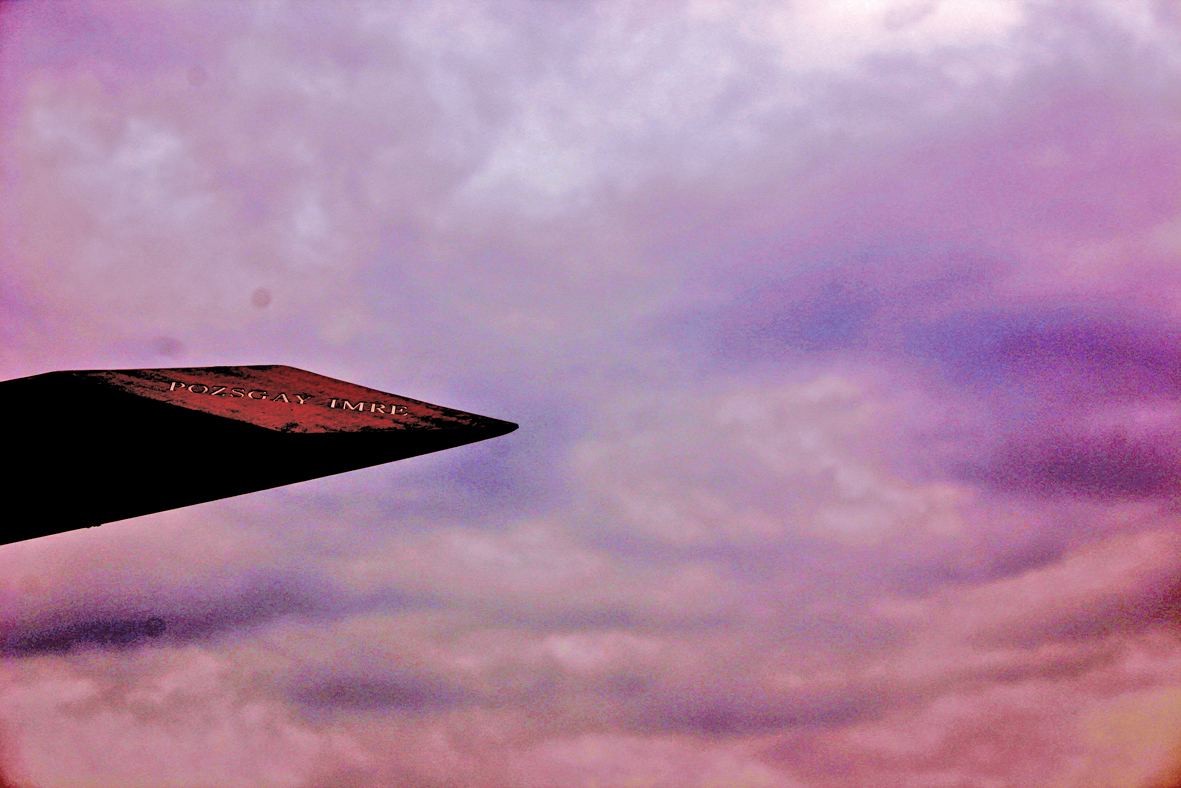
On the peaks of the monument to the Paneuropean Picnic created by Gabriela von Habsburg, the names of eight personalities who earned merit for freedom are engraved: Imre Pozsgay, Hungarian Minister of State, was the second patron of the picnic.
So, if we summarise the messages of this historical event 35 years after the Paneuropean Picnic, which are still crucial for Paneuropa’s policy today, I would formulate them with the following keywords:
- Paneuropa is all of Europe. Enlargement policy is part of a strategic European foreign policy.
- Europe instead of nationalism.
- Europe as a culture and community of destiny.
- Freedom instead of totalitarianism.
- Rule of law instead of political arbitrariness.
- Peace policy instead of war policy. However, this means that the attacked party has the right to self-defence, and that the free world has the right, or even the duty, to support the attacked party. If this were not the case, the messages of freedom instead of totalitarianism and rule of law instead of political arbitrariness would be undermined, because the aggressor would prevail.
Betrayal of the Freedom Fighters of 1956
Because the Paneuropean Picnic took place on the Austrian-Hungarian border, and because it was made possible by the Hungarian government, a final remark must be added: it is a historical disgrace that the government of precisely this country, Hungary, now wishes to deny its neighbour Ukraine these very freedoms – by which I mean accession to the EU and also to NATO. Or, to put it in reference to the quoted statement from the Otto von Habsburg interview: it is a betrayal of the freedom fighters of 1956!



