Rule of Law and Enlargement
EU enlargement is the European Union’s most powerful foreign policy instrument, even if the Union lacks a foreign policy identity. The rule of law, democracy, market economy, and freedom are Europe’s strengths. Many countries continue to push for EU membership. A report from a Paneuropa conference in Skopje.
Skopje, the capital of Macedonia, hosted a Paneuropa conference at the end of January. The topics were clear, given the Balkan country’s long-standing aspirations to become an EU member: enlargement policy and the rule of law. The conference was organised by the Paneuropa Union of Macedonia – which simultaneously celebrated its 30th anniversary – under its President Andrej Lepavcov and Secretary-General Biljana Janeva. The Paneuropa Movement Austria had the honour of acting as co-organiser. Companies from Austria operating commercially in the country, such as the Lower Austrian energy supplier EVN and Novomatic, also acted as sponsors.
The European dimension of the conference was particularly underlined by the number of participating Paneuropa organisations. In addition to Alain Terrenoire, President of the Paneuropa Union from France (who travelled with French energy expert Gerard Chabert), Walburga Habsburg-Douglas, Vice-President of the Paneuropa Union from Sweden, also came to Skopje. Christian Hoferer, Chairman of Paneuropa Youth, came from Germany; Vanja Gavran from Bosnia-Herzegovina; Genc Pollo, Chairman of the local Paneuropa organisation, with former parliamentarian and opposition politician Gerti Bogdani, from Albania; Alexandru Nazare, Paneuropa President, from Romania; Pavo Barisic, Secretary-General of the Paneuropa Union, from Croatia; Zlatko Mikulic, Vice-President of the local Paneuropa Movement, from Slovenia. Gordana Djurovic, Paneuropa Chairwoman, travelled from Montenegro with a small delegation, and Rainhard Kloucek, Secretary-General of the Paneuropa Movement Austria, came from Austria.
High-Calibre Guests from Across Europe
They were joined by the Austrian Ambassador to Macedonia, Martin Pammer, and his German counterpart, Petra Drexler; Patrick Voller, International Secretary of the EPP; and Daniel Braun, representative of the Konrad Adenauer Foundation in Macedonia. The Vice-President of the European Parliament, Othmar Karas, sent a video message. Hristijan Mickoski, leader of the Macedonian opposition party VMRO-DPMNE, participated in one of the panel discussions, while former Macedonian President Gjorge Ivanov – who was also a guest at Paneuropa congresses in Vienna – was one of the opening speakers at the Skopje congress. Former Macedonian government members such as Marjan Gjorchev (who was also Paneuropa President in Macedonia) and Emil Dimitriev (who was Prime Minister) attended the conference, as did numerous diplomats, business representatives, and civil society members.
The Question of the Name Change
Politically speaking, one should not refer to Macedonia. The official name of the country is North Macedonia. This name change was forced by Greece after years of blocking, and it was intended to pave the way for the country to join the EU. According to the Prespa Agreement, which was co-negotiated by, among others, Austrian EU Commissioner Johannes Hahn, Macedonia was to change its name to North Macedonia (for which the constitution was then also amended), and Greece was to drop its veto against accession negotiations.
The Country with Blocking Neighbours
However, Macedonia appears to be a country that does not only have friendly neighbours. After Greece withdrew its blockade, the next neighbour was ready with a veto. Bulgaria.
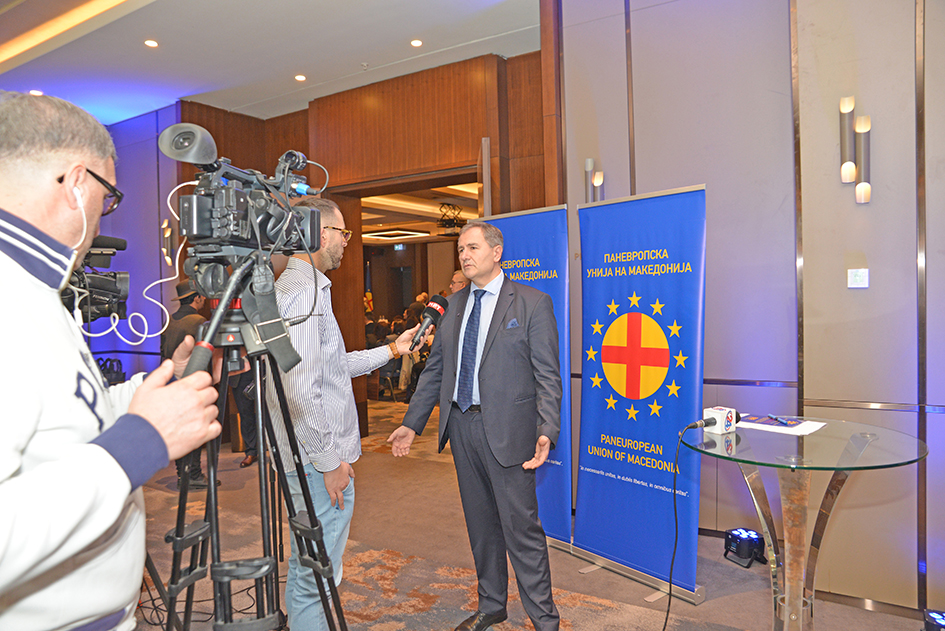
Andrej Lepavcov at the opening of the Paneuropa conference in the Macedonian capital Skopje.
This concerns a Bulgarian ethnic group in Macedonia. Once again, a change to the constitution is demanded to finally begin accession negotiations. The term ‘finally’ is appropriate here. In 2005, simultaneously with Croatia, Macedonia was granted candidate status for accession. Croatia has been an EU member for more than ten years, introduced the Euro last year, and is now also part of the Schengen area. Macedonia continues to wait for the start of concrete accession negotiations.
Already in 2003, in Thessaloniki, the countries of Southeast Europe, referred to as the Western Balkans in EU jargon, were promised EU accession. Not much has happened since then, even though more than 20 years have passed.
Double Standards and Other Obstacles
This weakness of the EU – the use of double standards, the delays and blockades by individual EU countries, but of course also the weaknesses of the candidate countries in the Balkans themselves – formed the main focus of the discussions. Alain Terrenoire referred to the geopolitical context and the associated challenges for the EU, which necessitate a committed approach to enlargement.
Andrej Lepavcov, who also served for many years as his country’s ambassador to the EU, shed light on the situation in the region, including the tensions repeatedly provoked by Serbia, but also addressed the new challenges for an accession country like Macedonia arising from newly added candidate countries such as Ukraine.
Elections in Macedonia in 2024 Too
Pavo Barisic addressed the election year 2024. This could lead to shifts in the political landscape in some countries with further consequences, particularly concerning the European elections. He described enlargement not merely as a technical process, but as a fundamental matter for the European Union. Genc Pollo recalled Richard Coudenhove-Kalergi’s original Paneuropa idea, which was about Europe being united and free. Therefore, the EU must not turn a blind eye to autocratic tendencies in the region. He deemed the EU’s decision that candidate countries may no longer issue golden passports to be correct. This addresses a practice where, in exchange for money, passports of an EU country (or indeed an accession country that could soon belong to the EU) are issued to citizens of third countries. Such passports are particularly popular among dubious businesspeople, including those from Russia. However, for Pollo, it is a double standard if this practice is not stopped in EU countries.
Regional Cooperation and Energy Issues
Regional cooperation through various smaller projects was the focus of Gordana Djurovic’s presentation. Energy supply played an important role in this. She advocates for moving towards majority decisions to prevent blockades by individual countries. Alexandru Nazare referred to his experiences with various obstacles on the path to the EU when the rules change during negotiations. He stressed that, precisely because of Russia’s ongoing war against Ukraine, it is absolutely necessary for the EU to show unity now.
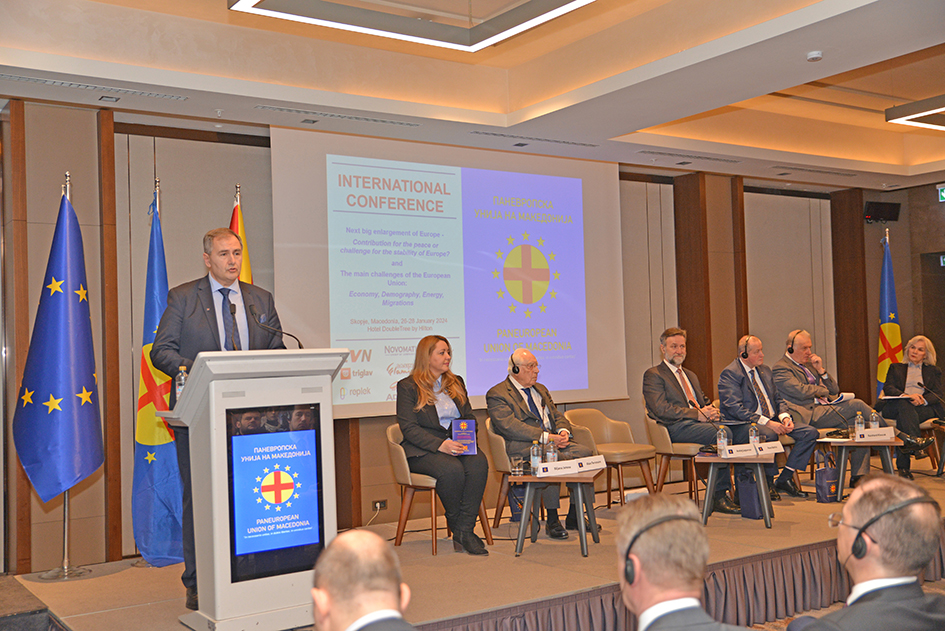
The crucial question of EU enlargement policy for Macedonia was at the heart of the opening panel. Speakers, from left: Andrej Lepavcov (at the lectern), Macedonia; Biljana Janeva moderated; Alain Terrenoire, France; Pavo Barisic, Croatia; Rainhard Kloucek, Austria; Genc Pollo, Albania; and Gordana Djurovic from Montenegro. It was clear to all participants that 20 years after the Thessaloniki conference, where the Western Balkan countries were promised EU accession, action must finally follow.
The success story of the EU, according to Rainhard Kloucek, is also one of its weaknesses. Founded on the experiences of two world wars, the goal was to prevent war between member states. European unification succeeded in this, and was able to extend this success to a broader zone by admitting new members. However, this meant that the project of European unification was inwardly focused.
A foreign policy identity is lacking. Each individual member state still insists on its sovereignty in foreign policy. However, a global comparison of countries shows that no foreign policy impact can be achieved this way. Enlargement is currently the most important pillar of what can be described as the EU’s foreign policy dimension, and it must therefore be used strategically.
A Vision for a United Europe is Needed
Crucially, however, it will be essential to succeed once again in outlining the vision of a united Europe. To build a ship, as one comparison suggested, trained specialists are needed. However, no one would think of building a ship if there wasn’t a vision of sailing into the vastness of the world’s oceans and discovering new territories.
One of the prerequisites for membership in the European Union is the rule of law. In its reports on the progress of candidate countries in reforms, the enforcement of the principles of the rule of law plays an important role for the European Commission. Patrick Voller referred to this, but at the same time made it clear that the European peace project must not only be preserved but also strengthened and expanded. Especially in today’s times, more Europe is needed.
Without the Rule of Law, Tyranny Comes
Walburga Habsburg Douglas fundamentally addressed the principle of the rule of law. The crucial point is that everyone is bound by law, regardless of their position or role. Without the rule of law, there is no functioning democracy; without the rule of law, there is no freedom, she stated. If the rule of law is absent, tyranny ensues. The fall of the Iron Curtain offered the opportunity to bring the principles of the rule of law to countries that had suffered under totalitarian, tyrannical regimes for decades. She emphasised the role of organisations like Paneuropa, which, as non-governmental, non-partisan organisations,
can always and everywhere advocate for this principle, regardless of which government of whatever colour is currently in power in which country. In her opinion, this principle of the rule of law is of such great importance for the further development of the EU because it constitutes a core aspect of the EU’s attractiveness. Alongside democracy, freedom, and a free economy, the rules-based order is a prominent feature of the EU’s appeal.
The EU and the Problem with the Rule of Law
Marjan Gjorchev reminded that even the EU itself does not always manage to adhere to the principle of the rule of law, referring to a judgment by the European Court of Justice from 15 December 2011. At that time, 15 judges in Luxembourg decided that Macedonia could join the EU under the acronym FYROM (Former Yugoslav Republic of Macedonia). However, the judicial ruling was politically ignored; Greece was still able to continue its blackmailing policy with the country’s name change, even though Macedonia would have been ready to join the EU as FYROM.
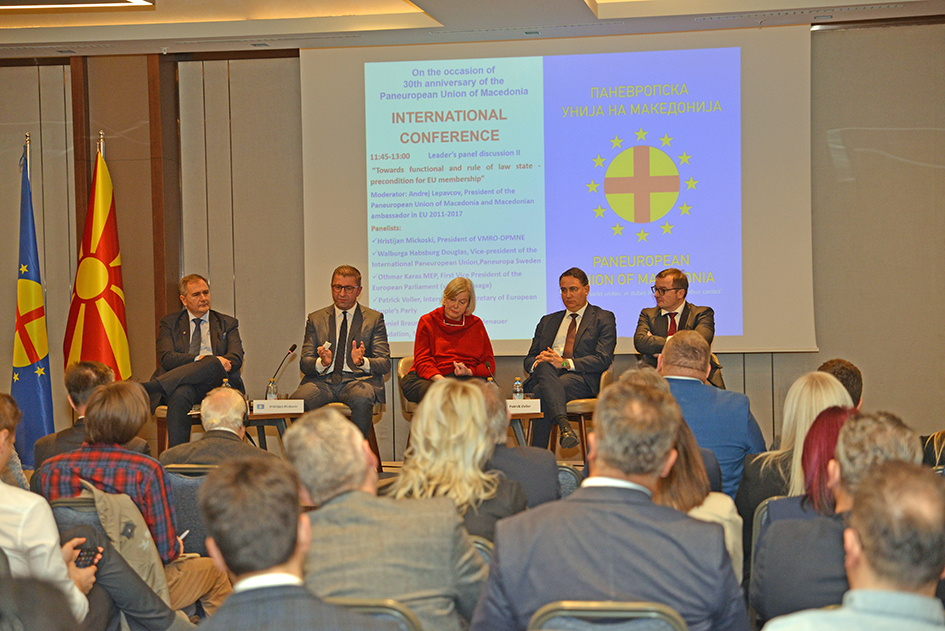
The questions of the rule of law were at the centre of the discussion in the second panel. From left: Andrej Lepavcov, President of the Paneuropa Union of Macedonia; Hristijan Mickoski, leader of the opposition party VMRO-DPMNE; Walburga Habsburg Douglas, Vice-President of the Paneuropa Union; Patrick Voller, International Secretary of the EPP; Daniel Braun, Konrad Adenauer Foundation Skopje.
The Macedonian opposition leader Hristijan Mickoski took a self-critical look at the situation in his own country. He described the current government of his country as a hybrid regime that had promised much but could show no real progress. It was not enough just to sign papers. Implementation was crucial. This required leadership but also good examples. Macedonia had proven with its constitutional amendments etc. that it could implement requirements, and the European path must be pursued with determination.
Empty Chair Instead of Unanimity Principle
Due to the slow progress in EU integration, Mickoski, as leader of the opposition party VMRO-DPMNE, hopes for a victory in the upcoming spring elections in Macedonia and thus a change of government. Alluding to the many veto blockades against Macedonia, Mickoski also made a jab at the EU’s decision-making process. At the Council meeting last December, it was learned that instead of the unanimity principle, there was now an ’empty chair’ principle. This was not an allusion to Otto von Habsburg’s empty chair policy during the Cold War, but to the recommendation to Hungarian Prime Minister Viktor Orbán to leave his seat and go for a coffee during the decision on opening accession negotiations with Ukraine.
Various Interests are Active in the Balkans
Thus, no veto could occur in the decision. This jab by Mickoski is noteworthy, among other reasons, because the current socialist government in Macedonia, in combination with other socialist networks at EU level, repeatedly accuses the opposition of being in cahoots with Orbán and thus with Russian interests.
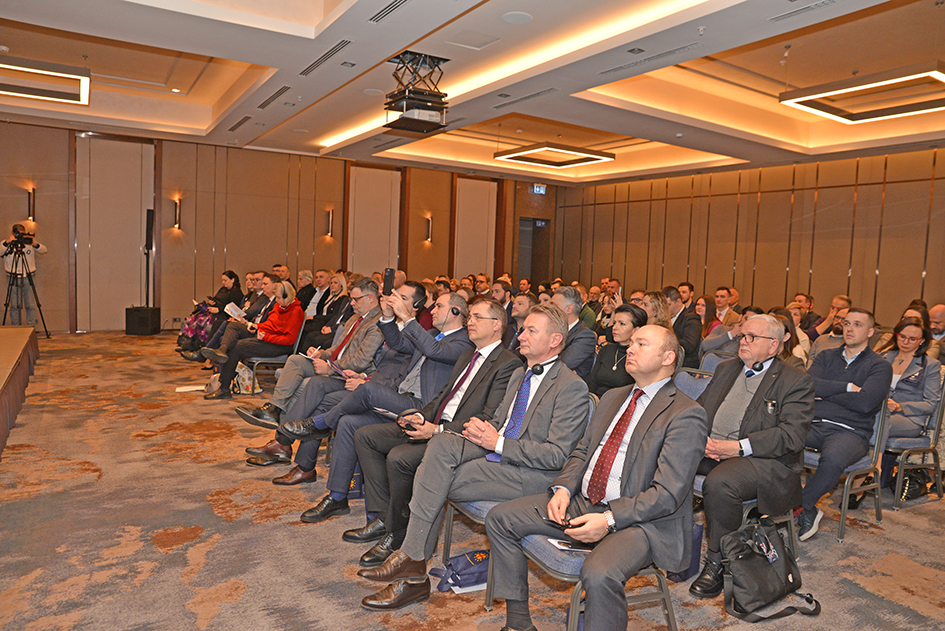
Among the guests at the well-attended conference in Skopje were, among others, the Austrian Ambassador to Macedonia, Martin Pammer (front row, far right), and sitting next to him, Wolfgang Maier from EVN in Macedonia.
In the various discussions during the conference, not only the many small problems and major obstacles on the path to the EU were discussed, which were clearly interpreted as a weakness in the policies of many EU countries, but also the strategic investments (political and economic) of other regional powers in Macedonia and the Balkans in general. Turkey was frequently mentioned specifically. One of the interlocutors remarked that in Turkey, people still think in terms of the Ottoman Empire.
Copyright Photos: Petar Paunche
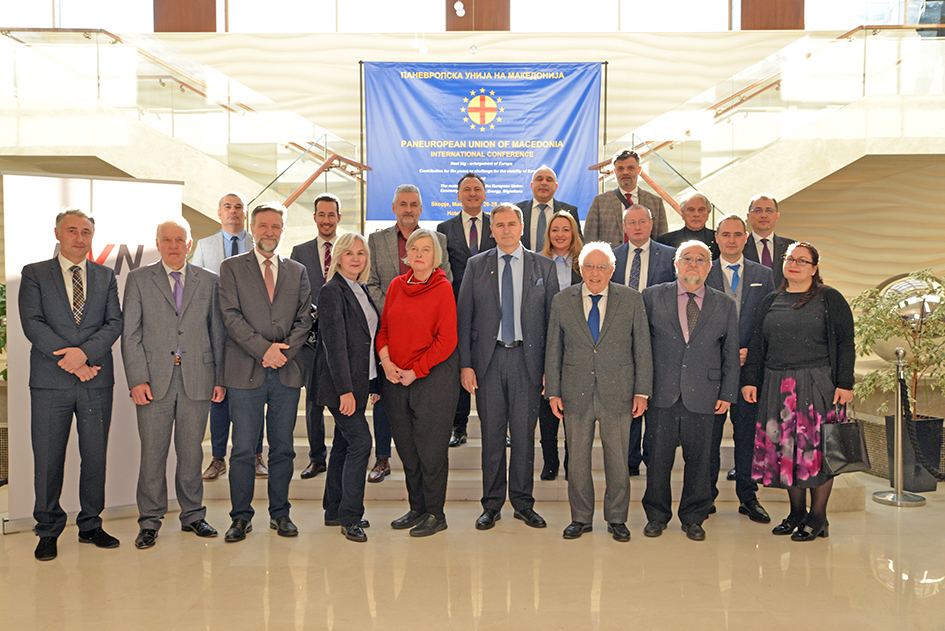
Featured Image: The leadership of the Paneuropa Union of Macedonia, Andrej Lepavcov and Biljana Janeva (right behind Lepavcov) with guests from several other Paneuropa organisations. Among them are Paneuropa President Alain Terrenoire (front row with blue tie) and Paneuropa Vice-President Walburga Habsburg Douglas (in red jumper) and Paneuropa Secretary-General Pavo Barisic (third from left). From the presidium members of the Paneuropa Union, Gordana Djurovic (right next to Walburga Habsburg Douglas) from Montenegro and Rainhard Kloucek (right next to Biljana Janeva) were present. Also present were Genc Pollo from Albania (second from left, front row), Christian Hoferer from Germany (second from left, second row), Zlatko Mikulic from Slovenia (second from right, third row), Alexandru Nazare from Romania (with blue tie, second row right) and Vanja Gavran from Bosnia-Herzegovina (last row, right).



