Disinformation and Conspiracy
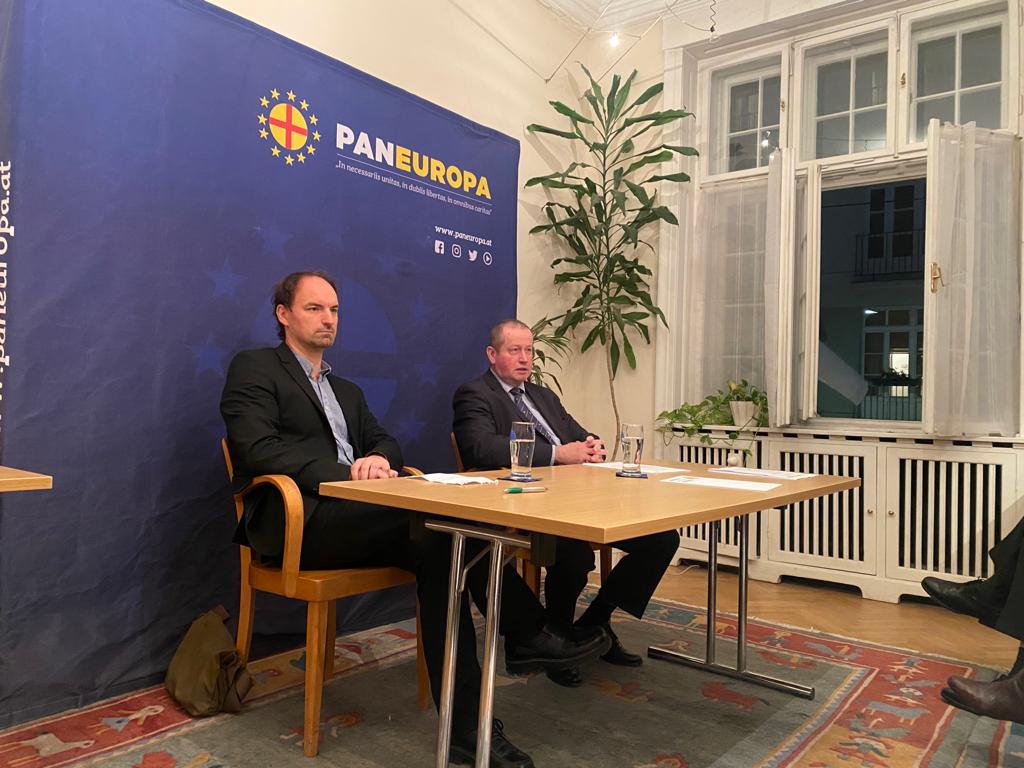
‘Disinformation and Conspiracy Fantasies’ was the title of a panel discussion held by the Paneuropa Movement with expert Dietmar Pichler, in which the mechanics of disinformation and other related topics were discussed.
They fantasised that Bill Gates would use COVID-19 vaccinations to implant chips in everyone. Others fantasised that the vaccination would wipe out half of humanity and a new ‘elite’ would take power. There are still people who believe that the Russian war of annihilation against Ukraine is a US invention. They view the sanctions against the Putin system as a provocation against Moscow, forgetting that it was Putin’s war of annihilation—the breach of all international agreements—that led to this reaction from the West.
False information is deliberately spread from Moscow via troll factories, finding its way into circles across the political spectrum, from the left to the right. However, the true goal of really effective disinformation campaigns is for people to ultimately believe nothing at all. Those who no longer believe anything, and are thus disoriented, are even easier to manipulate and instrumentalise.
How disinformation works, how it can be exposed, and the dangers it poses to democracy and freedom were the subjects of a Paneuropa discussion entitled ‘Disinformation and Conspiracy Fantasies’. The term ‘conspiracy fantasy’ was chosen intentionally instead of the more commonly used term ‘conspiracy theory’. Theories were developed by figures such as Albert Einstein and other greats. Theories are verifiable and falsifiable. Conspiracy fantasies, on the other hand, meet none of these criteria.
Expert Dietmar Pichler from the Centre for Digital Media Literacy attempted to clarify the phenomena at hand through a definition of terms. Disinformation is an invented piece of news spread to cause harm. A master of disinformation was the former KGB (now FSB), for whom the current Russian despot Vladimir Putin also worked. Moscow already employed entire disinformation offices and agencies. Misinformation, on the other hand, involves unintentionally telling something false. Pichler used the well-known example of ‘Chinese whispers’. Every time a person passes on a message, it is distorted in some way, so that after a certain amount of circulation, the original message (whether real news or a rumour) is no longer recognisable.
When satire is misunderstood as truth
A phenomenon that has also become very widespread is that satire is no longer seen for what it is—namely satire—but as truth. Even though disinformation and misinformation are often equated, they are two different things.
Conspiracy fantasies represent a category of their own. These always involve a ‘grand narrative’ spread to bolster the ‘theory’. In the background, there are always secret powers and secret circles controlling the world. This ranges from well-known conspiracy stories of an anti-Semitic nature to very current examples, such as the claim that Bill Gates’ support for vaccination programmes pursues the actual goal of implanting a chip in everyone, through which they can then be controlled—in the interest of the secret power behind it. Another version of this vaccination story claims that a secret elite (and only those fully ‘initiated’ into the relevant conspiracy fantasy know the names of these individuals) is working through the vaccination to exterminate half of humanity. The COVID-19 pandemic then becomes a ‘plandemic’ because, in the fantasy of those who believe it all, everything was planned long ago and then implemented.
They believe they are in possession of the full truth
People who have fallen for such fantasies see themselves as being in possession of the real truth, in which all the pieces of the mosaic fit together. They live in a closed system. Serious discussion is no longer possible because they can no longer engage with arguments. For hardcore conspiracy theorists, anyone who tries to counter with arguments only proves their thesis: that everyone else who does not share their fantasy is being controlled by this mysterious power.
In the field of disinformation, Russia is a master today. Just as the KGB once did, entire complexes in Moscow are working today on the dissemination of false information. Highly qualified employees sit in so-called troll factories, using social networks in particular for their propaganda. To this end, profiles are created on these social networks which suggest, for example, that a person from Austria is behind the profile. In reality, it is an employee of a troll factory. The fake profile, of which there are thousands, serves only to deliberately spread false information in order to influence public opinion in Europe in Moscow’s favour.
Dietmar Pichler from the Centre for Digital Media Literacy sees a problem in the fight against disinformation in a ‘false neutrality’. As an example, he cited a discussion programme in which Karl von Habsburg also participated. It concerned Moscow’s war of annihilation against Ukraine, the sanctions, and the nuclear threat. While three participants discussed the situation with Karl von Habsburg based on facts, two others tried to spread a different view of things using other approaches that were not fact-based.
Another example was the shooting down of flight MH17 over eastern Ukraine. It quickly became clear from the facts that Russian mercenaries had shot down the plane with a missile supplied from Russia. All passengers died. Moscow then produced a multitude of false versions: it was a Ukrainian missile, it was a Ukrainian fighter-bomber, there were no people on board at all but all the passengers were already corpses, etc. etc. The transparent aim of such narratives is to use a multitude of versions to present the only true version as just one possible story, and thus distract from the facts.
This raises the question of what can be done against such ‘fake news’. For Pichler, an important point is the verification of sources—in other words, where a piece of news comes from. This is very difficult in the digital age because false news usually spreads faster than facts over the internet.
What to do against disinformation?
It is also advisable to look at the chronological sequence of events. This was explained using the story that NATO had expanded eastwards—contrary to a promise—to encircle Russia. Aside from the fact that these promises never existed, contractual foundations also speak against such a promise: the CSCE Final Act, in which the USSR had already signed off on the freedom of sovereign states to choose their alliances; the Charter of Paris for a New Europe from 1990, in which this freedom of alliance was reaffirmed (the Iron Curtain had already fallen by then); etc. etc. An agreement between Moscow and Washington on which alliances the countries of Central and Eastern Europe would be allowed to join would therefore have been a breach of these aforementioned agreements and countless others. And in Putin’s case in particular, it must be mentioned that disinformation is part of the KGB officer’s toolkit.
© Cover image: Anna Pattermann. Dietmar Pichler (pictured) on the left at the discussion event, which was moderated by Rainhard Kloucek.



