Parliamentary Election in Ukraine, July 2019
The elections in Ukraine ran smoothly. Despite the challenges: three rounds of voting within four months. Now, the focus is on strengthening Ukraine’s European perspective. By Walburga Habsburg Douglas.
On 21st July, early parliamentary elections were held in Ukraine, announced by the newly elected President Volodymyr Zelensky the day after his victory. Following his convincing win over Petro Poroshenko, he also needed a parliamentary majority to implement his reforms and policies. For the supreme Ukrainian election commission and for Ukrainian voters, the whole process was not so straightforward: three elections within four months, given that the presidential election had two rounds.
Therefore, preparations, including candidate registration, campaigning, and the implementation of all new electoral laws, were not easy. One must admire the Ukrainian bureaucracy. Many election officials were on summer holidays. In some polling stations, election helpers were replaced up until the last day, which often rendered electoral training useless.
One must consider that half of the 450 deputies in the Ukrainian parliament, the Verkhovna Rada, are elected from party lists, and 22 parties stood for election. The other half are elected by majority candidates in 225 constituencies. And if that wasn’t enough: in a third of the country (in Crimea, Donetsk, and Luhansk, the region we know as Donbas), there are a number of electoral districts where a democratic election was simply not possible due to Russian acts of war. In Ukraine, the Russians didn’t even need to employ trolls or publish fake news. Acts of war and occupation were sufficient.
Direct Candidates Can Still Choose Factions
After the election, which foreign observers deemed good and democratic, albeit often very cumbersome, initially only the votes cast for party lists were counted. This made it seem as though President Zelensky’s new party, ‘Servant of the People’, had a majority. The party’s name was taken from the title of the satirical TV series in which Zelensky plays the involuntary president. The posters simply read ‘Yes’. The votes for the majority candidates will not be counted until 15th August. Therefore, the exact balance of power will not be known until then, as each independent candidate can decide for themselves which faction to join.
One could say that, in a way, Zelensky succeeded in what Emmanuel Macron demonstrated to him. A presidential candidate wins the election and then needs a parliamentary majority to implement his policies. He founds a new party and wins the election with it.
However, he will face problems with implementation. He has promised to fight corruption, end the war in Donbas, and reclaim Crimea. But Ukrainians are not prepared to compromise on any issue. His exit strategy will be the most important thing, and that will present him with a problem.
Then there is an electoral technicality: after the last parliamentary election in autumn 2012, the Venice Commission of the Council of Europe made proposals for improving electoral legislation – particularly concerning voter lists, women’s participation in political life, campaigning, reducing bureaucracy, and faster vote counting. Some of these were implemented, others remain on the back burner. The Council of Europe managed to annoy the Ukrainians by
reinstating the voting rights of Russians, which had been suspended after the invasion and annexation of Crimea, to such an extent that they did not invite the Council of Europe for election observation, thereby ending cooperation with the Venice Commission.
I was with the IRI (International Republican Institute) in Kyiv and observed in the capital region, which also includes Chernobyl and Slavutych. That’s why I was there the day before the election and could confirm that all preparations were excellent.
I met Viktor Yushchenko and representatives of Yulia Tymoshenko’s ‘Fatherland’ party. The day after the election, there were press conferences from the OSCE with ODIHR and the European Parliament, followed by NDI (National Democratic Institute) and IRI. All agreed that the election had gone well and expressed the will of the people, which is the most important thing. But the President’s major problems probably begin now, as he tries to implement his election promises. Then he will have to sit down with the Russians. As my father, Otto von Habsburg, once said: ‘He who sups with the devil needs a long spoon.’ We wish the satirist Zelensky a very long spoon, strong nerves, and capable advisors. After that, the EU and NATO will be called upon to seriously consider Ukraine’s membership. That would be the right response to the successful election.
Walburga Habsburg Douglas was Secretary-General and Executive Vice-President of the Paneuropean Union; she served two terms in the Swedish Riksdag (during which time she was also faction leader of the EPP in the OSCE Parliamentary Assembly). She lives in Sweden, where she is also President of the Paneuropean Union Sweden.
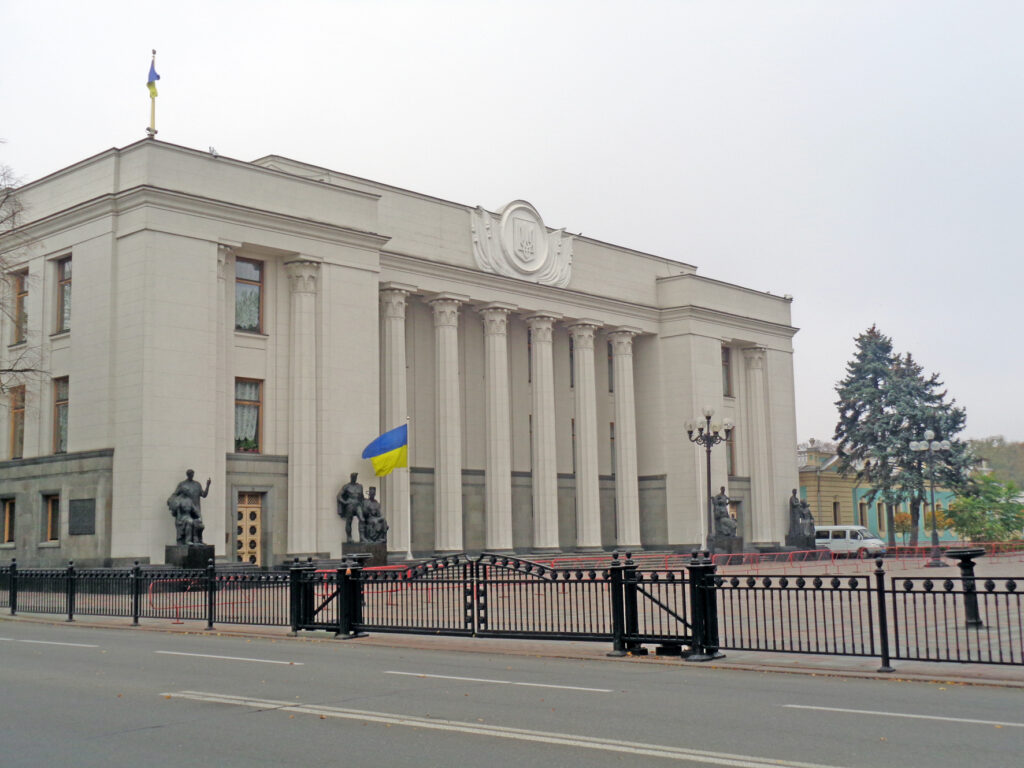
The featured image shows the Ukrainian parliament.



