Promoting the Vote: Civic Responsibility
More than three million Austrians choose not to be democratically represented. A gap in representation, and thus participation, between the populace and politics is becoming apparent. A commentary by Philipp Jauernik.
The European Parliament election is just around the corner. It is often referred to as a ‘fateful election’, a ‘directional decision’, or even a ‘fundamental question’. However, these terms apply to every election, because – as banal as it may sound – ultimately, every election fundamentally determines the direction of the fate of the respective voting entity, albeit with varying degrees of impact: a change of power in a small municipality has less significance than one in the federal government.
In the case of the European election, however, unlike state or national parliamentary elections, it is not about a change of power, as the distribution of seats at EU level is not directly linked to the appointment of the executive. On 26 May, the European Parliament, the European Union’s citizens’ chamber, will be elected. Its new composition will bring about change – forecasts suggest that 40 to 50 per cent of MEPs will be new.
The European Parliament is primarily known as a working parliament. In the legislative process, it receives drafts from the EU Commission, debates them, and adopts a position, which it then negotiates with the Council of the European Union, representing the Member States. In doing so, it fulfils, in the best sense, the oversight function that a legislative body in a democracy is meant to have: the control of power and the representation of the electorate’s interests. No one can seriously dispute that decisions in the EU are made by democratically legitimate representatives, regardless of how satisfied one may be with them.
However, current forecasts suggest that a Europe-wide trend is continuing: the fringes are growing at the expense of the centre. Christiane Bender and Elmar Wiesendahl analysed a reason for this in 2011, using the example of the increasingly weakening SPD. Its history is characterised by the promise to be there for those who need solidarity. Yet it is precisely these people who are now turning their backs on it – partly by voting for other parties, partly by not voting at all. The two political scientists state: ‘There is a danger that their interests will no longer be represented by elected politicians. A gap in representation, and thus participation, between the populace and politics is becoming apparent.’
This problem also exists in Austria. With the exception of the first Austrian European election in 1996, less than half of eligible voters have turned out to cast their ballot each time – with a low of 42.4 per cent voter turnout in 2004. This means that over three million Austrians actively choose not to be democratically represented. Certainly not a pleasing circumstance. If the right to vote is one of the noblest achievements of a democracy (of which I am convinced), then against this background, it seems all the more to be one of the most important duties of civic responsibility to actively advocate for voting in one’s personal environment in the run-up to the election: Go and vote!
Philipp Jauernik works as a Political Advisor in the European Parliament. He is also the Federal Chairman of the Paneuropa Youth Austria and Editor-in-Chief of ‘Couleur’ magazine.
This commentary originally appeared in the ‘Wiener Zeitung’ on 9 May (Europe Day): https://www.wienerzeitung.at/meinung/gastkommentare/2008370-Werbung-fuer-die-Wahl-Staatsbuergerliche-Verantwortung.html
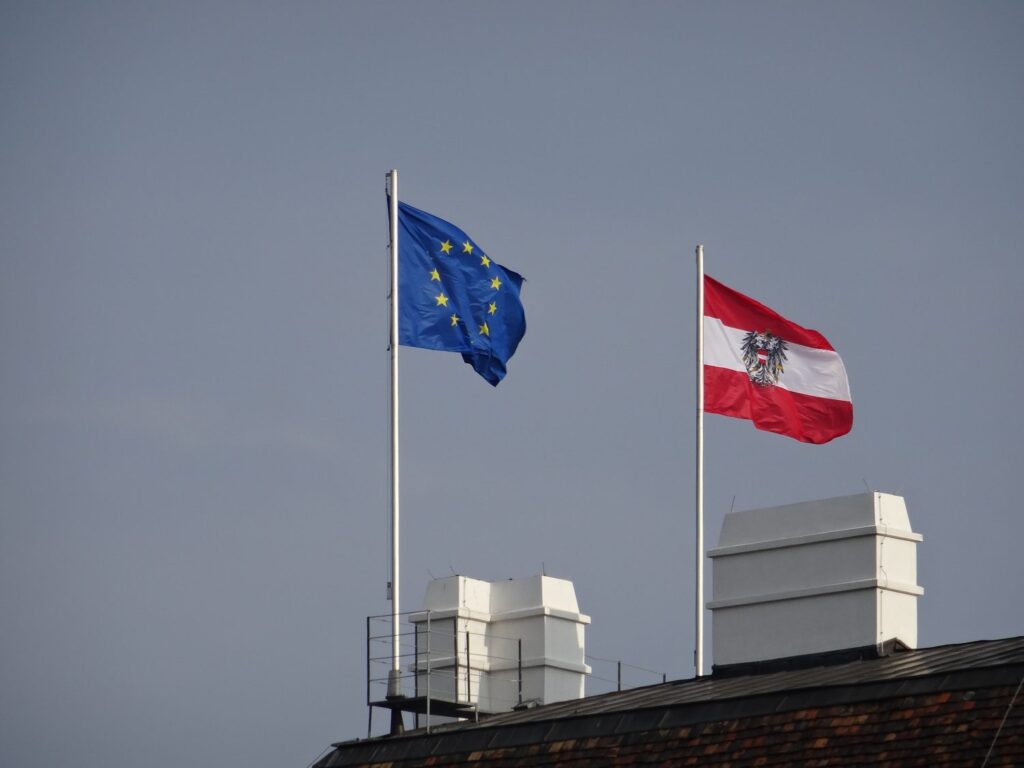
Photo: By Stb1er – Own work, CC BY-SA 4.0, https://commons.wikimedia.org/w/index.php?curid=73899277



