Europe Must Be a Guarantor of Free Trade and the Market Economy
Trade wars are unwinnable. Everyone loses: consumers, employees, and businesses. A commentary by Paul Rübig.
On 31 May, the USA imposed “punitive tariffs” on steel and aluminium products from the EU, Mexico, and Canada. In an economic policy following the campaign slogan “Make America Great Again”, the US President attacks everyone – be they friend or foe.
Europe was in an uproar. The very Europe where the free trade agreement with the USA had been massively attacked for years suddenly became the target of an arbitrary trade policy. The great success of the EU lies in its comprehensive trade policy with agreements across the globe. Such agreements are also intended to protect against arbitrariness. The arbitrariness that Trump displays when he speaks of the “enemy EU” only to celebrate the beginning of a “wonderful friendship” a few days later. Such arbitrariness could at least have been curbed by TTIP. Pacta sunt servanda.
Retaliatory Measures Are Not Sensible
The EU must now find ways to optimally leverage its existing trade policy power (the EU is the strongest economic area in the world) without resorting to retaliatory measures. Paying back in kind would be more about revenge than a sensible, level-headed trade policy.
The idea of creating a counterbalance with European punitive tariffs on certain US products is more political in nature. Steel versus motorcycles. Harley-Davidson is one of Wisconsin’s flagship companies, the constituency of the powerful politician Paul Ryan. This strikes at the heart of US politics. Harley-Davidson itself came into Trump’s sights after announcing plans to relocate parts of its production abroad. The tariffs would make production in the USA more expensive.
Trump also targets German car manufacturers, accusing them of harming US industry. Yet, the largest American car exporter is BMW. German car manufacturers contribute almost 10 billion dollars to US exports.
That the steel industry is not immune to populism was evident in 2016, when the European Steel Association pointed out the following facts:(…)The UK steel sector heavily depends on the EU as a market for its steel products: in 2015 71% of its total flat products exports and 65% of its total long product exports were sold to EU countries. Around 13,000 people work in the UK steel industry”
Turkey Stands No Chance in the Conflict
The highly political nature of tariff policy is now also evident in the case of Turkey: in the fierce struggle between President Erdoğan and his adversary Fethullah Gülen, who lives in the USA, the economy is now under attack. In 2016, Turkey arrested US pastor Andrew Brunson and refused his release. The USA responded with sanctions. Now, Turkey has introduced tariffs on 22 US products, up to 140%. Turkey stands no chance in this trade war – the Turkish currency plummeted. Now, Qatar must step in as an investor.
Punitive tariffs are costly for all parties involved. The domestic steel and aluminium industry, which exported 200,000 tonnes of steel and steel products worth €400 million, and almost 40,000 tonnes of aluminium and aluminium products worth €170 million to the USA in 2017, could face damages of €50 – 240 million. This depends on whether the tariffs are extended to the (German) automotive industry.
They affect not only European manufacturers but, above all, the processing industry in the USA. For them, steel and aluminium products are indispensable raw materials. Many products become more expensive because the basic materials cost more. Thus, the tariffs also burden consumers.
What Should Europe Do?
First and foremost, we must not participate in the US government’s protectionist game. We stand for fair trade and want our companies to be competitive and expand exports. A race to the bottom with punitive tariffs achieves nothing.
The EU should advocate for a general reduction of tariffs at WTO level to prevent global trade wars from the outset. And the EU must continue its successful path of trade agreements. These are intensively negotiated on an equal footing and primarily benefit European small and medium-sized enterprises. This is because SMEs usually do not have their own production facilities in the respective countries or large legal departments. They are therefore all the more dependent on investment protection and legal certainty. The example of China shows that an imbalance still exists here too. Here, too, the motto is: negotiate and achieve progress together.
Protectionists, opponents of the market economy, and nationalists think in zero-sum terms. One wins, the other must lose. We must resist this way of thinking. We need win-win situations.
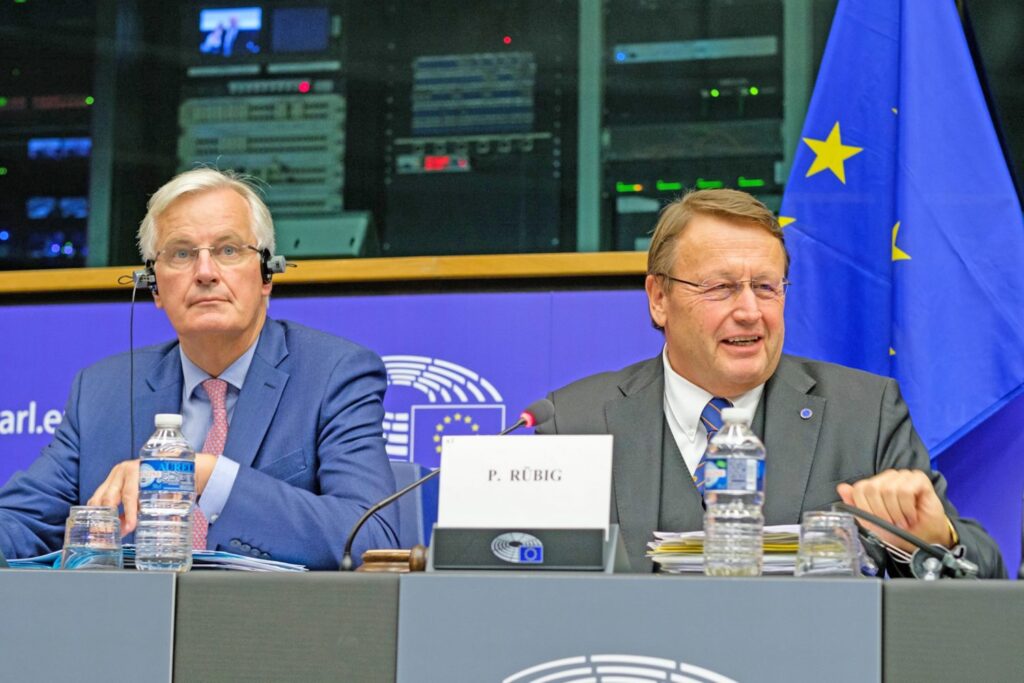
The featured image shows Dr. Paul Rübig, MEP, with EU Brexit Commissioner Michel Barnier.



