How Credible is the EU?
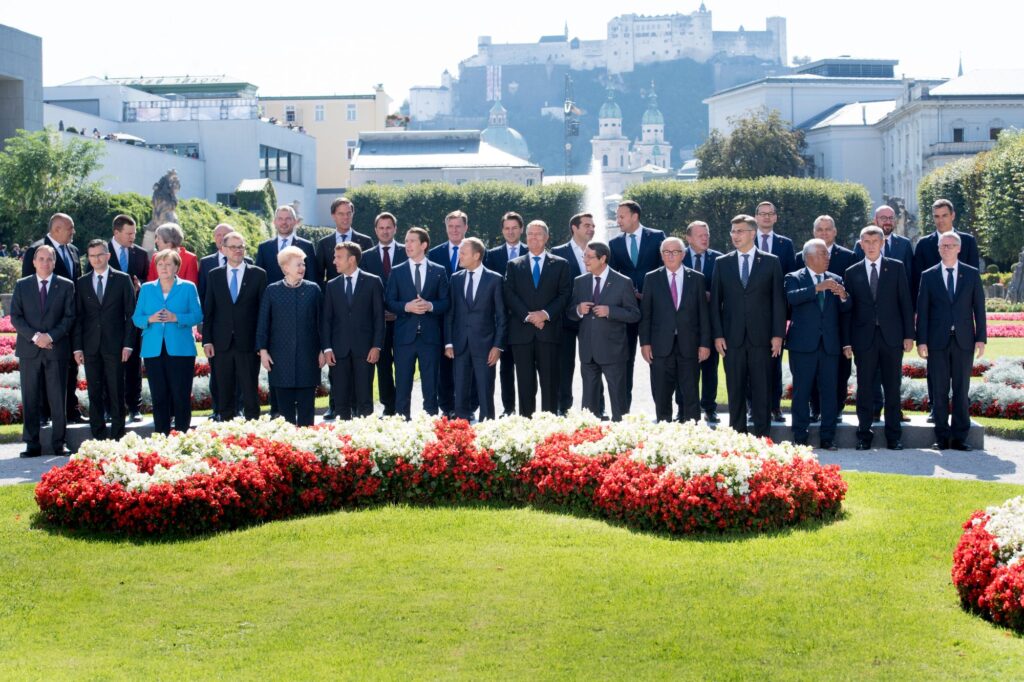
Without a clear strategy, Europe, or rather the EU, will remain weak in its Russia policy. A commentary by Karl von Habsburg.
Immediately after the renewed escalation of Russian aggression against Ukraine, Germany and France offered themselves as mediators in the conflict. Vladimir Putin was probably shrewd enough to anticipate such a reaction. Thinking strategically, he had already ensured in previous years that European policy towards Moscow had become disoriented, and as a mediator, it now faces a massive credibility problem.
It would not be the first time that individual EU countries have offered their mediation. Recall Russia’s invasion of Georgia and the subsequent occupation of two territories (which were then granted sham independence). France intervened massively, with the result that Russia was able to retain its conquests and continue its policy of destabilisation. A return to normality in policy towards Moscow.
Then came Russian aggression against Ukraine. The annexation of Crimea was apparently acknowledged without any real reaction. Then came the invasion of Eastern Ukraine. Until the downing of the passenger plane, where there is truly no longer any doubt about Russia’s culpability for the crime, only warning words came from Europe. Only after the downing did Germany and France again intervene. The Minsk Agreement led to a freezing of the conflict. However, the conflict is not entirely frozen; people are still dying in attacks by Russian mercenaries. Germany and France continue to “mediate”, but Russia shows no inclination to end the conflict by withdrawing. The mediation is futile. Mediation cannot consist of encouraging the aggressor to commit further acts of aggression. It must lead to the aggressor abandoning their aggression.
The Main Thing is That the Gas Flows
This also repeatedly raises the question of how credible individual countries are in their role as mediators towards Ukraine. This is not just about evaluating the lack of success in previous mediations, as in the case of Georgia. Germany is building new gas pipelines with Russia, which, from a Russian perspective, primarily demonstrate a massive political interest: to bypass Ukraine. The ‘Schröderisation’ of German politics has gone far too far.
Which other European states could act as credible mediators? Of course, a country’s strength plays an important role, but it is not the only factor. Austria could certainly have played a significant role here. The intensive diplomatic visits between Vienna and Moscow, which this year went far beyond what is normal during or in preparation for a Council Presidency, and whose objectives are still unclear (apart from the same interest as in Germany, namely gas supplies), have probably somewhat damaged Austria’s image as an honest mediator in Ukraine. The many loud voices calling for the lifting of sanctions against Russia do not improve the situation.
Great Britain could still act as a credible European power under the Budapest Memorandum. But the country is currently so intensely preoccupied with its withdrawal from the EU that it is too weak for such actions. That leaves the EU as a whole. But here, everything that has been neglected in establishing a European foreign policy is now taking its toll. The responsible Commissioner plays no role here because the member states, out of pure egoism, did not want to give her this role and still do not want to.
It remains to be seen whether, at least as a consequence of Russian aggression, there is finally a willingness to think in a European dimension regarding foreign policy, or whether we will continue to be led by the nose by Moscow.
Towards Ukraine, only one measure can currently be taken by the EU: the transformation of neighbourhood policy into a clear accession policy, as well as an end to appeasement towards Moscow. This will be tough, but ultimately it is about whether Europe still wants to play an independent role.
The article originally appeared on the website of Karl von Habsburg.
Feature image: © European Union, 2018 / Source: EC-Audiovisual Service / Photo: Etienne Ansotte



