Presidential Election in Georgia
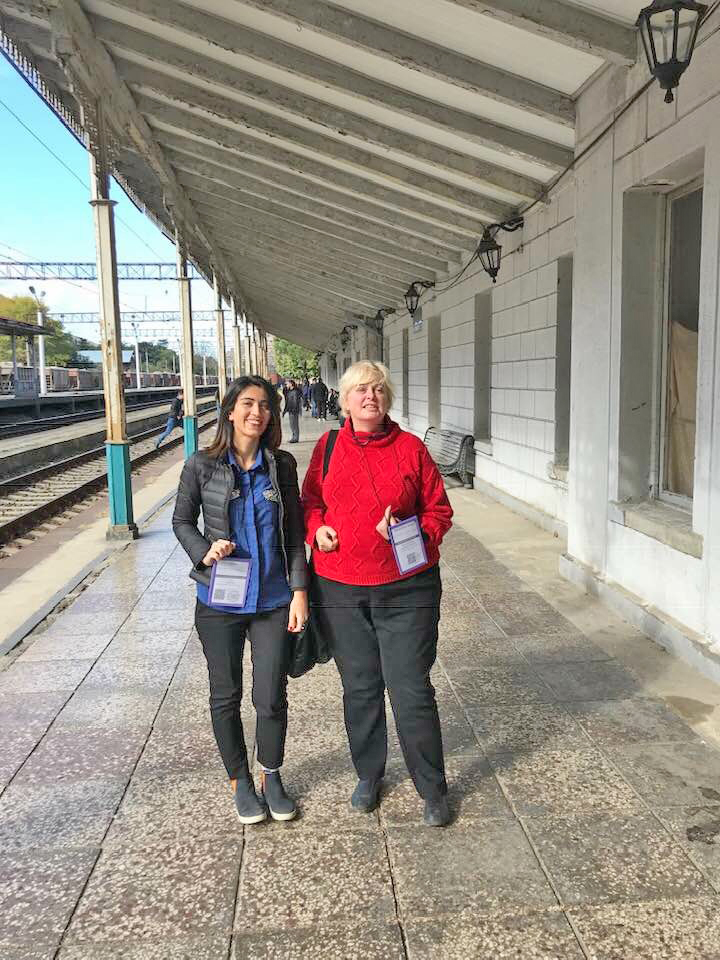
The first round of the presidential election took place in Georgia. Walburga Habsburg Douglas, who was on site as an election observer, shares her impressions of the election and its outcome.
The first round of the presidential election was held in Georgia. In a general election, the president is elected for six years. Interestingly, this will be the last time this happens, as a constitutional amendment stipulates that the next president will be chosen by electors. Over forty candidates stood for election, with three emerging as main contenders:
David Bakradze, the former Speaker of Parliament and now leader of the ‘European Georgia’ party, a group that had split off from the largest opposition party, the ‘United National Movement (UNM)’, founded by Mikheil Saakashvili.
Salome Zurabishvili, who began her career in Georgia as the French Ambassador to Tbilisi, then served as Foreign Minister in the Saakashvili government, and is now running as an independent candidate, supported by the ruling party ‘Georgian Dream’ with its party leader, the oligarch Bidzina Ivanishvili.
Grigol Vashadze, the candidate of the United Opposition, also a former Foreign Minister under Mikheil Saakashvili.
According to the constitution still in force, the winner is the candidate who receives 50%+1 of the votes cast. If no candidate achieves an absolute majority, a second round of voting will take place between the two candidates who secured the most votes. In this specific case, these are Salome Zurabishvili and Grigol Vashadze.
The Big Question of Amnesty
The election campaign was not about ideological issues. It was mainly about the question of who was willing to grant amnesty to whom, with everyone secretly wondering if Saakashvili could return to Georgia after the election. Both candidates are pro-Western, pro-NATO, although Zurabishvili seeks a closer connection with Russia. When asked who the most important politician was for her, she replied in an interview: Sergey Lavrov (the Russian Foreign Minister). She blames Saakashvili alone for the 2008 Russian invasion. This question preoccupied not only Georgian voters but also the Russian President, who gave an interview on election day in which he spoke about Saakashvili seven times.
The run-off election between Zurabishvili and Vashadze will be held in three weeks. Since Bakradze, who received 10 percent of the votes, is urging his voters to support Vashadze, the outcome seems clear. There will be another election observation mission.
What do you experience on election day? Problems with voter lists, problems with voter intimidation, and attempted vote buying. But even with massive attempts, the election result can only be altered by a maximum of three percent, up or down. Election monitoring is necessary, however, as it also tests the democratic maturity of the country and assesses the election campaign: did all candidates have the same opportunities, how did the media operate, etc.?
It will now be interesting to see what Bidzina Ivanishvili will try to do to promote his candidate. It will probably be shown for the first time that money alone does not win an election. For Europe, it is good to see that Georgia is on the right track, even if European integration is still a long way off.
Georgia is on the Right Track
The role of an election observer is also a crash course in a country’s politics and culture; you receive lectures on the candidates and parties, as well as on electoral legislation. If you have some experience, you can make comparisons. This allows conclusions to be drawn. It is also important to understand that election monitoring is not primarily about control, but about assistance, because after the election, a meeting follows with the responsible institutions where errors and weaknesses are discussed, and ideally, legislation is adjusted. The highlight of my mission was visiting a polling station in the waiting room of a closed railway station in Mtskheta, cold, picturesque, and interesting.
What conclusions can be drawn from the election observation mission? Georgia is on the right track but still needs patience and, above all, time to prove to Europe that it wants to continue on its chosen path. Then, perhaps soon, there will be another proper Eastern enlargement that Russia will not like.
Walburga Habsburg Douglas was the Executive Vice-President of the Paneuropa-Union until 2014, and before that, its Secretary-General. From 2006 to 2014, she was a member of the Swedish Riksdag. During this time, she also belonged to the OSCE Parliamentary Assembly, where she was the faction leader of the EPP. The featured image shows her (right in the picture) during the election observation mission in Georgia.



