Habsburg: Patriotism is positive
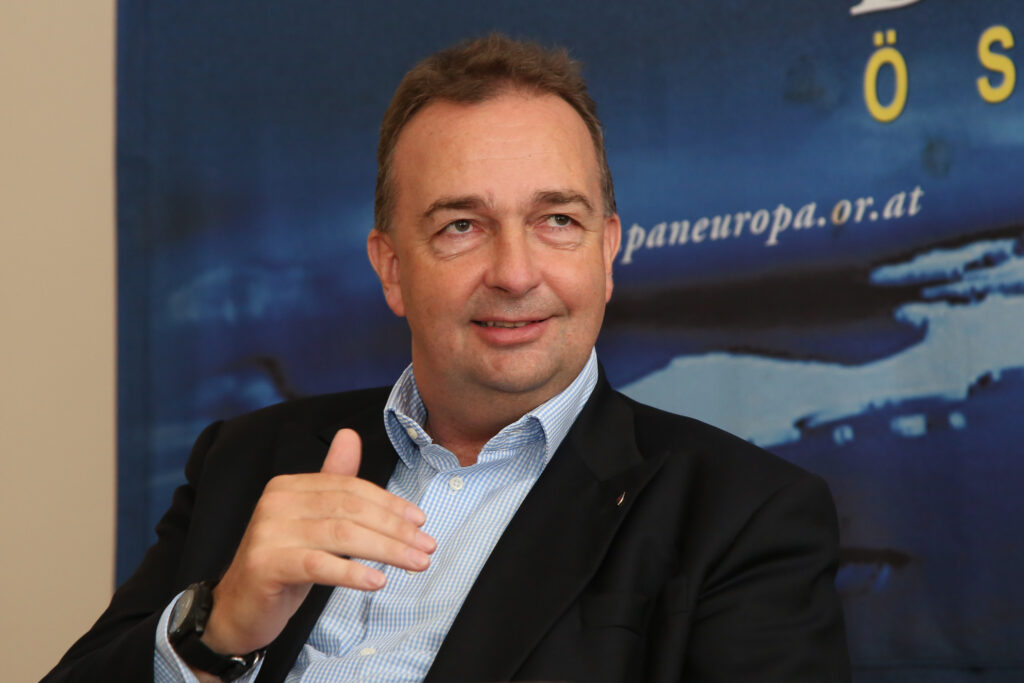
Nearly 100 years ago, “old Austria” – as the Habsburg Monarchy is often called – came to an end. Parts of its legacy endure to this day. The grandson of the last Emperor, Karl von Habsburg, was a Member of the European Parliament, just like his father. In this Couleur interview, he speaks about subsidiarity, the rule of law, and patriotism.
Your family originally comes from what is now Switzerland. Your family ruled almost all of Europe for centuries and bears the epithet ‘House of Austria’. As a child, you were not even allowed to enter modern-day Austria. How much ‘Austria’ is in a Habsburg today?
To answer that, one must look more closely at the question of roots. While my family’s origins lie linguistically and geographically in what is now Switzerland, the Burgundian roots are likely to have had a much stronger influence in terms of substance. This Burgundian heritage played a major role in the formation of the European continent. Philip the Good was certainly the person who most vigorously drove the transition from the Middle Ages to the Renaissance, at least for the region north of the Alps – in Italy, of course, this happened somewhat earlier. He worked on a completely new state system. How strong the Burgundian heritage is in my family can be seen, for example, in the fact that Charles V always sailed into battle under the Burgundian flag.
How did this Burgundian heritage manifest itself more concretely?
For instance, in the fact that with Charles VI, Habsburg power moved more strongly from the Spanish sphere towards Central Europe. It became a foundation for this Central Europe. I therefore see the terms ‘Austria’ and ‘Central Europe’ as being, to a certain extent, congruent.
How should one imagine that?
For me, ‘Austria’ is a multifaceted term. Naturally, it is a geographical one, but not only that. For me, the term ‘Austria’ also stands for having helped shape a supranational legal order. The primacy of law is very much an outgrowth of this heritage – and fortunately, this is not limited to the borders of today’s Austria. To answer the initial question more specifically: in this context, there is a great, great deal of Austria in me.
What exactly do you mean by the ‘Burgundian heritage’ in terms of content?
Not least the concept of subsidiarity. At the time, Burgundy was forced to develop a modern concept of the state due to the fact that it did not possess a contiguous territory. The area had to function so that the individual territories could be administered largely autonomously, yet still function as a whole. Thus, Burgundy can serve as a model for today’s Europe.
You had a father whom everyone knew – Crown Prince, resistance fighter against Hitler, and later a Member of the European Parliament for the CSU. What did you take away from your father that is specifically Habsburg?
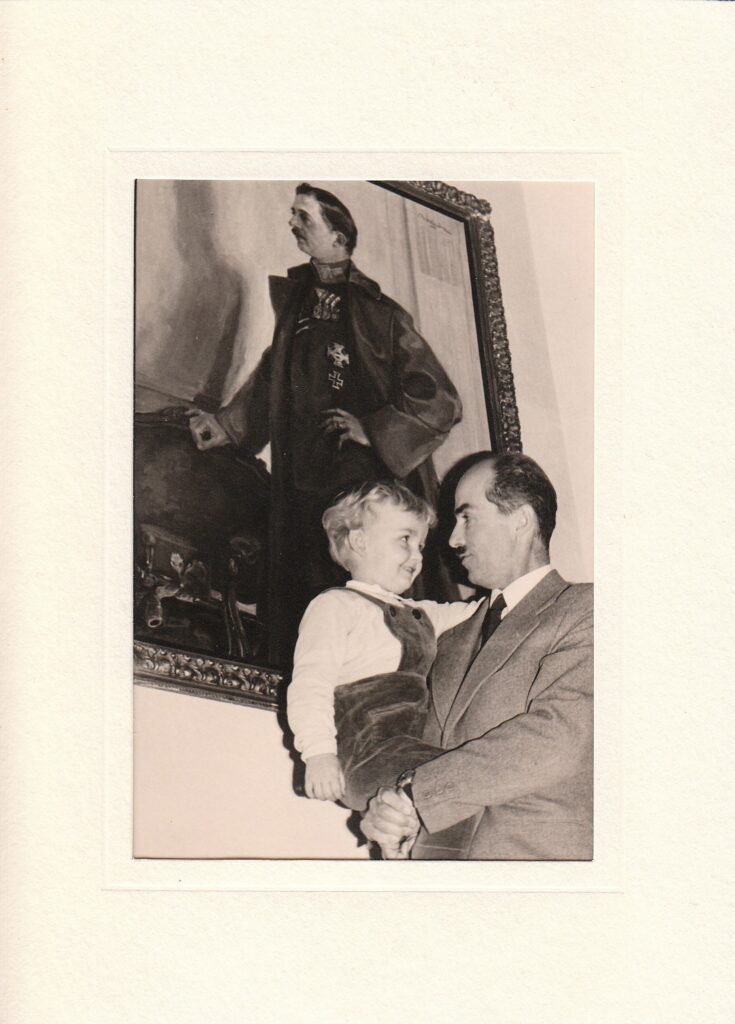
Three generations in one picture: Grandfather Emperor Karl, father Dr Otto von Habsburg, grandson Karl
A lot happened through upbringing. My parents placed great emphasis on three areas: firstly, an understanding of geography and the fact that it provides constraints that one cannot simply ignore. This also applies to the second area, namely history, which can only be understood in the context of geography. There is the concept of the ‘inevitability of geography’, which means: you are placed somewhere, and that has consequences. You cannot act the same way everywhere in the world. Only by understanding this can I draw conclusions for the future. However, the ability to position oneself in such a coordinate system of geography and history only works with the third area, namely religion, which is very important to us.
Let us turn to the term ‘Central Europe’. Some might now believe you are referring to the Habsburg Empire within its pre-1918 borders.
Central Europe is defined in many different ways. I consider the current definition of the European Union, which understands it as Germany with a small appendix in the southeast, to be completely wrong. Rather, Central Europe is a supranational legal order that developed in the heart of the continent, not least through the cultures of the peoples living here. Through the coexistence of these peoples, a higher tolerance towards the ‘other’ developed, though of course there was always a specific threat – from the Ottomans, for example. As a result, a very distinct Central European spirit was formed here, which could support many cultures and religions. For example, it was perfectly normal for the national anthem to be sung in all the languages of the peoples as a matter of course. That was unique – singing the Marseillaise in Breton or the British anthem in Gaelic would have been completely unthinkable. An image that illustrates this tolerance well comes from the First World War: a Catholic priest, a field rabbi, and a field imam praying together for the safety of the soldiers. That, too, was absolutely unique at the time.
How can Central Europe be defined geographically?
Ultimately, that is difficult. It cannot be done with states. The Visegrad states, for example, are well aware that they alone are not Central Europe, if only because Austria is not included. For me, it is perfectly clear that Central Europe can only be defined via regions. There is often talk of the Danube region, which of course is also insufficient. Bavaria would certainly be part of it. Western Ukraine definitely as well, but Eastern Ukraine no longer. Vojvodina belongs to it, but Serbia as a whole does not. And in the border regions, there are several grey areas.
We also know grey areas in border regions from today’s nation-states. The Saarland, Alsace, parts of Burgenland, the Slovenian-Carinthian border area – these are all examples of where they occur. Now, nation-states have caused almost all European wars of the past 150 years. What do you associate with the modern concept of the nation?
First of all, it must be pointed out that it is not state entities per se that wage war, but the people within them, who naturally have feelings. The nation-states were, for their part, heavily responsible for the feeling of nationalism – a certain sense of superiority for one’s own nation that led to these conflicts. But I would go further back, namely to the French Revolution. It is sold to us very positively today, but it also represents a great catastrophe because it fuelled excessive nationalism. That did not exist before. I don’t even need to speak of the genocides during that time. From 1789 onwards, nationalism runs through European history via the World Wars.
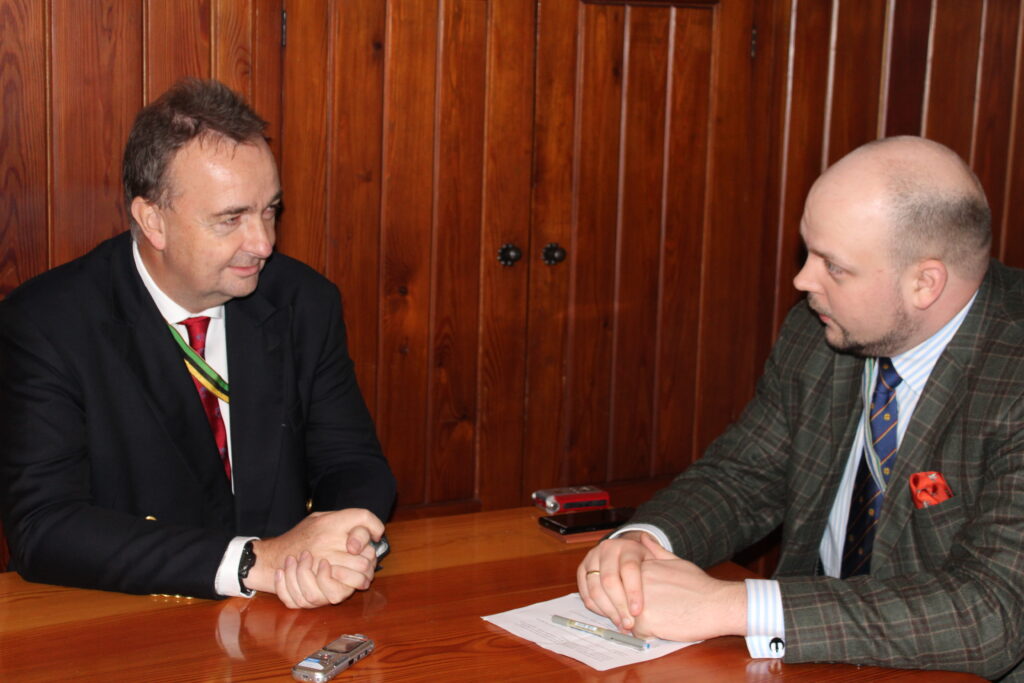
In conversation with Couleur editor-in-chief Philipp Jauernik
How do you judge nationalism as such?
It is undoubtedly a feeling that belongs to the world of negative emotions. It defines itself by the exclusion of others. This stems from a certain rationale, because it provides the justification for the rejection of others, for wars and conflicts. I myself prefer patriotism, which is positive, which emphasises love for one’s own country, for one’s own community, but does not reject the other. Nationalism lives off the border to the other; patriotism lives off the affection for one’s own. I can be a patriot for my community, my region, and my country, but at the same time a European patriot. Logically, nationalism does not allow for this.
Your mother was German, your father lived in Vienna and Bavaria, you live in Salzburg. How do you define your own identity?
Exactly as I said before regarding patriotism: it is not necessary to assign myself to only one specific region; rather, one can feel at home in many parts of Europe or the world. For me, these regions are Europe, Central Europe. I am a Central European and a European. I have the closest relationship to Salzburg as a place.
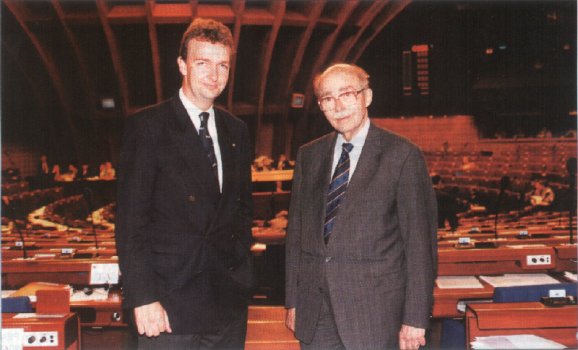
1997 in Strasbourg: Father Otto was then a Member of the European Parliament for the CSU, son Karl for the ÖVP.
In 1989, you stood at the Pan-European Picnic on the Hungarian border. How do you feel about such borders today?
For someone who was previously locked in a country, the feeling that these borders are removed is particularly important. Someone who lived in a free country might feel this less. A good portion of US citizens do not have a passport because they have never left their huge country. There, the understanding for the abolition of borders is much lower than here.
The border regime in Europe has been heavily debated in the recent past.
Yes, and these debates alarm me. I consider the mania of some people to erect borders to be very dangerous. These borders have brought us nothing. Looking at the facts, we know perfectly well that the reintroduction of border controls within Europe achieves nothing in terms of security. Freedom brings more than locking people in. Instead, we must work on further developing Schengen, securing the external borders of the European Union efficiently and strongly, but expanding freedom within. However, the burden of securing the external borders cannot lie solely with the states located there; it must be borne collectively. Border protection, security, and foreign policy are competences that, in the spirit of subsidiarity, are best solved at the European level.
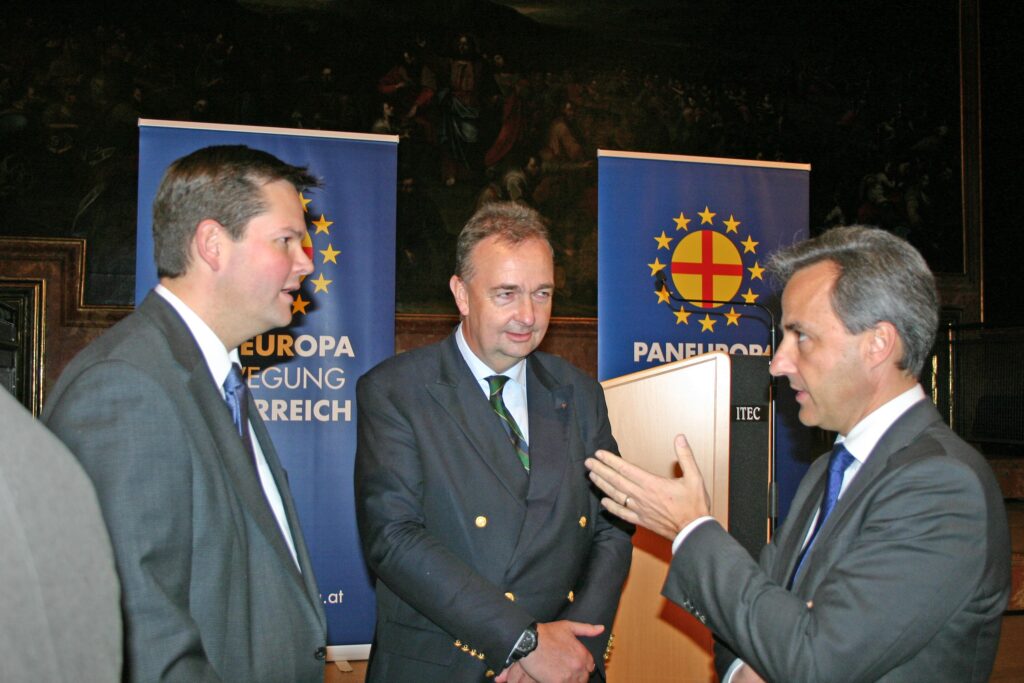
Always in exchange with politicians at local, national, and international levels: Habsburg in 2017 in Graz with MEP Lukas Mandl and Mayor Siegfried Nagl. Subsidiarity is one of the core messages for which Habsburg is politically committed – it also includes close cooperation between political levels.
That probably still makes sense to most people. However, at the same time, the term ‘European solution’ has long since become a trigger for many. The new Federal Government emphasises the concept of subsidiarity more strongly than many before.
We must be clear that subsidiarity is the only solution to keep our system functional and to improve it. The question is how exactly one interprets this principle. Subsidiarity is not exhausted by defining the relationship between the national and European levels. It is a social principle that assumes competences should be located where they can best be fulfilled. The question of ‘national or European’ therefore falls short. Some things could be solved much better by the states, districts, or municipalities than by the federal government.
This approach certainly goes deeper than what is discussed in daily political debate.
Yes, without doubt. When I was in the European Parliament, I proposed forming a dedicated subsidiarity committee. There, before a new regulation or directive was voted on, it should have been clarified whether it even complied with the principle of subsidiarity. The problem becomes immediately apparent when you look at the institutions. They are divided into those that think European and those that think national. The European Council thinks nationally – namely according to the principle of what helps the national level most. Europe cannot function like that. Europe cannot be dominated only by the national. It needs stronger regions and a European level that can solve those competences that are best solved there, without petty squabbling starting every time. If we think of the refugee crisis, the member states were ultimately unable to agree on a common course of action. That is why it escalated so much. But that was not the fault of the EU, but of the nationally-minded member states.
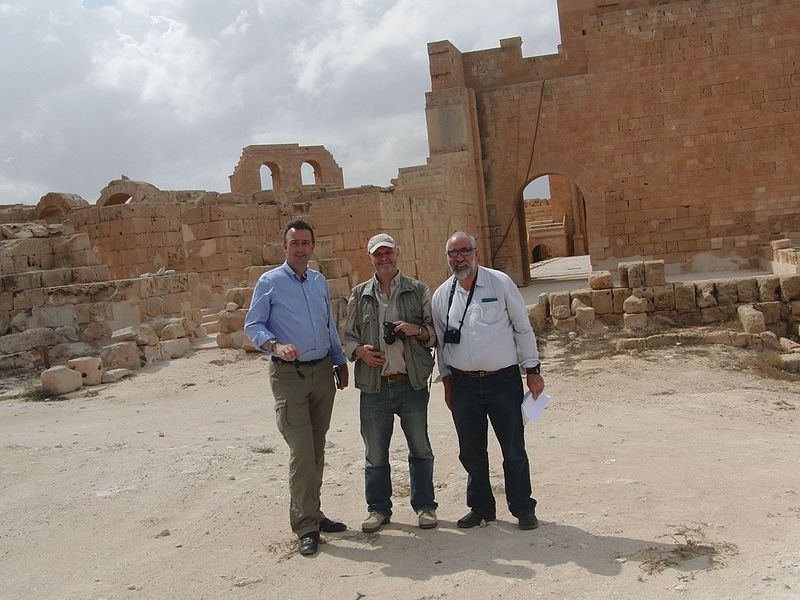
Mission in Libya 2012: The protection of cultural property has long been a matter close to Habsburg’s heart.
© BlueShields
Can the institutions work more meaningfully within the current framework at all?
I believe so. We have excellent administrative structures at the regional and local levels. We have the Committee of the Regions. This just needs to be better elaborated. Not everything should take place between the national and EU levels. All social levels must come into play. Every decision must be made as close as possible to those it affects – and where it achieves the best results. It is not about abolishing the national level. It has important tasks and functions. But the experience of two world wars has shown us that the nation-state should stay within certain limits and not become excessive. Today, however, we are again in a situation where the national level has also carved out an enormous position of power within the EU.
What could a better institutional structure look like?
The founding fathers had many important things in mind – such as the separation of powers and the rule of law. The basic idea of the Council was that it should take on the role of a strong second chamber. That would also be the most logical thing, that the states have representation. But the fact that the Council has begun to take over the function of the legislature and also the executive, so that all decisions ultimately only happen from the national level, continues in the wrong direction to this day.
What would that mean?
Parliamentary history shows that second chambers – such as the Bundesrat – have a very important function as a corrective. Instead, the Council dominates everything. It would be better if the Commission restricted itself to executive tasks, the Parliament as a directly elected democratic representation received the right of initiative, and the Council functioned alongside it as a supervisory body.
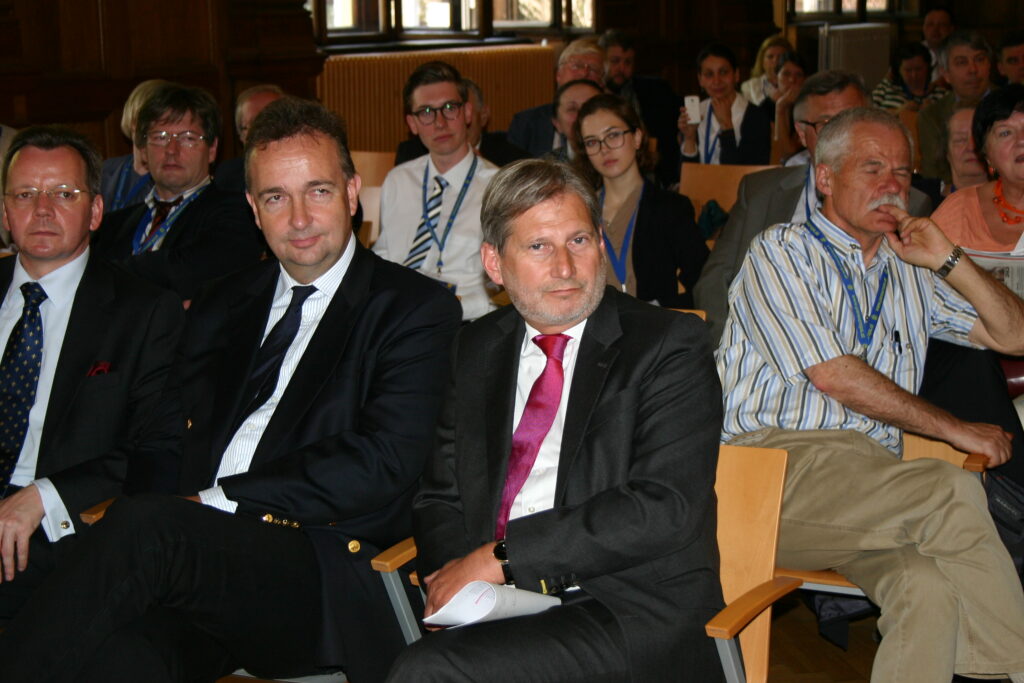
Pan-European Symposium 2015: With Austria’s EU Commissioner Johannes Hahn in Vienna.
How do you judge the EU’s image today?
All too often in recent years, the national level has tended to look for the blame in Brussels for things that are not working well. In this way, a negative campaign against Europe is taking place. Similarly, for some time now, an anti-European campaign by various foreign agents has been observed, masquerading as news magazines and deliberately stirring up sentiment in Europe with half-truths and misinformation. We need a European awakening regarding external propaganda. Perhaps it would be good if 3Sat or arte could also broadcast in foreign languages – for example, Ukrainian, Serbian, or Russian. We must not let Europe be talked down as worse than it is – and we should also correct some prejudices in non-EU states about this Europe.
If we still had the monarchy today, you would probably be Emperor. Is that even a desirable office?
If one considers realistically what the function entails, one cannot actually want to have it. Then one can only see it as an obligation that one has towards a country and a people, and view it from the perspective of history and values. Being a monarch is not something one can strive for. My father often said that he would not have been able to carry out most of his activities as a monarch; therefore, he was given the grace of not having to take on the role.
This interview originally appeared in the 1/2018 issue of “Couleur”.



