Macron the European?
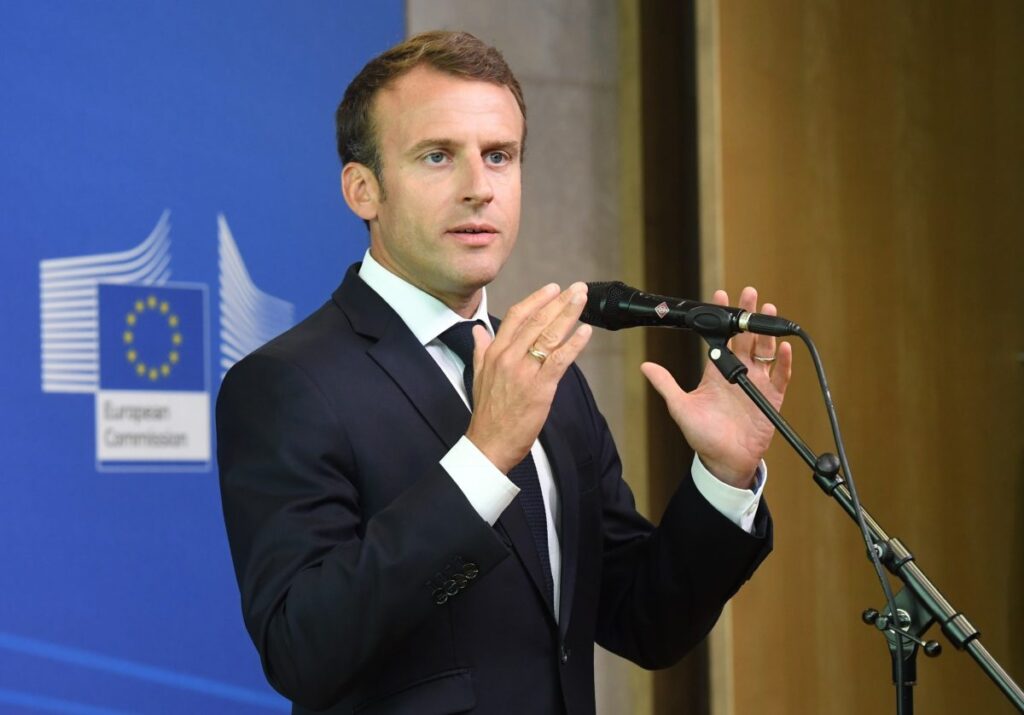
That French President Emmanuel Macron provided positive photo opportunities with the Russian President Vladimir Putin during the Football World Cup is something that must be overlooked, just as it was for the Croatian President Kolinda Grabar-Kitarović. However, his recent statements on EU enlargement cast doubt on his European convictions. A commentary by Rainhard Kloucek, Secretary General of the Paneuropean Movement Austria.
Sporting events cause emotions to run high. This is especially true for the final of a Football World Cup. It is therefore quite understandable when leading political representatives of the countries whose teams are playing in the final use this national emotional high to put themselves in the spotlight. Of course, this is populism, but a politician who wants to be re-elected simply must seize such moments in a mass democracy. The collateral damage – that dictatorships are also cast in a favourable light (as was the case with Putin at the World Cup in his empire) – is part of the calculation.
Less understandable is when Emmanuel Macron, the French President who likes to present himself as a great European, wants to put enlargement policy on ice. He already drew attention with similar remarks at the South East Europe summit in Sofia; during a recent visit to the Serbian President Aleksandar Vučić in Belgrade, he again made it clear that enlargement could only happen if reforms were made first, as the EU is already functioning poorly. What Macron means by reforms is also clear: his own reform proposals should be implemented. These essentially amount to a strong centralisation of the EU: a debt union, a banking union, protectionism, and even a separate budget for the Eurozone – in other words, a split of the EU into a Euro-EU and a non-Euro-EU.
Macron apparently refuses to accept the principle that Paneurope is the whole of Europe, and that every European country has the right to participate in European integration. Yet the countries of South East Europe were promised a clear prospect of accession in Thessaloniki as long as 15 years ago. Since then, people have been very inventive with excuses and blockades.
This has caused considerable domestic political upheaval in the region, but has also opened the gates to non-European influences that certainly cannot (and do not want to) bring the rule of law that is the goal of every EU enlargement.
Vladimir Putin can rejoice at such short-sightedness.
Featured image: French President Emmanuel Macron. © European Union 2018



