A New Compromise
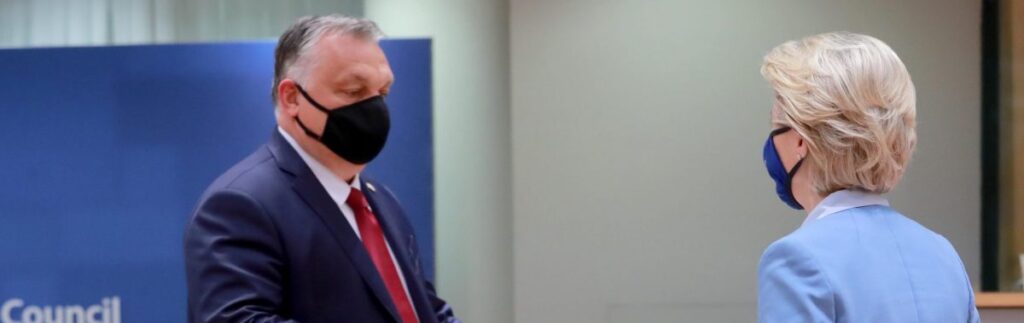
A law protecting the family is allegedly said to violate European values. However, some other European policy ideas from Budapest pose a far greater danger to European unity. A commentary by Rainhard Kloucek.
Hungary is once again in the dock. This time, for a new law intended to protect the family, which, for instance, clearly assigns the sexual education of children to the responsibility of parents. The law is discriminatory and violates the principles of the rule of law, its opponents claim. They have yet to provide any proof. Now, the European Commission has initiated infringement proceedings, which will presumably clarify whether and how European norms are being violated (or not). The story about discrimination, at any rate, cannot be entirely true. The Pride parade in Budapest proceeded without further issues, and same-sex couples can register their partnerships in Hungary.
Why a law protecting the family should constitute a violation of European values remains obscure. After all, the family is the nucleus of society, preceding the state (both historically – families existed before states – and organisationally – the family is not an institution of the nation-state).
Nor is this a conflict between Western and Central Europe, even if some are now hyping it up as a new East-West divide. This narrative is propagated by ideologues who portray themselves as victims of Eastern Europe’s oppression by Western Europe, building a story that they are the only (and last) ones defending Europe’s true values. It is, rather, a conflict between ideologies that ultimately seek to undermine the rule of law and impose their ideological views upon it. The essence of the liberal rule of law is precisely not the state enforcement of a particular vision of happiness and welfare. The task of the liberal rule of law is to guarantee rights and freedom! Just as there are many people in Western Europe who advocate for the (traditional) family and live by this ideal, so too are there representatives of the LGBTIQA movement in Central and Eastern Europe.
It is utterly absurd, however, for the entire debate about Europe, about European values, to be conducted on the basis of sexual preferences. This is a gigantic civilisational regression. Humanity has risen above animalistic drives through its spirit (or was created that way). But perhaps some truly believe that this is how we will banish the threat from Beijing and Moscow, because politicians there might just laugh themselves to death over this absurdity.
Thus, Viktor Orbán will certainly not become a threat to Europe with a law protecting the family. And the more he is criticised for this policy by Ursula von der Leyen, Mark Rutte, or Karoline Edtstadler, the more certain his re-election will be in next year’s Hungarian elections.
Nevertheless, it would be wrong to absolve Viktor Orbán and his party members entirely. For in many respects, the Hungarian government pursues policies that hold enormous explosive potential for European unity. The 7-point plan, advertised in early July in several daily newspapers across various EU countries (in Austria, in “Die Presse”), is one such example. A reduction of European integration to mere intergovernmental cooperation, where everything would be reduced to the lowest common denominator, would undoubtedly be welcomed in Moscow and Beijing. Europe – and with it, those states propagating this regression into nationalism – would, however, be the loser. Without direct elections to the European Parliament, Otto von Habsburg would probably never have become a member of this European popular assembly, from which, incidentally, he achieved a great deal specifically for Hungary.
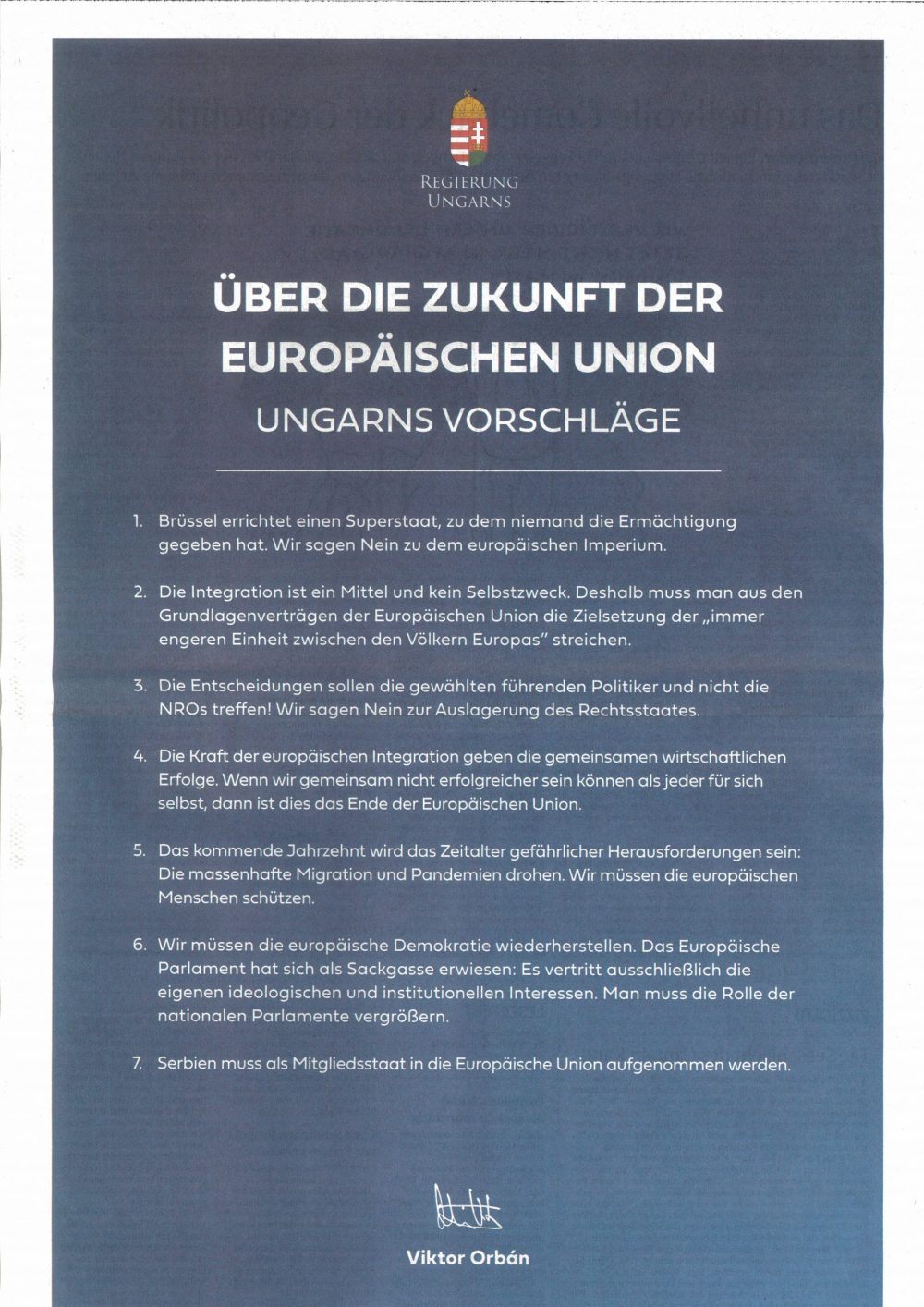
Viktor Orbán’s 7-Point Plan
This raises the fundamental question of what Viktor Orbán truly wants. Well, it is logical that a politician enjoys being in the spotlight and wishes to be a sought-after interview partner. Just as it is logical that he strives for power. Only recently, Viktor Orbán made several statements that clarify his real objective. A Hungarian diplomat serving in Vienna once remarked in a personal conversation that to understand Orbán and his policies, one must look into Hungarian history. Not that of the 20th century, but of the 19th century. This brings us to the Hungarian National Revolution of 1848 and the Austro-Hungarian Compromise of 1867.
In an extensive interview with the Slovak portal Postoj.sk, also available in German on Magyar Nemzet, Orbán interprets the European Union as follows: “Until now, the European Union revolved around a German-French axis, in a bipolar mode of cooperation. What we are now striving for is a Europe that will have a third pole by 2030: Central Europe, meaning the V4.” (V4 stands for the four Visegrad states: Poland, Czech Republic, Hungary, and Slovakia, note.) Apart from the misuse of the term Central Europe here (Central Europe is not a construct of the nation-state; Central Europe was destroyed by the nation-state), the statement (which was also disseminated in Hungarian Embassy press releases on 19 May 2021) shows that Orbán’s thinking is evidently rooted in an old hegemonic political style. In this understanding, he claims a pillar of hegemonic power for himself.
What is being propagated here, then, is the demand for a new Hungarian Compromise. In this specific case, Vienna is no longer the problem, but Brussels. Thus, in the already cited advertisement, Brussels is accused of establishing a superstate without authorisation. “We say no to a European empire,” Orbán has formulated. The fact that “Brussels” can only act with the permission of the member states is conveniently omitted.
It is therefore not a law protecting families that destroys Europe’s identity, but the pursuit of a new Hungarian Compromise that restricts European capacity for action and thus serves non-European powers. The shameful aspect of European politics is that this threat is not addressed by any politician.
c Featured image: EU 2021 Etienne Ansotte



