Geopolitics and Human Rights
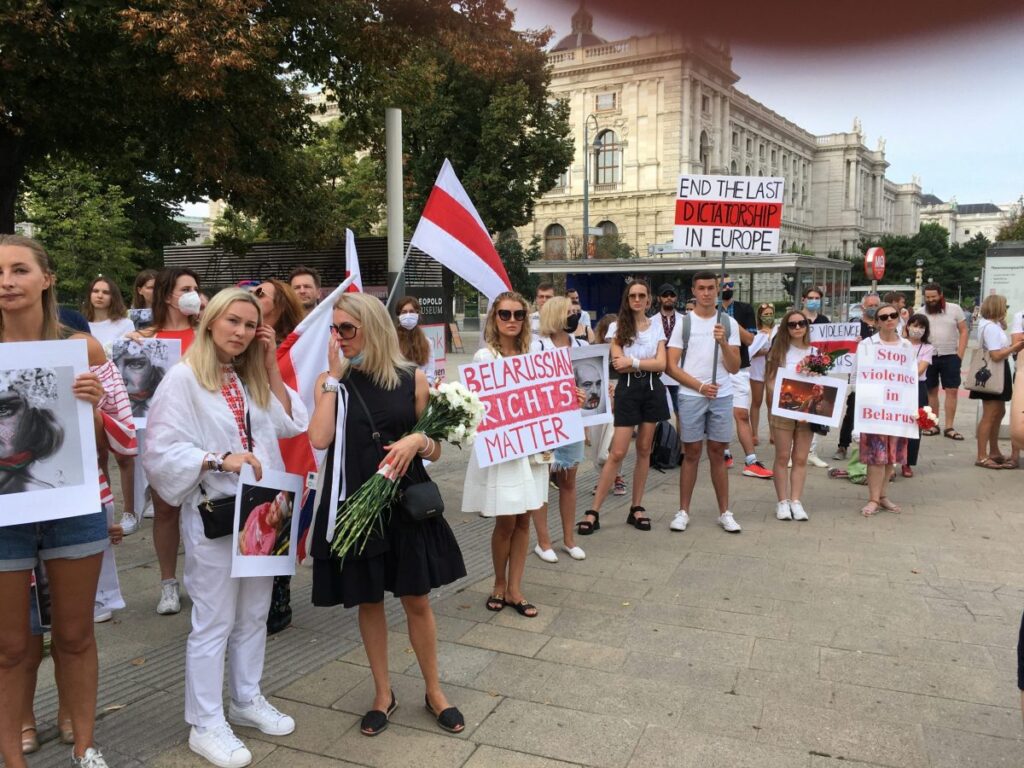
In Belarus, the people are demonstrating against the long-term tyrant Alexander Lukashenko. It is a struggle for freedom, democracy, and human rights. But it is also about geopolitics. A commentary by Karl von Habsburg
Massive electoral fraud in Belarus has incensed the country’s citizens against the long-term ruler Alexander Lukashenko. The dictator, whose regime does not shrink from murder, is a relic of the Soviet era. His days are surely numbered. The question is how his removal will take place.
The great neighbour to the east, Russia, which views Belarus as part of its sphere of influence, will play a major role. Putin cannot afford to act as he did in Ukraine. To do so would be to lose Belarus and its population. For them, the question of relations with Russia currently plays almost no role. This is one of the major differences from the Revolution of Dignity in Ukraine, where European orientation was a significant factor. The decisive point for Belarus is the withdrawal of Lukashenko.
The Russian FSB (the successor to the Soviet KGB) still has enough influence over the Belarusian KGB (which still bears that name) to organise an internal systemic replacement of Lukashenko. Whether this will satisfy the country’s citizens is, however, doubtful. They want to break free from the old Soviet system, which Lukashenko represents just as much as Putin.
The long-serving Russian Foreign Minister Sergey Lavrov has pointed out in this context that Belarus is a geopolitical issue. The President of the European Council responded that this is not about geopolitics, but about human rights.
Of course it is about human rights and civil liberties. But it is equally about geopolitics. Lavrov’s statement alone is clear proof that for Moscow, human rights do not play the slightest role; instead, Russia’s geopolitical interests are paramount. Moscow wants to maintain, and indeed expand, its sphere of influence. Accordingly, disinformation campaigns are being spread across Europe by trolls of all kinds. The pattern is the same as with the Euromaidan: fascists are attempting to seize power in Minsk, the USA is supposedly organising a coup, and NATO wants to invade.
The EU spent a long time trying to build a relaxed relationship with Belarus and Lukashenko. This policy has failed. Lukashenko himself destroyed it. Now, the task is to provide the pro-democracy movement with a perspective.
The article originally appeared on the website of Karl von Habsburg.



