The Picnic Has a Message
To mark the anniversary of the Pan-European Picnic of 19 August 1989, the Paneuropa Movement organised an online discussion with Walburga Habsburg Douglas, Vice President of the Paneuropean Union. At the time, she represented her father Otto von Habsburg, one of the picnic’s two patrons.
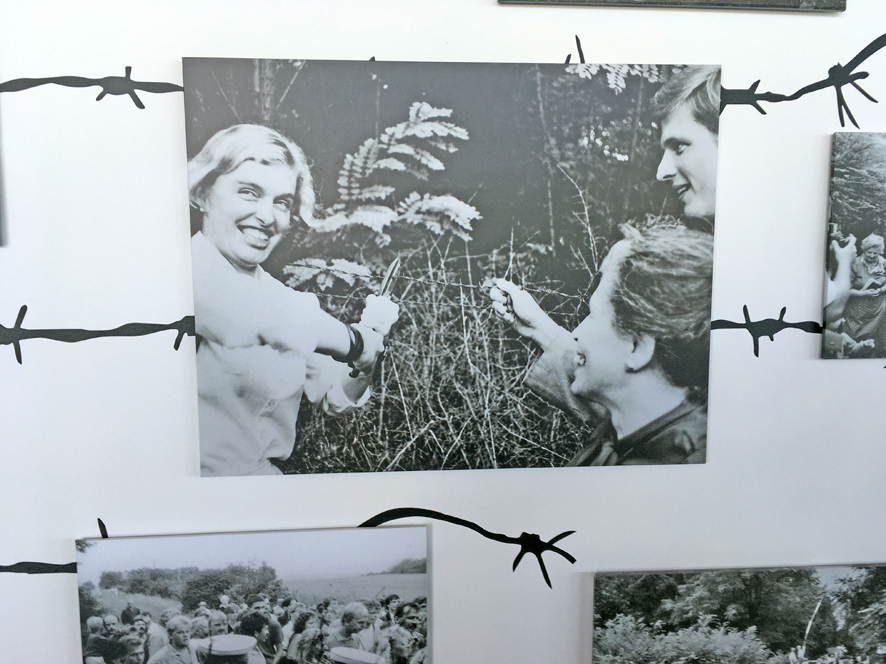
The “Pan-European Picnic” on 19 August 1989 at the Austro-Hungarian border, on the old road from St. Margarethen to Sopron (Ödenburg), was a historic event. Historic, on the one hand, because it is part of history, but also historic because it decisively changed the course of European history. Within the framework of this event, which was originally intended to allow Austrians to attend a gathering on the Hungarian side without further restrictions, the first mass exodus from the then-existing Eastern Bloc occurred. These were citizens of the so-called GDR who had learned of the event through leaflets and word of mouth. They were able to travel to Hungary for holidays without major problems. Hungary had already begun to dismantle the Iron Curtain because the installations were defective. Thanks to socialist policy, the funds for a reconstruction were non-existent. Added to this was the image of the fence being cut by the two foreign ministers, Alois Mock (Austria) and Gyula Horn (Hungary). This news had spread as far as East Germany. It nourished the hope of an escape to freedom via the holiday destination of Hungary. 661 citizens of the so-called GDR managed to find their way to freedom that day. The border was closed once more afterwards, until it was finally opened on 10 September 1989. It was not until 31 years later that the Corona pandemic led to a renewed border closure.
The Paneuropa Movement Austria was represented at the time by its former President, Vinzenz von Liechtenstein, and the then regional chairman of the Paneuropa Movement Lower Austria, Klaus Lange. Otto von Habsburg was a patron of the picnic together with the Hungarian Minister of State, Imre Pozsgay. However, neither attended the event in person, sending representatives instead.
Under the leadership of the European Order of the Knights of Wine, Ordo Equestris Vini Europae, the Paneuropa Movement Austria commemorates this historic event every year on 19 August. This year, the day of remembrance was enriched by a ceremony at the Europe Table in front of the Landhaus in Eisenstadt. The event normally takes place on Europe Day, 9 May, but had to be postponed this year due to Corona restrictions. During the ceremony, the two envoys Silvio Kus and Rudolph Rainer from the Croatian and German embassies (Croatia held the EU Council Presidency in the first half of 2020, Germany in the second half) emphasised the importance of the European integration process, especially in light of challenges such as the 2020 pandemic. Alfred Tombor-Tintera, Consul Primus of the Knights of Wine, recalled the task of the state—in reference to Paneuropa founder Richard Coudenhove-Kalergi—to serve the people and promote their freedom.
The Picnic’s Message Also Applies to Belarus
At the subsequent Paneuropa Wine Picnic, speakers included representatives of the Order of the Knights of Wine, the Vice-Chancellor of the Order of St. George, Peter Harold, and Rudolf Strommer from the Europaforum Burgenland. Rainhard Kloucek, Secretary General of the Paneuropa Movement Austria, referred to the message that Walburga Habsburg Douglas had delivered for her father Otto von Habsburg at the time, and now, 31 years later, read out a message from the Vice President of the Paneuropean Union, which she had formulated two days earlier regarding the events in Belarus:
“Even the founder of the Paneuropean Union, Richard Coudenhove-Kalergi, noted that freedom defines Europe’s identity. This freedom must be fought for time and again; it does not come of its own accord. This is what the citizens of Belarus are currently doing. We must be grateful to them for this, because the freedom being fought for by the citizens in Belarus also has an impact on our freedom. Our task is to support the Belarusians in this struggle for freedom and democracy wherever we can. In a few days, we will mark the 31st anniversary of the Pan-European Picnic, which heralded the beginning of the end of the Iron Curtain. With Lukashenko, a man of the old Soviet apparatus, a ‘homo sovieticus’, a man of the Iron Curtain, still rules in Belarus. The citizens of Belarus are currently in the process of removing the final part of this Iron Curtain.”
In an online discussion involving figures from several European countries and Japan, three representatives of the Paneuropa Youth then conducted an interview with the Vice President of the Paneuropean Union. Raphael Stangl from Paneuropa Youth Austria, Iryna Prodan from Ukraine, and Fernando Garcia focused their questions on the history of the picnic on the one hand, and on the message of the event, which remains valid today, on the other.
For the Paneuropean Union, overcoming the Iron Curtain was a clearly defined goal. “It was clear that the Iron Curtain was not built for eternity,” formulated Walburga Habsburg Douglas. Personally, the Habsburg family was frequently at the border, as Regina von Habsburg came from that part of Germany which later became the Soviet-occupied zone. During the preparations for the picnic 31 years ago, it was naturally not clear what would happen. There was no information on how Hungary’s socialist “brother countries” would react. But the picnic was officially authorised. On the day before the picnic, Walburga had spoken on the phone with her father, who advised: “Don’t do anything I wouldn’t do”—a clear: be careful. When more and more people who spoke German, and thus obviously came from the GDR, arrived at the border from the Hungarian side (there were already refugee camps for GDR citizens in Hungary at the time), it was clear that “something big is going to happen”, recalls the current Vice President of the Paneuropean Union.
For Paneuropa, it is also a Question of Values
Asked how she assessed the development of today’s EU, she replied that she was naturally not happy with everything happening in politics today. As a negative example, she cited the United Kingdom’s withdrawal. Even then, after the fall of the Iron Curtain, some had suggested that the Paneuropean Union was perhaps no longer needed. But for Paneuropa, it is not just about the geographical dimension of Europe, but also about its substance. Paneuropa stands for a clear concept of values.
Totalitarianism and nationalism do not disappear either, as current developments show. These evils must be fought time and again. Linked to the Pan-European Picnic was the clear message of freedom (Otto von Habsburg spoke in his message at the time of the “dawn of freedom”), as Walburga Habsburg Douglas emphasised. And she expressed her hope that the demonstrations in Belarus would lead to an end to the rule of Alexander Lukashenko. Just as at the picnic back then, the citizens of Belarus are now showing that they are no longer afraid.



