Belarus at a Turning Point
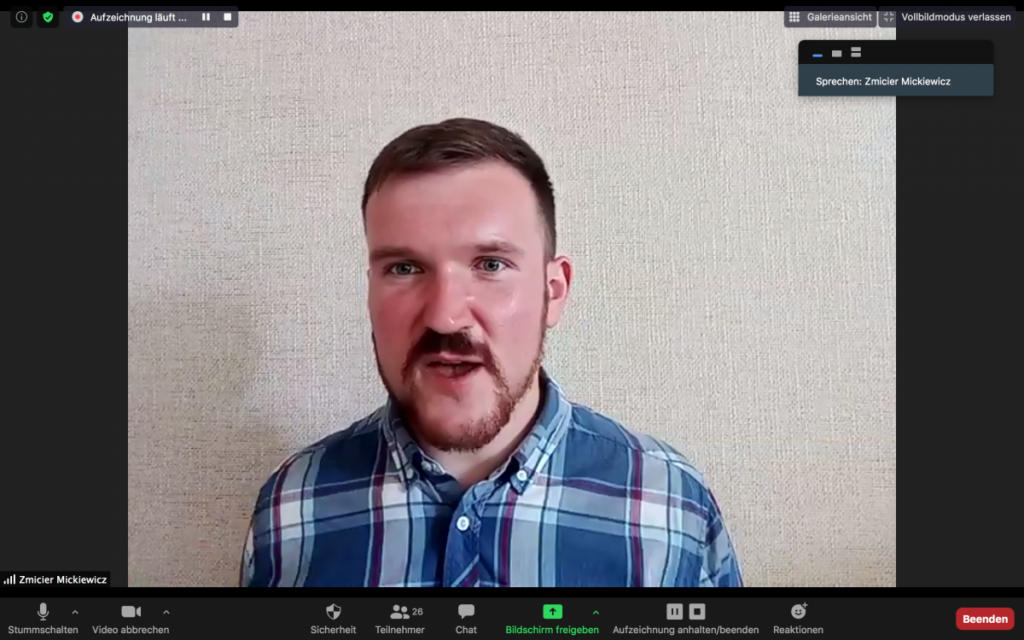
The political developments in Belarus, which has been dictatorially ruled by Alexander Lukashenko for a quarter of a century, were the focus of an online Paneuropa event.
Alexander Lukashenko has ruled Belarus for more than a quarter of a century. And with an iron fist. His rule is often referred to as Europe’s last dictatorship. Yet, in his first election in 1994, Lukashenko managed to present himself as a reformer. This was despite having a very typical Soviet career behind him. In 1991, he was the only deputy in the (Soviet) parliament in Minsk to vote against the dissolution of the Soviet Union. Later, he initiated a union with Russia, even seeing himself as the president of this union. That was until Vladimir Putin came to power in Moscow, and Lukashenko had to realise that he, not Putin, would not be the head of such a union. This led him to attempt to give his regime a Western orientation, thereby keeping Moscow at arm’s length. A strategy that showed some success, but which he himself ended, at the latest, with the presidential election in August 2020.
While Lukashenko had an easy ride in previous elections, either because his opponents were too weak or he could neutralise or compromise them in time, this time it was clear he could not win the election. Although he imprisoned his opponents, he faced a challenger in Sviatlana Tsikhanouskaya, whom he underestimated. The wife of an imprisoned regime opponent, who was not permitted to run as a candidate, ran herself. The regime declared a Lukashenko victory. Since then, the citizens of Belarus have been protesting against the obvious and massive electoral fraud. Tsikhanouskaya was forced to flee to Lithuania.
Together with the Paneuropa Union Ukraine – and with the assistance of the Paneuropa organisations Spain and Sweden – the Paneuropa Movement Austria organised an online discussion on the situation in Belarus. Zmicier Mickiewicz from the Belarus Security Blog formulated the three central demands of the democracy movement:
The Opposition’s Demands
New elections without Lukashenko, with international observation.
Release of all political prisoners.
Return to the 1994 Constitution.
According to Mickiewicz, the problem for the democracy movement is the lack of identifiable leaders. The known opposition leaders are all outside the country. A return would be possible, but the state authorities would permanently control them. Sviatlana Tsikhanouskaya proposed creating a committee of experts to take over government affairs and organise the transition after Lukashenko’s inevitable departure.
Yet, the regime is not thinking of giving up. The police units are acting with extreme brutality. People are indiscriminately beaten and imprisoned, where some are further tortured. Mickiewicz reports on a colleague who was not even at a demonstration, yet was beaten and imprisoned by the police.
The Population Takes Responsibility
But violence is not the only tactic; the regime also tries to create chaos. For instance, a demonstration with approximately 300,000 participants took place in the capital, Minsk. Traffic continued normally on the wide streets. Then the regime switched off the traffic lights. The apparent goal was to provoke a traffic collapse. But the people knew how to help themselves. They selected individuals from their midst to direct traffic. It worked. Zmicier Mickiewicz also reported that the city was clean after the rally, even in the squares where hundreds of thousands of people had gathered. They simply collected the rubbish themselves. The citizens are capable of self-organisation.
Lukashenko has lost the support of the population. Zmicier Mickiewicz reports that at the time when 300,000 people in Minsk alone were protesting against Lukashenko, the regime tried to organise its own rally. Sympathisers were to be brought to the capital by bus from all over the country. But numerous demonstrators disappeared on the way there. They asked for a stop to relieve themselves. And so, they vanished from the buses.
In addition, there are strikes in the large and systemically important state-owned enterprises. This harms the economy. Mickiewicz expects a veritable economic crisis by winter at the latest, and he fears Lukashenko could turn Belarus into the Venezuela of Central Europe.
How is Moscow Reacting?
Apart from the internal developments in Belarus, the question of how Russia will react also arises. Zmicier Mickiewicz does not foresee support from Moscow for Lukashenko. That would not even be sensible. Lukashenko is a negative figure in his homeland. Any support for him would cost the supporter sympathy. A military option, as in Ukraine, would be expensive for Moscow. With the intervention in Crimea, Moscow definitively lost Ukraine, according to Zmicier Mickiewicz. And this was despite Ukraine and Russia being much more closely linked at the time than Belarus and Russia are now. For Moscow, the best option now would simply be to wait and see.
Finally, the question was discussed as to what, after 25 years of patience with Lukashenko, had finally broken the citizens’ patience. For Zmicier Mickiewicz, the coronavirus also played a role here. The regime tried to downplay and ignore the danger. Mickiewicz reports on the case of his mother, who was very ill. Only when she threatened that her son, the journalist, would write about the conditions in the hospital was she tested. With this, the regime had broken the unwritten agreement of 1994: no participation, but a chance for material prosperity. With its reaction to the pandemic, the regime clearly showed that the citizens were completely irrelevant.
Mickiewicz advocated for targeted sanctions against representatives of the regime. For the regime’s representatives certainly appreciate the Western lifestyle they deny their citizens, and would gladly take holidays in Western countries and enjoy the amenities offered there. Travel bans would hit them hard. Such sanctions should target not only Lukashenko and his government, but also the electoral authorities responsible for the massive manipulations, the OMON troops, and the police responsible for the brutal beatings.
Clear Statement from Paneuropa
Walburga Habsburg Douglas, Vice-President of the Paneuropa Union, used the discussion to make a clear statement on the events in Belarus: “The founder of the Paneuropa Union, Richard Coudenhove-Kalergi, already stated that freedom shapes Europe’s identity. This freedom must be fought for again and again; it does not come by itself. The citizens of Belarus are doing that right now. For this, we must be grateful to them, because the freedom being fought for by the citizens in Belarus also affects our freedom. Our task is to support the Belarusians in this struggle for freedom and democracy wherever we can. In a few days, we will commemorate the 31st anniversary of the Pan-European Picnic, which heralded the beginning of the end of the Iron Curtain. With Lukashenko, Belarus is still ruled by a man of the old Soviet apparatus, a ‘homo sovieticus’, a man of the Iron Curtain. The citizens of Belarus are currently in the process of removing the last part of this Iron Curtain.”



