Corona, Europe and Disinformation
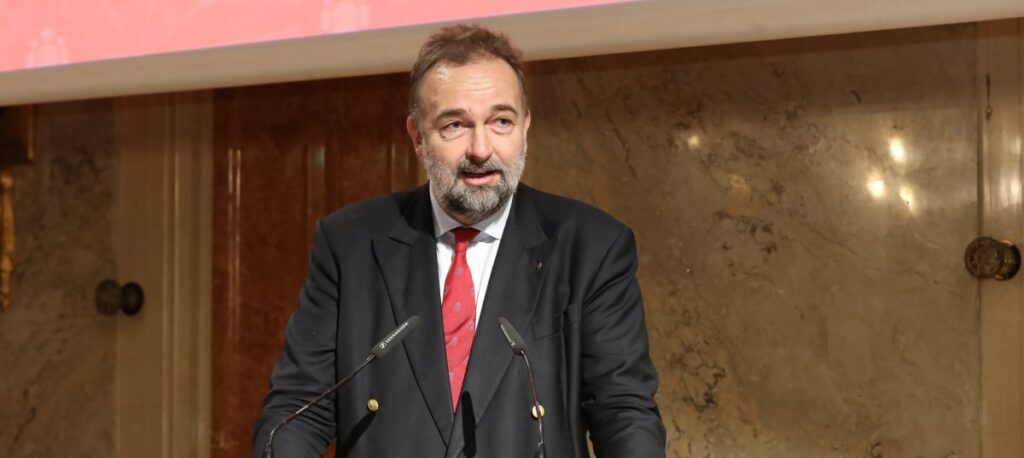
In an interview with the Ukrainian news agency Ukrinform (conducted by Austria correspondent Wasyl Korotkyi), Karl von Habsburg, President of the Paneuropean Movement Austria, comments on the coronavirus pandemic, the changing world order, and Russia as the grandmaster of disinformation. He unequivocally rejects resurgent nationalist populism. You can read the interview in Ukrainian here. The German version follows below.
Dear Mr Karl von Habsburg, first and foremost, congratulations on your recovery from COVID-19 and we wish you continued good health! How did the treatment proceed? How did you react when you learned about the illness? Were you concerned for your life?
Karl von Habsburg: Thankfully, the illness was very mild for me. That is to say, I had a slight fever and a bit of a cough. I was not concerned for my life. And there was no treatment either. I just stayed at home. After about a week, the fever was gone, so I was tested again, and the test was then negative.
Many people still do not take the COVID-19 pandemic seriously and believe they will not be affected. Or, if they do get infected, their healthy body will overcome this ‘flu’. What would you say to these people?
Karl von Habsburg: I myself am a poor example of the seriousness of the situation, because for me it was truly nothing more than a mild flu. However, at the meeting where I became infected, there was also another person who then spent two weeks in hospital with serious pneumonia. The insidious thing about this virus is that most cases are relatively mild. But where the virus truly strikes, it becomes dangerous. If someone is negligent with their own health, one might say: well, everyone is the architect of their own fortune. But here, it is about the lives and health of other people, because this virus is highly contagious. We must demand that level of responsibility from every individual!
COVID-19 has paralysed social and economic life across the globe, and it is still difficult to predict the consequences of this ‘paralysis’. Will the world be different after the coronavirus pandemic? Will the coronavirus crisis lead to a new international order?
Karl von Habsburg: The course of the pandemic has shown that the international order is already undergoing significant change. Just five years ago, the USA would most likely have taken initial steps last year, when the first cases from China became known, to prevent a pandemic. In reality, however, the leading world power this time said it had nothing to do with them. Perhaps President Trump genuinely believed that. What the world will look like after COVID-19, I cannot predict. It will depend, among other things, on how long this crisis lasts. What I can say with certainty is that national debt will increase dramatically. That will be a burden for the next generation.
Should we expect a strengthening of global governance (leadership), or will nationalist sentiment be strengthened instead, leading countries to become more insular?
Karl von Habsburg: Neither. I do not believe in the idea of a global government. There are such things as world powers, i.e., countries that can indeed operate globally. The USA is an example, but it does not govern the world, nor will it. Russia wants to be a world power, but will face economic problems with a collapsed oil price. China is attempting to assert global leadership, partly through the ‘New Silk Road’. The nationalist currents in Europe, which dream of a return to the nation-state of the 1950s, are on the wrong track. That must be stated clearly. We see that the importance of regional alliances in Asia and Africa, some of which take the EU as a model, will increase, which is sensible given the challenges. If one wishes to act within national confines in Europe, that is like shooting oneself in the foot.
What are the implications for the European project and further European integration? Will the European Union be more unified and united, or will it lose its appeal, with national interests taking precedence over European ones?
The Contradiction of Nationalist Populists
Karl von Habsburg: It is precisely on this issue that we see the contradiction of nationalist populists. On the one hand, they criticise the EU for not acting in the coronavirus crisis; on the other hand, they constantly criticise EU interference. Health competencies lie with the states, so ‘the EU’ cannot act. However, where it does have competencies, such as coordination, the Commission acted, and faster than the member states. It is understandable that in a crisis one might retreat into the deceptive security of the nation-state. However, upon a rational assessment of the situation, we will very quickly realise that this is a deceptive security. The economy, which is the foundation of our lives, is so interconnected that we can see, just from the issue of harvest workers, many of whom also come from Ukraine, or the issue of care workers, that we cannot seal off borders. Our prosperity, and only a wealthy society can afford a high-quality healthcare system, is based on an economy with a division of labour. This is the materialistic reason for the importance of European unification. But there is also the security policy and foreign policy aspect. As small nation-states, we become pawns of other powers. The European Union should not become something like a nation-state. However, it should be clear to everyone that, for example, in foreign policy, we as the EU can act more strongly than individual countries.
The measures imposed due to the pandemic have drastically restricted freedom of movement. What will happen to the Schengen Area? Will it be possible for Europeans to move freely as they could before the crisis, or can that be forgotten?
The Four Freedoms Have Brought Us Many Advantages
Karl von Habsburg: I reiterate this constantly: freedom of travel within Europe, which the Schengen Agreement brought us, is one of the great and important achievements of European unification. The four fundamental freedoms have brought us all many advantages. We only need to think of the hours-long waiting times that have occurred due to border closures. Firstly, no reasonable person can aim for that; secondly, no reasonable person can believe that is good. It is bad enough that we have these hours-long waiting times at the external Schengen borders. Ukrainians can tell you a thing or two about that. What we need is reasonable and effective protection of external borders to control migration movements, but within Europe, open borders must be the goal. Checks, for example on suspicious vehicles, can also be carried out within a country; there is no need to create traffic jams for that. I do hope that reason will prevail on this issue.
Due to the coronavirus crisis, the IMF expects the worst economic crisis since the Great Depression, and it is possible that not all governments will manage this crisis well. Could this lead to changes in government, or even changes in political regimes in individual countries?
Karl von Habsburg: Many of the economic impacts cannot yet be assessed. For example, I keep asking myself what consequences the sharply fallen oil price will have. But I do not know the answer. What I do know is that every crisis is also an opportunity. The period after the Second World War is a good example, showing the impact of political principles. Many countries were destroyed. In Germany and Austria, the so-called economic miracle occurred, bringing both countries an upswing from the 1950s onwards. In Germany, this was Ludwig Erhard’s policy; in Austria, it became known as the Raab-Kamitz course. The foundation was economic freedom. This will also be the decisive question now. Do we fall back into state-controlled economic concepts that perhaps serve some oligarchs, or do we take Ludwig Erhard as an example, whose policy enabled a broad middle class to rise? This, incidentally, is also the best recipe for stable democratic systems, because this policy is based on subsidiarity and the rule of law. In such a system, a change of government does not worry me. It only becomes dangerous if a populist race ensues.
As is known, declining incomes and rising inequalities can lead to a further strengthening of populist parties. Does this mean that a ‘golden era’ for populists in the world and in Europe could be approaching?
Karl von Habsburg: The danger certainly exists. The great talent of populists lies in putting their finger on the wounds of society and politics. However, they cannot offer solutions, only pseudo-solutions. Reasonable people should therefore always be sceptical when politicians claim to offer solutions for everything. That does not work, because we humans were created by God as free individuals. Therefore, it is not the task of politics to regulate everything for us, but to create a framework in which we can act in freedom and security.
Russia actively supports European right-wing and populist movements, thereby creating a network of Kremlin allies in Europe to break EU unity. Now Moscow has provided aid to Italy, which has been particularly affected by the coronavirus, resembling more of a PR campaign: the EU abandoned Italy, and only the Russians came to the rescue. How do you see Moscow’s role in Europe after the crisis and the relations between the EU and Russia?
Russia Wants to Divide Europe
Karl von Habsburg: ‘From Russia with love’ was written on the Russian lorries that drove through half of Italy. Russia is a master of disinformation. And this example wonderfully illustrates how disinformation works. The EU had already proposed a common approach at the beginning of February. The states believed they had everything under control. Especially in Lombardy, the region of Italy – a wealthy region at that – which was so hard hit, regional politicians had even dismissed healthcare workers for wearing masks. Masks would create panic, was the justification for the dismissals. Then the virus began its triumphant march, and suddenly all countries realised there was a shortage of protective equipment. Of course, the EU could not send aid deliveries. It has no competence in health policy; the coordinated approach had been rejected by the countries. In this situation, Russia sends a CBRN defence unit from its military. That looks far more martial than protective masks in hospitals. But this is a unit designed for a battlefield, not for a pandemic. The images of the lorries and the message ‘Russia helps Italy’ spread through all media. And slowly, voices emerge noting that Russia delivered hardly anything useful. But Moscow had landed its PR coup. I myself, and my colleagues, have repeatedly dealt with people who fell for this story. As soon as facts were presented, their neat narrative collapsed. Russia is seeking its role in world politics. Moscow has no interest in a united Europe. A united Europe disrupts Russian power politics, which relies on weakening the policies of its political competitors on the political stage by dividing them. Tensions will increase, or Europe will allow itself to be divided, in which case we will become insignificant.
At the same time, the Russian Federation is trying to use the current crisis to lift the sanctions imposed on it for aggression against Ukraine and the occupation of Crimea. The Russian side has already made repeated statements to this effect. Can it succeed? How should European capitals react?
Karl von Habsburg: Moscow is acting very cleverly here, and is not only relying on the so-called right-wing. In the entire propaganda battle, some of the old communist structures are still in use. We have seen this in Austria, but also in Germany, where Stasi operatives reappear. The problem is that we in Europe think differently from Moscow. Every voice in Europe that advocates for an end to sanctions is proof for Moscow that the conquest is legitimate. This is an incentive to continue the policy of aggression. If Europe gives in here, then we abandon our own principles.
Will the coronavirus crisis have any impact on the prospects of EU enlargement? Ukraine hopes to become part of a large European family. Are the chances now diminishing?
Karl von Habsburg: On this issue, the EU – albeit with some delays – has demonstrated its capacity to act. Accession talks are now set to begin with Albania and Macedonia (now officially North Macedonia). This is good. The countries of Southeast Europe clearly belong to Europe. Ukraine is still far from such a step. It is part of the Neighbourhood Policy, which excludes a membership perspective. That is why we in the Paneuropean Union have clearly stated that we need a change in policy for Ukraine, with a clear membership perspective. The goal here is very clear, but the path is certainly still very stony.
c Featured image: Katharina Schiffl



