The Power of Nuclear Weapons
Russia’s breach of the Budapest Memorandum also impacts the credibility of the Nuclear Non-Proliferation Treaty. An event report by Paneuropa Secretary-General Rainhard Kloucek.
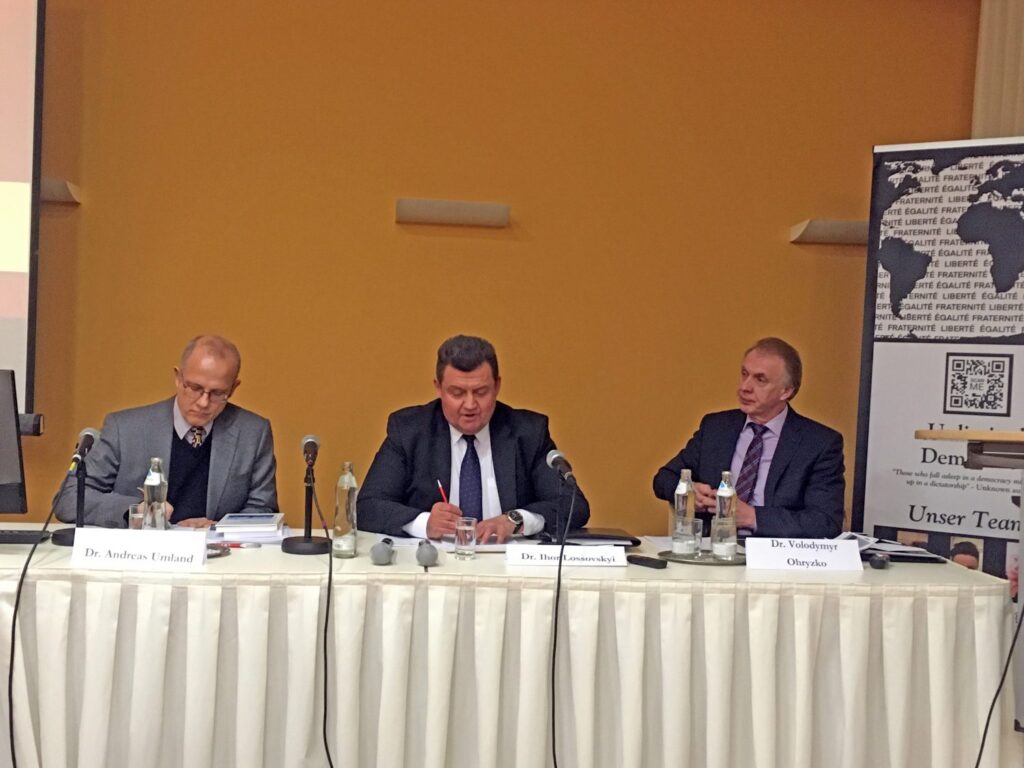
The 25th anniversary of the Budapest Memorandum (signed in December 1994) provided an occasion to evaluate this agreement and its current significance in light of Russia’s aggression against Ukraine. Organised by ‘Unlimited Democracy – Association for the Promotion of Democratisation’, discussions featured Ukraine’s Deputy OSCE Ambassador Igor Lossovskiy, former Ukrainian Foreign Minister and erstwhile Ukrainian Ambassador to Vienna Volodymyr Ohryzko, and Andreas Umland from the Institute for Euro-Atlantic Cooperation.
The Budapest Memorandum was concluded by the USA, Russia, Great Britain, and Ukraine. In exchange for guaranteed borders, Ukraine then relinquished its nuclear weapons. Volodymyr Ohryzko pointed out that, after the collapse of the Soviet Empire, Ukraine was the third-largest nuclear power. The USA and Russia exerted immense pressure on the newly independent Ukraine to destroy its nuclear arsenal. Ukraine sought compensation and, crucially, security guarantees in return. Compensation, Ohryzko stated, was minimal, and the Budapest Memorandum was intended to provide the security guarantee.
In the English text of the Memorandum, Igor Lossovskiy highlighted, the term used is ‘assurance’, which is weaker than a guarantee. However, the Russian and Ukrainian translations both feature the word ‘guarantee’. Russia also claims the Memorandum is invalid because it was not ratified. Yet, as the Deputy OSCE Ambassador pointed out, the treaty clearly stipulates that the Memorandum becomes valid upon signature. Lossovskiy also drew attention to another peculiarity: the medal for Russian soldiers involved in the occupation of Crimea bears the date 20 February 2014.
20 February 2014 and the Medal
Andreas Umland addressed the significance of this date. For this was the bloodiest day of the Revolution of Dignity. Numerous people were executed by snipers. Viktor Yanukovych was still president. He only fled Ukraine a few days later. The annexation of Crimea was thus independent of the fate of Moscow’s ally, Yanukovych.
Umland emphasised another point regarding the Budapest Memorandum and its violation by Russia, which has implications for current politics. The Memorandum was also signed by Great Britain, which was not part of the negotiations. However, Great Britain was one of the co-founders of the Nuclear Non-Proliferation Treaty.
One dimension of the Memorandum was the prevention of further nuclear proliferation. Ukraine surrendered this arsenal. Umland posed the question of whether Moscow would have annexed Crimea if there had been a risk of a devastating attack on Moscow in return. Russia, however, was and remains in possession of nuclear weapons. The West could not – as in the Balkan wars – intervene and repel the aggression. Moscow was thus able to expand its territory due to its possession of nuclear weapons. This, Andreas Umland argued, turned the logic of the Nuclear Non-Proliferation Treaty on its head.
The featured image shows the three speakers at the Unlimited Democracy event. From left: Dr. Andreas Umland from the Institute for Euro-Atlantic Cooperation, Ukraine’s Deputy OSCE Ambassador Dr. Igor Lossovskiy, and former Ukrainian Foreign Minister and erstwhile Ukrainian Ambassador to Vienna Volodymyr Ohryzko.



