The Dawn of Freedom
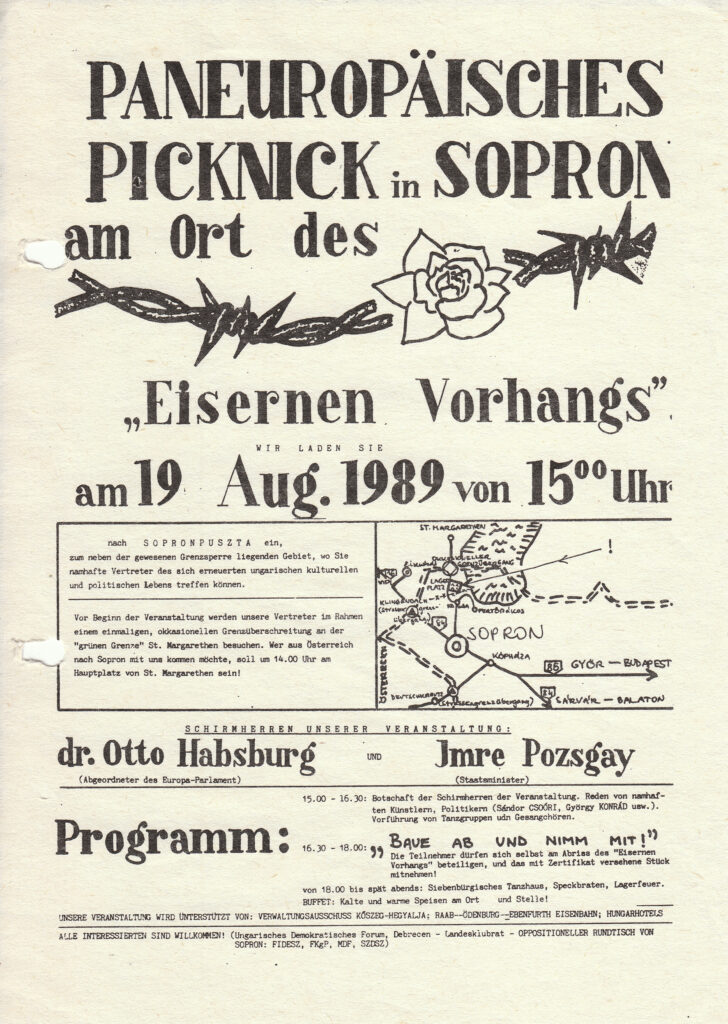
The Pan-European Picnic of 19 August 1989 was an event of world-historical significance. Its messages from back then remain just as relevant today. An assessment by Rainhard Kloucek
“Pan-Europe is the whole of Europe”. For this clear statement, representatives of the Pan-European Movement were repeatedly dismissed by many proponents of realpolitik as revanchists, cold warriors, and yesterday’s men. What is almost taken for granted today—that one can cross the borders to Hungary, Czechia, Slovakia, or Slovenia almost entirely without problems or checks—was, 30 years ago, merely the political pipe dream of these very “revanchists”. NATO in the West, the Warsaw Pact in the East, and a few neutrals in between: that was the “order” of a divided Europe born from the Yalta Agreement. Shots were fired at the Berlin Wall just as they were at other parts of the Iron Curtain. Nevertheless, people repeatedly attempted to flee the “socialist paradise”. On 19 August 1989, at the Pan-European Picnic, the mass escape finally succeeded; the Iron Curtain crumbled, the Berlin Wall was overcome, and the henchmen of Soviet communism in Central Europe largely became history.
Poland and Hungary were undoubtedly the pioneers of this development. Western governments—with the exception of a few representatives—can hardly be credited here. When workers in Poland began deserting the communist trade unions in the early 1980s, and the Solidarność trade union movement under Lech Wałęsa began demanding a peaceful transfer of power, the Austrian Trade Union Federation (ÖGB) clung to its contacts with the communist state union and failed to establish any links with Solidarność. By 4 June 1989, the first “free” elections were already held in Poland. Solidarność captured 99 out of 100 Senate seats and all 160 freely electable seats in the Sejm, the Polish parliament. The communists had reserved 300 seats for themselves in the preceding negotiations. Two months later, the country had a non-communist Prime Minister in Tadeusz Mazowiecki.
In Hungary, a secret decision had been made years earlier to draft new laws in a way that made them compatible with the regulations of the then EC. In 1989, the Magyars began the gradual dismantling of the Iron Curtain. On 27 June 1989, the well-known photo opportunity took place at the Austro-Hungarian border, where the two foreign ministers, Gyula Horn (Hungary) and Alois Mock (Austria), cut through a section of barbed wire. The image went around the world. The first visible hole had appeared, and many a holidaymaker from the socialist “brother countries” took advantage of this gap to cross over into freedom.
27 and 28 June 1989
However, 27 June 1989 is also a symbol of how closely positive and negative historical events can lie together. On the following day, St Vitus’ Day 1989, the Serbian tyrant Slobodan Milošević delivered his now-famous speech at Gazimestan. It marked the beginning of a decade-long war in South-Eastern Europe that brought death, genocide, displacement, rape, and misery, yet failed to break the will for freedom of the region’s peoples.
As early as 1987, as Hungarian Major General János Székely reported at an event marking the tenth anniversary of the Pan-European Picnic in Sopron, the border guard—of which he was the head—had prepared a proposal for the government recommending the dismantling of the electronic border security. The systems were partially broken and reacted to wind, weather, and birds, leading soldiers to switch off alarms—usually without checking. In Moscow, Mikhail Gorbachev was in power. He had promised the Hungarian Prime Minister Miklós Németh not to repeat the “sin of 1956”.
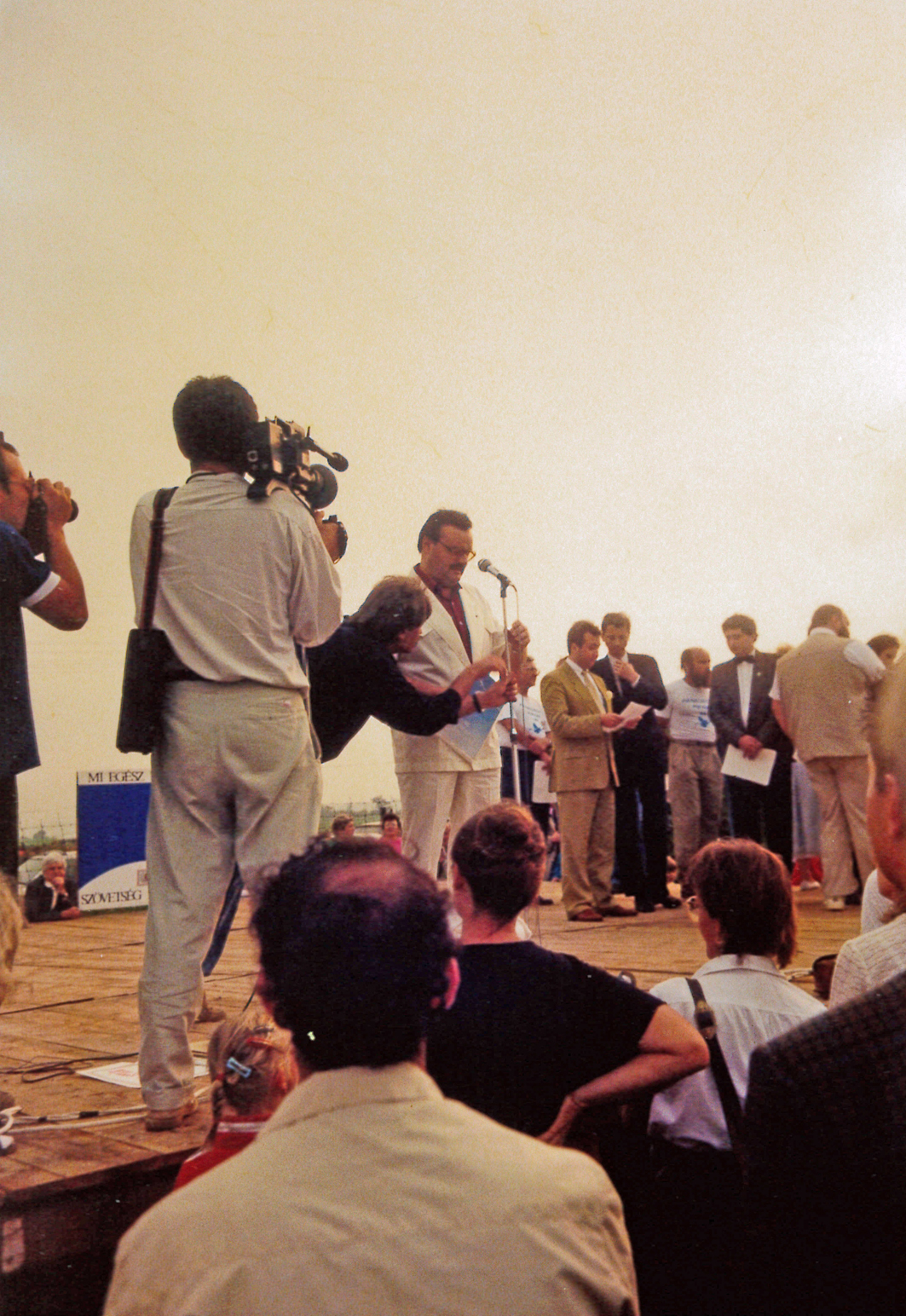
To the right of the man at the microphone in the light suit stands Klaus Lange, then regional chairman of the Pan-European Movement of Lower Austria; to his right is Vinzenz Liechtenstein, who was chairman of the Pan-European Movement Austria until 1987 and later a member of the National Council and Federal Council. Both delivered speeches at the event. To their right, wearing a bow tie, is László Nagy from the then Hungarian Democratic Forum in Sopron, one of the organisers of the picnic.
On the other side was US President Ronald Reagan, who not only called upon the General Secretary of the CPSU, Mikhail Gorbachev, to tear down the Iron Curtain—most notably in a brilliant speech at the Brandenburg Gate during a visit to Berlin in 1987—but also forced the USSR into economic bankruptcy through his armament policy. We must certainly not forget the now-canonised Pope John Paul II, who not only hailed from a communist country but, like few popes before him, championed the overcoming of Europe’s division, telling the people clearly during his visit to Poland that they should have no fear.
On 19 August, on the eve of the Hungarian national holiday, that Pan-European policy which refused to ever accept the division of the continent was to be put into practice, at least for a short time. At a Pan-European Picnic on the border, citizens of both countries could experience for once what it would be like without the Iron Curtain.
Hungarian Minister of State Imre Pozsgay and Otto von Habsburg, then President of the Pan-European Union and Member of the European Parliament, had assumed patronage. Both decided not to attend the event themselves. Otto von Habsburg sent his daughter Walburga. Pozsgay sent his aide László Vass. The official reason why both patrons did not come to the picnic was that they did not want to further inflame the delicate political situation or provoke Moscow through the presence of two such well-known and prominent figures.
For Otto von Habsburg, there was another motive entirely for staying away. During his previous visits to Hungary, he had seen the sometimes nostalgic crowds his presence attracted. He would have been the centre of attention. He wanted to avoid this; for him, it was about the message of this “Pan-European Picnic”.
Dismantle and take with you
“Dismantle and take with you!” So read the flyer for the picnic. “Participants may take part in the demolition of the Iron Curtain themselves and take home a piece provided with a certificate!” No one had come for the certificate. It was about freedom.
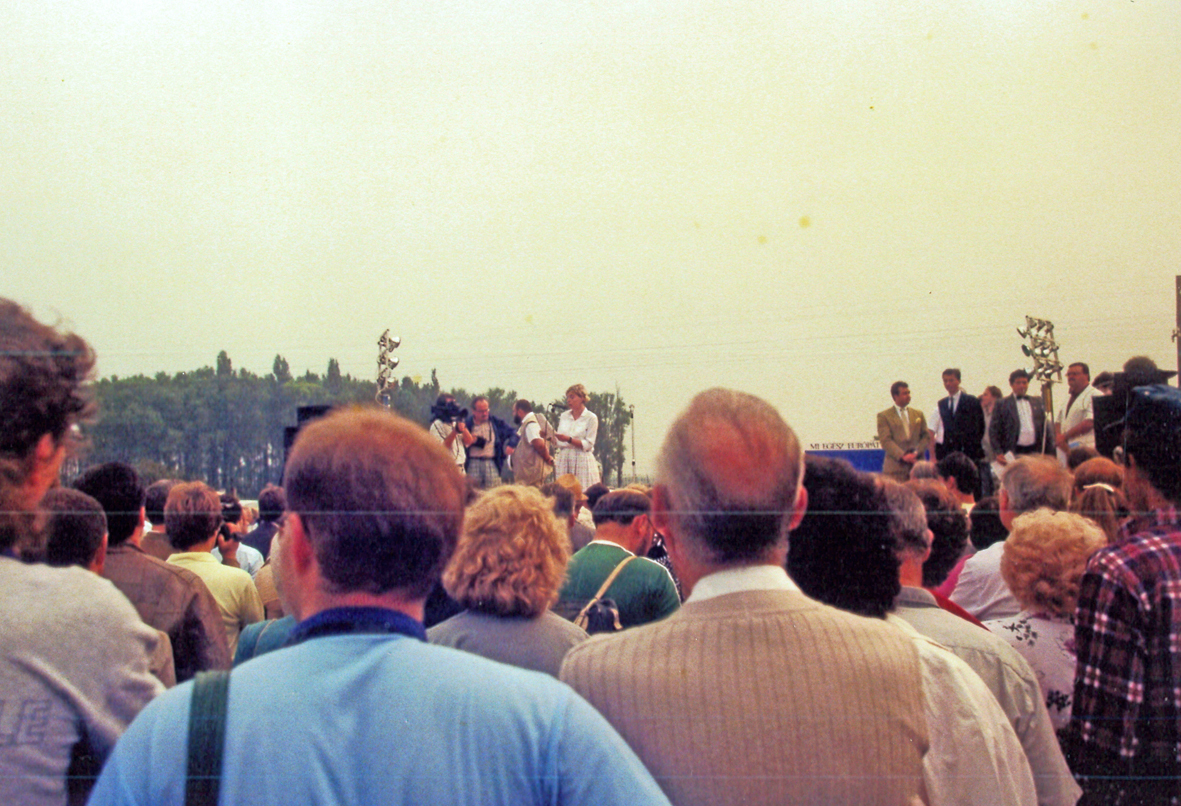
Walburga Habsburg Douglas delivered the greeting from her father, Otto von Habsburg.
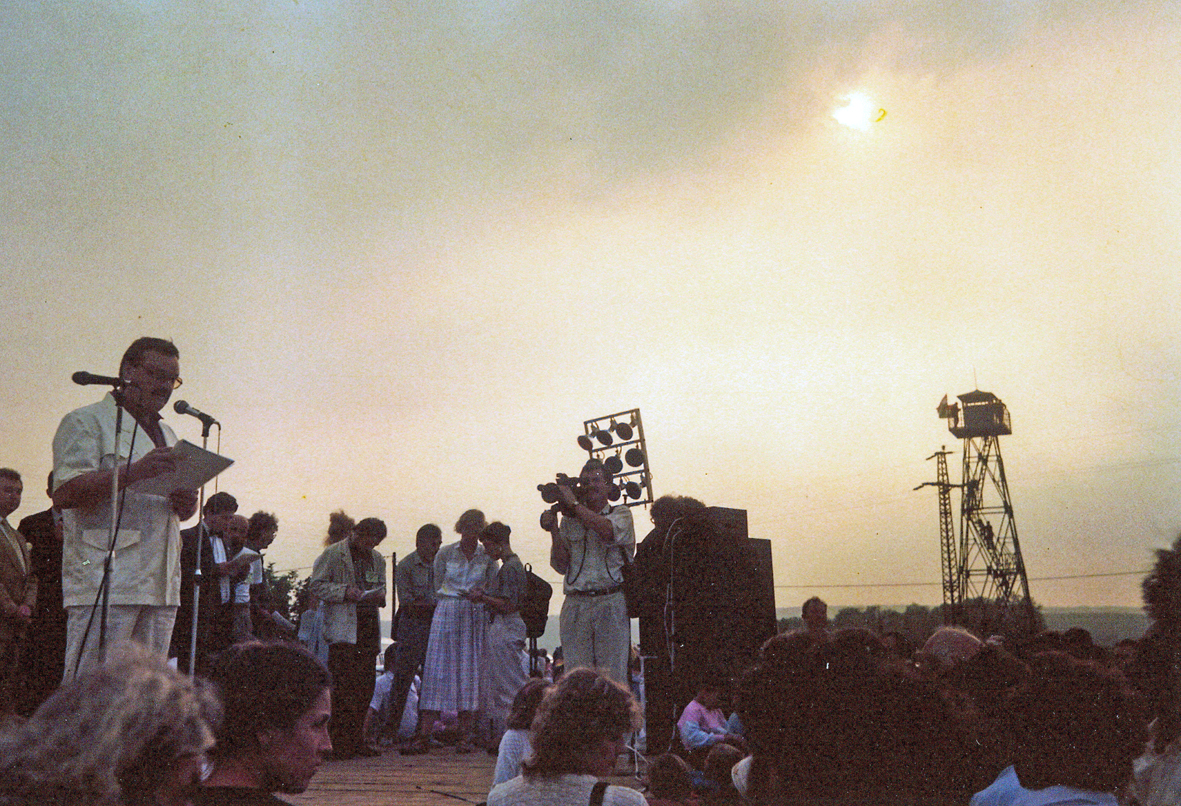
First, the barbed wire was cut and torn down in several places. On the meadow of the picnic grounds stood a watchtower that Hungarian border guards had been using shortly before. Now, a Pan-European flag flew at the top. A small gate at the border was opened. However, the five Hungarian border guards, who were supposed to issue day visas to Austrian visitors, could no longer perform their actual duties. Hundreds of citizens of the so-called GDR had come—lured by thousands of distributed flyers—to seize the opportunity. Some had failed in previous attempts to flee to freedom. This time, 661 people would succeed.
The escape from the workers’ and peasants’ paradise
They had nothing with them beyond the clothes on their backs, or perhaps a small bag. Walburga Habsburg Douglas, who at the time (still as Walburga von Habsburg) represented her father Otto von Habsburg at the picnic, was asked by Gudula Walterkirchen, publisher of the *Burgenländische Volkszeitung* (BVZ), what the most impressive thing about that day was for her. She said she would never forget seeing people crying out of pure happiness and joy over their successful escape. Normally one cries out of grief and pain; here, people cried out of joy and luck. The second thing that impressed her was that the refugees left their cars behind. Even if it was only a Trabant, one had to wait many years back then just to get a car. But when faced with the choice between freedom and a car, the decision was clear.
Among the heroes of the day, alongside the organisers, were the Hungarian customs officers who kept their cool amidst the chaos brought by the mass escape. Walburga Habsburg Douglas recalls a conversation with one of the officers: “We have three options. Either we shoot into the mass of fleeing people, but we certainly won’t do that because we don’t want to hurt anyone. Or we try to stop the crowds, but we can’t do that with our forces; we are far too few. The third option is the one that seems best and most right to us: we turn around and let everyone who wants to run to freedom.” Afterwards, he asked her for an autograph on one of the pink visa applications, “as a souvenir of a historic day for Europe”, as he put it.
After the picnic, the border was closed again. However, on 10 September 1989, it was opened by the Hungarian side. In the days between the picnic and the border opening, a tragic incident occurred during an escape attempt, which cost a German refugee his life.
Erich Honecker and Otto von Habsburg
Erich Honecker, who strongly disagreed with the events, blamed Otto von Habsburg for the mass escape from his GDR in an interview with the *Daily Mirror*—conducted personally by publisher Robert Maxwell: “Habsburg distributed flyers as far as Poland, inviting East German holidaymakers to a picnic. When they came to the picnic, they were given gifts, food, and Deutsche Marks, and then they were persuaded to come to the West.” The *Neue Zürcher Zeitung* commented that it was a joke of history that Austria-Hungary of all places helped the Prussians to freedom.
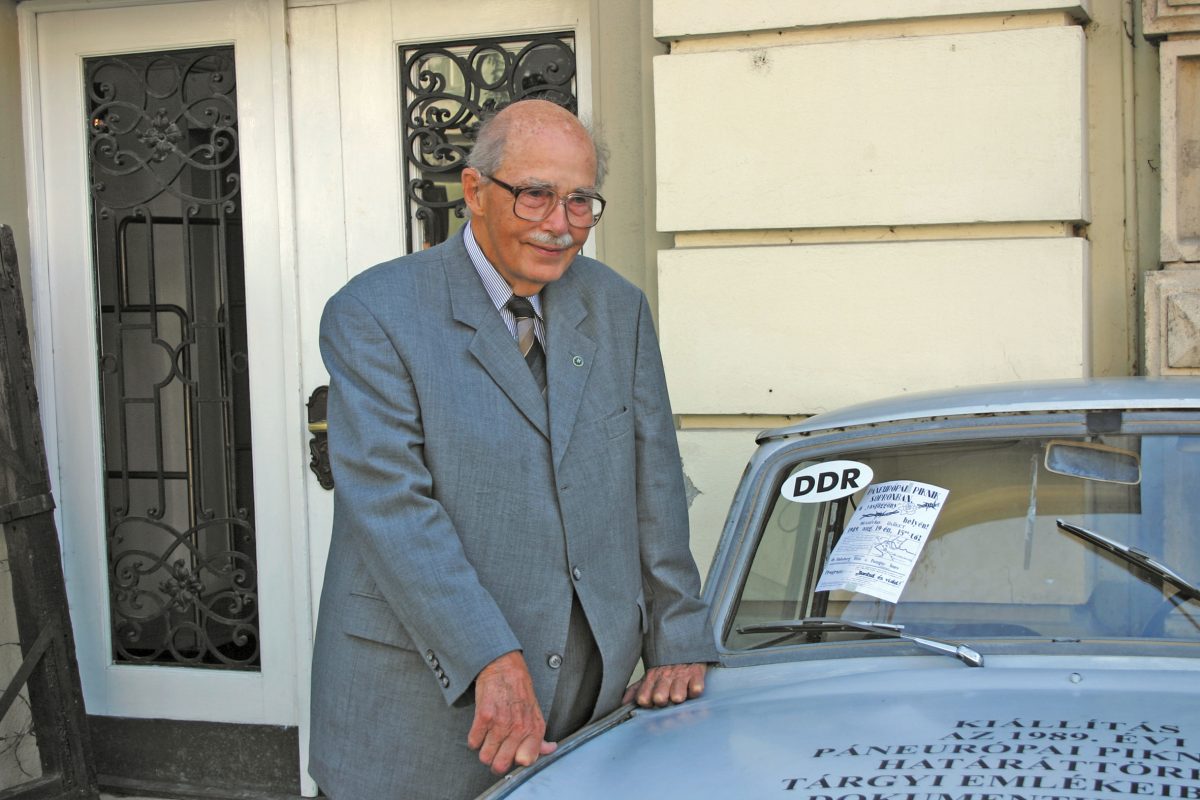
A snapshot from one of the commemorative events for the Pan-European Picnic: Otto von Habsburg in front of a Trabant, with the invitation to the picnic tucked into the windscreen.
In his greeting, delivered by his daughter Walburga, Otto von Habsburg spoke of the “dawn of freedom” that became visible that day. “We must continue to work towards the emergence of a genuine pluralistic democracy and civil liberty in Hungary, and a social order that ensures a dignified existence for every one of our compatriots. On this path, we have already achieved great successes—I would say successes exceeding all hope. But success is not a cushion on which one can rest. Success can only be a starting point. It is our task to shape the Hungarian and European future.”
In 1996, a seven-metre-high sculpture modelled on barbed wire was erected in Fertőrákos (Kroisbach), the neighbouring village of Sopron (Ödenburg), to commemorate the historic event. The creator of the sculpture was Gabriela von Habsburg, the daughter of Otto and Regina von Habsburg, known as an artist. A commemorative plaque bears the names of the eight most important people for the Pan-European Picnic: Otto von Habsburg, who had assumed patronage with Imre Pozsgay; Walburga von Habsburg and László Vass, who delivered speeches at the picnic on behalf of her father and the Minister of State respectively; Imre Kozma, then President of the Hungarian Maltese Service, who had set up a refugee camp for GDR citizens in Budapest; Baroness Csilla von Boeselager, who worked tirelessly for the refugees; Lukács Szabó, then chairman of the Democratic Forum of Debrecen, and his assistant Mária Fülep. The idea for the picnic had arisen after an event with Otto von Habsburg at the University of Debrecen, during a conversation with Hungarian opposition figures.
The decisive element of the historic “Pan-European Picnic”, which wrote world history, is the clear political messages conveyed then, which from a Pan-European perspective remain valid today. “Pan-Europe is the whole of Europe” is one of the slogans of Pan-European policy that led to this picnic and links it inseparably with Pan-Europe. Opening a perspective for accession to the European Union is a logical consequence of the freedom won in 1989/1990. This applies today particularly to the countries of South-Eastern Europe and Ukraine. Kosovars, Bosnians, or Ukrainians have just as much right to Europe as Hungarians, Austrians, or Poles. Above all, one must not forget that this picnic took place at a border that for centuries was no border at all, because this was and is Central Europe, as Karl von Habsburg noted in a press statement on the 30th anniversary of the Pan-European Picnic.
The messages still apply today
Another message of this Pan-European Picnic was, of course: Europe instead of nationalism. It is the message of a united Europe against a Europe of nationalism, a Europe of freedom and the rule of law instead of totalitarianism and political arbitrariness. Freedom without responsibility cannot exist, and responsibility cannot exist without freedom. The moment the state begins to regulate things that, strictly speaking, fall within the competence of the individual, it restricts freedom and responsibility. When the individual no longer exercises their own responsibility, the concept of freedom also vanishes.
Thirty years after the Pan-European Picnic, it is as important as ever to emphasise the substantive dimension of those events. The Pan-European Picnic was a historic event, but merely historicising it would not do it justice.
The Pan-European Movement Austria would like to sincerely thank Dr Klara Kotai-Szarka for the historical photographs from 1989.



