An Ambitious Programme
In some respects, the government programme of the ÖVP-FPÖ coalition goes into great detail. However, concrete indications are lacking as to how the relief so intensely promised during the election campaign is now to be realised. An assessment by Rainhard Kloucek
Even though it spans 180 pages, the government programme of the new Austrian federal government leaves several questions unanswered. This particularly concerns the necessity, so heavily emphasised by both governing parties during the election campaign, of providing relief for citizens burdened by one of the highest tax loads. Conversely, the programme delves deeply into detail on some points. Fundamentally, everything is to become more efficient, better, less bureaucratic, and freer. The state is to become leaner. When reading about some of the proposed measures for debureaucratisation and deregulation, one wonders how a country with such bureaucracy can even continue to exist. Some aspects are also contradictory. And, quite naturally, the programme contains declarations that are standard repertoire in any political Sunday speech. Given how often ‘greater proximity to citizens’ has already been demanded in political programmes, if one takes political promises seriously, ‘even greater proximity to citizens’ might no longer be possible.
Naturally, the programme also contains self-evident truths, although some points should not even be included in such a declaration of future government plans, as they have been law in Austria for years. The transparency database is one such example. It is intended to record all subsidies, thereby providing an overview of who is funding what, where, and at what level. Multiple subsidies should thus become a thing of the past. Although it has been law for many years, the provincial governments have stubbornly refused to populate this transparency database. So, the implementation of this long-standing law is once again in the government programme. What is new is the inclusion of a demand from the Neos. This small opposition party wants to impose sanctions on the provincial governors if the law is not implemented, i.e., if the provinces continue to refuse to provide data. The government is now demanding ‘sanctioning possibilities for non-fulfilment of obligations for the transparency database in the course of fiscal equalisation’.
Open Description of the Problem
The preface provides a surprisingly frank insight into the existing problems. It criticises one of the highest tax and levy rates, as well as the fact that the state, despite record revenues, cannot make ends meet and is accumulating ever more debt. ‘We are world champions in regulating and restricting freedom and personal responsibility,’ the government programme states verbatim. It criticises the imbalance of the social system, as well as the fact that, despite working, one can afford less and less with one’s wages. This is followed by the lofty aspiration to create framework conditions ‘so that every individual can achieve a successful life according to their own ideas.’ And further: ‘Every individual should take responsibility for their own life. We must put an end to state paternalism.’ Naturally, however, those who cannot help themselves should be assisted.
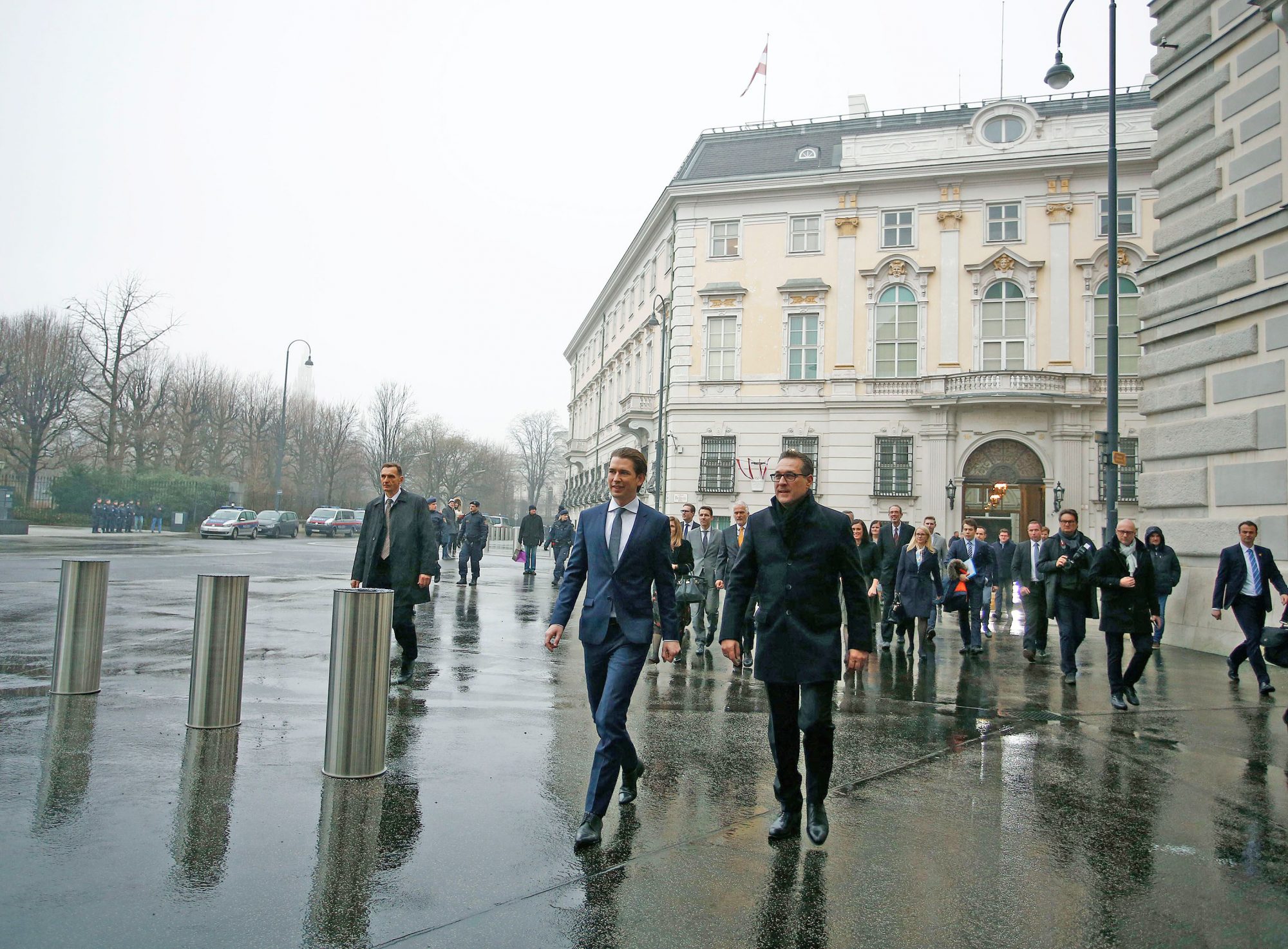
On 18 December 2017, the new federal government was sworn in by the Federal President at the Presidential Chancellery. Pictured Sebastian Kurz (left) with Heinz-Christian Strache (right) on their way to the Hofburg.
The repeated mention of neutrality as one of Austria’s foundations is striking. Particularly in the area of a necessary European security policy, but also a European foreign policy, this commitment raises more questions than it could possibly offer solutions.
A formulation in the preamble, concerning the cooperation of the two governing parties, is indicative of the political system: ‘The parliamentary factions of the coalition parties and their club leaders ensure a common approach in all parliamentary matters, including voting.’ This sentence means nothing less than an end to the free mandate and a restriction of parliamentarianism. While in a parliamentary democracy, parliament, as the representation of citizens, should control the government, here it is agreed that the members of parliament from the two governing parties must obey the directives of the government or party leaders. Yet, direct democracy is to be strengthened or expanded.
Expand Differentiated School System
In the field of education, the government aims to maintain and expand the proven differentiated school system. Compulsory education is to be introduced – primarily addressing the problem that many young people leave school without truly being able to read, write, and count – as well as mandatory German language skills before starting school. It is to be ensured ‘that elementary pedagogical institutions are not used as instruments for promoting anti-societal models.’ A ‘commitment to the constitutional, values, and social order’ is to be enshrined: ‘Any work in elementary pedagogical institutions must be carried out on the basis of these values’.
This framework of values is not defined in more detail. A hint might be found in the preface of the government programme, which speaks of a foundation for future policy: ‘This foundation is composed of the Austrian constitution, perpetual neutrality, the fundamental principles of the European Union, as well as fundamental and human rights, civil liberties, and the rights of minorities.’ Additionally, party politics are to be brought into schools. Student parliaments are to be legally enshrined.
An interesting remark is found in the area of science, concerning the Austrian National Union of Students (ÖH). ‘The funds made available to the ÖH should be used exclusively for tasks of advising and representing the interests of students.’ This effectively eliminates the so-called general political mandate, a demand already raised in a similar form by the Jes student initiative in the 1970s. The ÖH, like all chambers as statutory interest groups, is financed by compulsory contributions. The ÖH is the chamber of students, in which every student must become a compulsory member and pay a contribution. However, no intention to similarly limit the tasks of other chambers is found in the government programme.
Commitment to Family Promotion
As probably expected by the voters of both governing parties, the programme contains a clear commitment to the family and its promotion. In the chapter ‘Women’, there is a sentence that will likely cause all gender ideologues to collapse: ‘The distinctiveness of both sexes makes the added value for society visible. To know and acknowledge the differences between men and women is an integral part of human life and thus inextricably linked to human dignity.’
Little Courage in Social Security Reform
Less courage was shown in the necessary reform of social insurance. Here, a reduction to five social insurance providers is planned, with regional needs to be taken into account. This can be seen as a concession to the diverse interests of the federal states. Benefits are to be harmonised. However, the reform pressure will not be great enough due to these planned changes. Reform pressure only ever arises where there is competition. In the area of social insurance, this could only be achieved by shifting from compulsory insurance to mandatory insurance. This would require individual providers to actively seek customers, create appropriate offers, and work efficiently. Such competitive pressure, on the other hand, would reduce political influence.
Unanswered Questions in European Policy
Many questions remain open in the area of European policy. As in the election campaign, the concept of subsidiarity is overused in the government programme. ‘At the European level, we are working to ensure that the EU, in the spirit of subsidiarity, focuses on essential issues suitable for common solutions.’ The community of European values is emphasised. What these issues suitable for common solutions might be is not specified. A clue is provided by the declaration of intent on the protection of the EU’s external borders. Here, while advocating for increased cooperation among EU states, a European border guard is disregarded. A European perspective is also lacking in the area of foreign and security policy. Neutrality is repeatedly cited as a guideline, which, however, merely serves as an excuse against new initiatives. The commitment to strengthening cooperation with Central European neighbouring states is a positive note. Incidentally, the examination of a possibility for a subsidiarity check for new regulations, as demanded in the programme, already exists in the EU treaties.
Austria: Hub Between East and West?
A formulation that recalls the Cold War rather than a genuine European perspective suggests that Austria, ‘as a historical hub between East and West, should be an active place for dialogue,’ promoting a ‘détente policy between the West and Russia.’ Misjudging reality, it speaks of newly arisen tensions – ‘especially due to the Ukraine conflict’ – where efforts are to be made to de-escalate the conflict and reduce sanctions. Here, the fact that Russia has started a war of aggression against Ukraine, which with its now well over 10,000 dead cannot be trivialised as mere tension, is clearly suppressed. A reduction of measures (sanctions) against warmongers in the Russian system would surely be an invitation to Moscow to escalate its aggression against its European neighbour, Ukraine, once again.
Nothing Concrete on Relief
The programme is very cautious regarding the necessary relief for citizens. The term ‘tax cut’ is sought in vain. While during the election campaign there was talk of reducing the tax and levy rate to below 40 percent, now the aim is only to reduce this burden ‘towards’ 40 percent. Regarding the announced elimination of fiscal drag – corresponding motions were already introduced in the National Council by the opposition in the previous legislative period – one now only reads: ‘Examination of the automatic adjustment of the threshold amounts for progressive tax brackets based on the previous year’s inflation within the framework of a tax structure reform.’
Conversely, the programme becomes very concrete when it comes to taxing internet platforms like Facebook or Google. They are to be ‘forced to pay tax in Austria.’ Initial steps taken, such as the reduction of contributions to unemployment insurance for low-income earners, certainly reveal a certain populism towards the much-cited ‘common man,’ but do not yet open up a perspective for reversing the massive burden on the middle class. Thus, it is to be feared that the commitment to ending state paternalism, formulated in the preface, will remain a mere beautiful declaration.
The article originally appeared in issue 1/2018 of the magazine “Paneuropa”
Photos: BKA / Dragan Tatic, BKA / Andy Wenzel



