Symposium: Christ and Politics
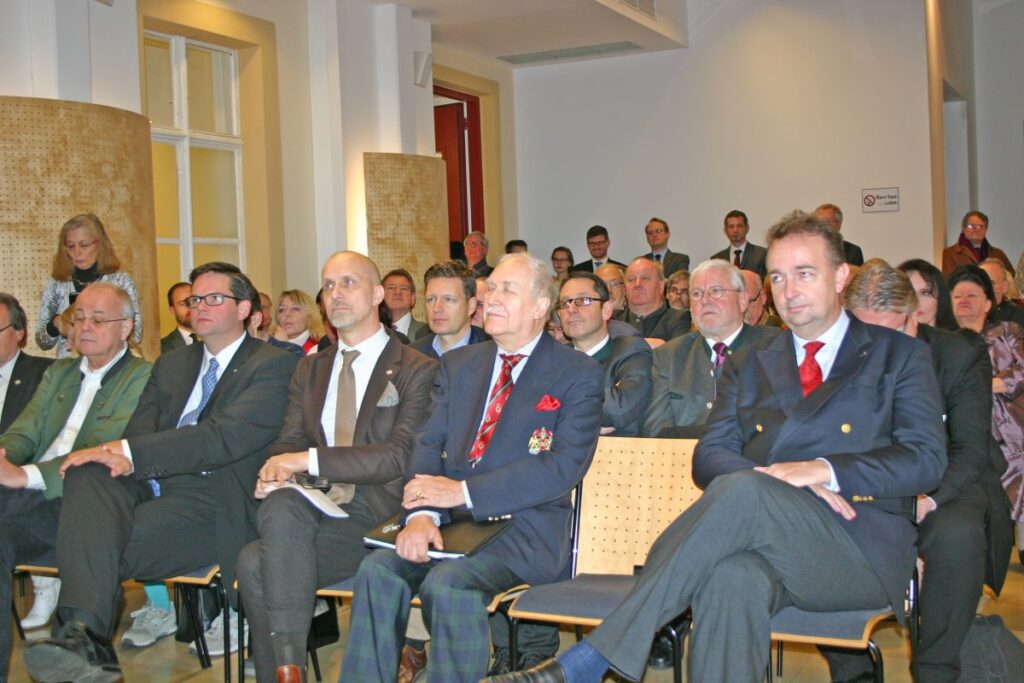
The tenth anniversary of the death of Vincenz von und zu Liechtenstein, founder of the Jes Student Initiative and long-serving ÖVP politician, was the occasion for a symposium ‘Christ and Politics’.
What do Christianity and politics have in common? Values, to quote Vinzenz Stimpfl-Abele, Procurator of the Order of St. George and member of the Presidium of the Paneuropean Movement Austria. Vincenz von und zu Liechtenstein founded the Jes Student Initiative in 1975; later, he served in the Federal Council and the National Council for the ÖVP. Ten years ago, in January 2008, he was called to the Lord far too soon. On the tenth anniversary of his death, friends and colleagues organised a symposium ‘Christ and Politics’, where – following a Holy Mass celebrated by St. Pölten Bishop DDr. Klaus Küng – political companions of Vincenz Liechtenstein took a stand on the former Styrian politician’s political priorities.
Fundamental attitude, basic principles, clear value orientation, principles before party expediency, a clear commitment to values – these were the keywords that ran through all the speeches at the symposium. Sissi Potzinger, a Graz family politician and co-initiator of the symposium, spoke of Christian values as a compass that applied to Vincenz Liechtenstein and should also apply to us. For: ‘The compass needle is unwavering.’ Showing your colours for life, she formulated as a core message. Gudrun Kugler, a Catholic Member of Parliament for the ÖVP in the National Council, emphasised the family bonus as a milestone in family policy, and referred to a speech by Pope Benedict XVI, who spoke of Christianity as a creative minority. Creative understood as inventive, formative.
Loyalty to Principles Before Party Expediency
Reinhold Lopatka, long-serving ÖVP parliamentary group leader in the National Council and a compatriot of Vincenz Liechtenstein, paid tribute in very personal words to his steadfast adherence to principles in politics. Vincenz Liechtenstein always prioritised fundamental principles over day-to-day politics, loyalty to principles over party expediency. Lukas Mandl, recently a Member of the European Parliament after many years in the Lower Austrian State Parliament, recalled the forum that Vincenz Liechtenstein had created for young politicians at his Waldstein Castle.
Professor Günter Danhel, also a co-initiator of the symposium, outlined the particular aspect of family policy. He advocated for an end to the gender madness and described intergenerational justice as true sustainability. Alexander Pachta-Reyhofen, co-organiser of the event, emphasised the significance of the founding of the Jes Student Initiative as a comprehensive counter-attack against the ’68 generation. Citing articles by Vincenz Liechtenstein, he drew connections to current problems that Vincenz had outlined early on. Security expert Peter Fender addressed the issue of defence policy.
Karl von Habsburg recalled the political instinct of his cousin Vincenz and the diverse educational opportunities he had created. He summarised his political credo in the clear statement: Maximum freedom – minimum state!



