Longing for the Strongman
Political leadership is in demand. However, this does not absolve the individual of their personal responsibility, which must not be delegated to the state. A commentary by our President, Karl von Habsburg.
Even in established democracies, studies repeatedly show a longing for a strong political leader, for the proverbial “strongman“. After the experiences of the 20th century, with totalitarian systems that haunted almost every country in Europe, one would think that sufficient experience exists to relegate such ideas to the programme of an incorrigible small minority. Apparently, however, at least in Western Europe, the temporal distance from the dictatorships is so great that the generation of those who personally experienced what “the strongman” can actually mean is no longer with us, and new generations no longer consider what the consequences could be. Some observers believe that the strengthening of so-called right-wing populist parties is a symptom of this longing.
Undoubtedly, history is shaped by strong men – and also strong women – who have shaped the political fortunes of their countries, founded empires, and expanded them. Europe went through the era of absolutism, in which the prince was the sole ruler. The state in the age of absolutism is not entirely comparable to today’s welfare state; the density of regulation and thus the direct intervention of the state in the lives of its citizens was significantly lower then than is the case today. It is fascinating to observe, as Pieter Judson describes in his book “The Habsburg Empire”, for example, that the formation of the rule of law began with the creation of the modern state, even during the era of absolutism.
The longing for the strongman observed today, however, does not seem to be entirely independent of the idea of the welfare state. The state as an institution that cares for everything, from the cradle to the grave, from schooling to a guaranteed job and the state pension. The many unresolved crises of the recent past show that the state is overwhelmed by this. However, the crises are generally not blamed on an overextended state, but on insufficient or poor regulation. The centrist parties also follow this line, but in doing so, they delay the problems. This then leads to that polarisation in which a strong leader appears to many as the only salvation. Forgotten is the fifth of Felix Somary’s 20 social laws of inverted proportions: “The larger and more versatile the state, the more powerless the people.”
Of course, politics requires leadership quality and leadership responsibility. Naturally, this applies to democracy as well. The peculiar chaos of the British Brexit negotiations (and their backstory) is just one example of what happens when these skills are lacking, and how supposedly strong men can use the situation for their own advantage, but not for the benefit of the population.
The state, politics, cannot take care of everything. The more the state concentrates on its core competencies, the better it can perform its tasks. However, this requires citizens to have a strong sense of their own responsibility.

© Katharina Schiffl
Karl von Habsburg is President of the Paneuropa Movement Austria and Vice-President of the Paneuropean Union. This commentary also appears on his website.
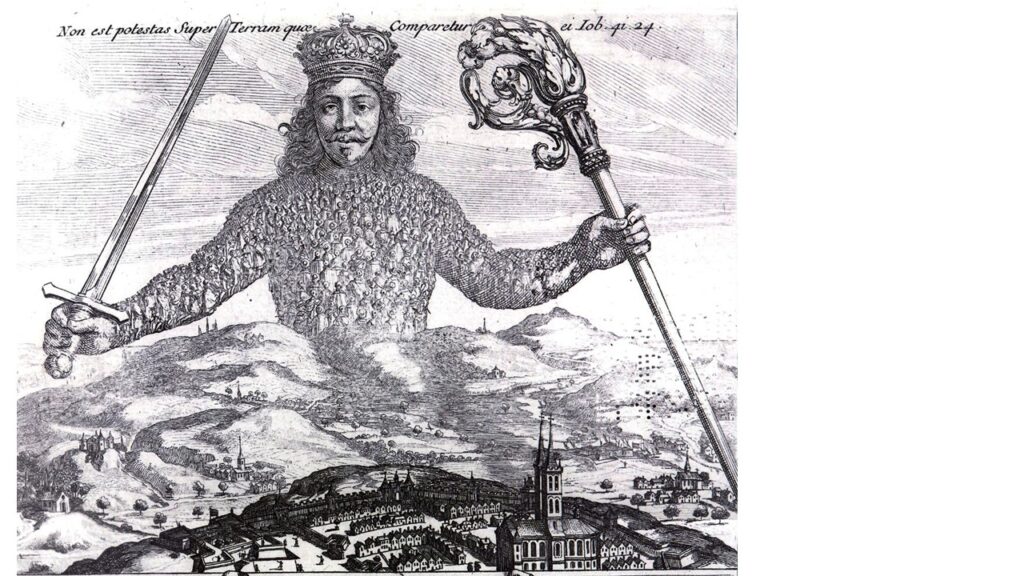
Cover image: Frontispiece of Thomas Hobbes’ Leviathan (1651). It shows the sovereign ruling over the land, cities, and their inhabitants. His body consists of the people who have consented to the social contract. The title of the work refers to the biblical-mythological sea monster Leviathan, before whose omnipotence all human resistance must fail. In Hobbes’ absolutist understanding of politics, the state plays a similar role, thus becoming the counterpart to the state of nature personified by the monster Behemoth.



