Amongst Cranes and Vultures
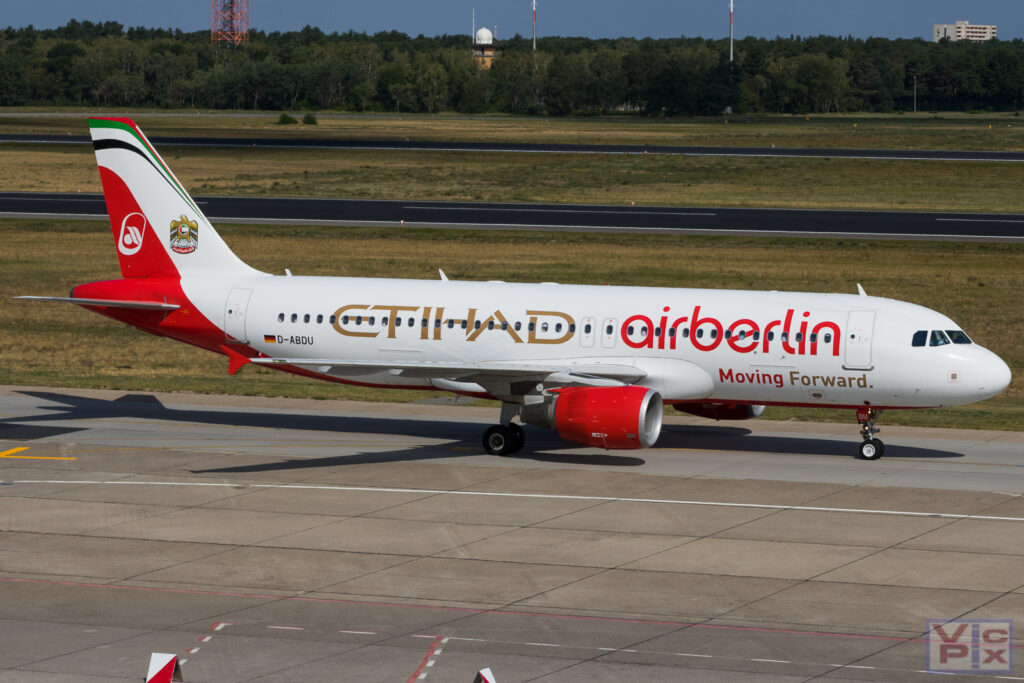
What consequences Air Berlin’s collapse could have for the aviation industry and consumers. An analysis by Viktor Szontagh.
Historically savvy aviation enthusiasts must have felt a bit like in ‘Groundhog Day’ – once again a German airline is being wound up – and once again Lufthansa seems to have secured the prime assets.
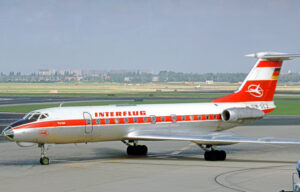
A Tupolev 134, for years the backbone of the Interflug fleet. With its own airline, the GDR also showed its face to the world until the very end.
By RuthAS – Own work, CC BY 3.0, https://commons.wikimedia.org/w/index.php?curid=29437200
Flashback: 1990, German reunification. Suddenly, a country had two ‘state-owned’ airlines. The federal government held a 49 per cent stake in Lufthansa, while East German Interflug had been founded as a purely state-owned enterprise. The East German company was not doing well financially. The Interflug fleet largely consisted of shapely but outdated Russian-built aircraft, and passenger numbers stagnated.
The Battle for the Prime Assets – with Hardball Tactics
However, what made the former GDR flagship company attractive were other parts of the business. Interflug operated Berlin-Schönefeld Airport, owned further properties in Berlin and the state of Brandenburg, and held route rights and slots that made it an interesting investment. In the days of the ‘German gold rush’, Interflug fell victim to a shady power play between the Federal Cartel Office, Treuhand-GmbH, and Lufthansa.
The restructuring through Lufthansa’s involvement was prohibited for antitrust reasons, potential bidder British Airways was deterred from investing by falsified balance sheets, valuable company assets were spun off, and Interflug was ultimately sent into insolvency. The clear victor in this ‘battle for Berlin’s air supremacy’ was Lufthansa; Interflug’s workforce was left empty-handed.
Now, over 25 years later, a similar picture emerges: once again, a German airline is in financial difficulties – and once again, Lufthansa is preparing to secure the prime assets from the spoils. This time, it’s not the long-haul route rights, but European and domestic connections, as well as short and medium-haul aircraft. The rest can be left to the vultures – the crane contents itself with a de facto monopoly in the domestic airspace.
Air Berlin – A Look Back
How did it come to this? Air Berlin, insolvent? Insiders are not surprised; for them, this was rather the end of a slow demise of a company that didn’t quite know what it wanted.
Initially, things looked quite good: Air Berlin (AB) was founded in the late seventies – curiously, as a US company. This was due to the fact that West Berlin could only be served by aircraft of the victorious powers. The main destination back then was already Palma de Mallorca, and other Mediterranean destinations were also served for charter flights. In the course of the 1990s, the first regular routes were established, most of which also led to holiday destinations. When low-cost airlines (LCCs) began to expand in Europe around 2000, AB wanted a piece of this pie and also offered intra-European regular connections as a ‘City Shuttle’.
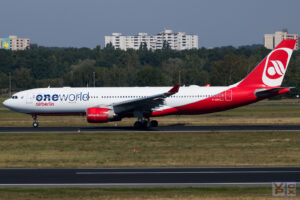
Symptomatic of the company’s management crisis was its entry into the OneWorld alliance: it never seemed entirely clear what course the airline intended to take in the medium term.
© Viktor Szontagh
Business boomed, Air Berlin expanded. In just a few years, the holiday airlines Belair, dba, and LTU – including their long-haul connections and
wide-body aircraft – were acquired, a strategic alliance was formed with competitor TUIfly, and the stake in the Austrian airline Niki was expanded to 100 per cent ownership. They joined the Oneworld airline alliance. But behind this glamorous facade, cracks were already appearing. Management could never decide whether to be a cheap network carrier or a holiday flight provider with point-to-point routes. Insiders had long foreseen that trying to be both would not work out in the long run.
The Problems Mount
And so began the slow demise of Germany’s second-largest carrier. The cash injection from Etihad Airways’ entry certainly opened the door to the Arabian Gulf, but this
Etihad repeatedly provided Air Berlin with fresh funds, but the German airline proved to be a bottomless pit.
© Viktor Szontagh
fiercely competitive market tied up capacities that could have been better utilised elsewhere – and the Federal Aviation Office put an end to the codeshare flights in autumn 2014.
The subsequent events are easy to interpret in hindsight: the abandonment of hubs in Nuremberg and Palma de Mallorca, the sale of all aircraft through ‘sale and lease back’ which ultimately burdened cash flow, the leasing of dozens of aircraft to Eurowings and Austrian Airlines, the continuous management merry-go-round, repeated waves of redundancies for ‘healthy downsizing’ – all was in vain. When it became known in spring 2017 that an operating result of -667 million Euros had been achieved in 2016 (compared to -307 million Euros in 2015), the writing was on the wall. Bankruptcy was no longer avoidable.
Outlook: Consequences for Central European Airspace?
What impact might this have? We don’t know from today’s perspective, so what follows is mere speculation – though not entirely unfounded.
AB employees will not have an easy time of it in the future. They face redundancy if company parts, such as long-haul connections, are not continued by bidders. Or they will ‘voluntarily’ transfer to other companies, presumably not under more employee-friendly conditions.
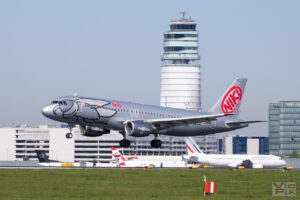
The Austrian subsidiary Niki Luftfahrt is highly coveted, as it is considered a “healthy company”.
© Viktor Szontagh
The future of the Austrian AB subsidiary Niki could be exciting. Unlike its parent company – and thanks to bridging finance from the Republic of Austria – the airline is not insolvent (a bankruptcy petition was recently rejected by an Austrian court). It focuses on the holiday flight business and is quite successful in this area. Through an exchange of aircraft, it now flies Airbus 321s, thus offering higher capacities on more frequented holiday routes. Which new owner it will ultimately ‘land’ with is currently unforeseeable, but signs are mounting that Lufthansa may also have set its sights on this part of the spoils.
If Luftfahrtgesellschaft Walter (LGW), which operated Air Berlin’s Dash-8 short-haul fleet, were indeed to go to Easyjet – as is currently suspected – the turboprop aircraft would be given up in favour of the English airline’s uniform Airbus fleet, and their crews could be left out in the cold. Why Easyjet, specifically? Well, the English airline could use LGW’s operating licence (Air Operator Certificate, AOC) to operate largely unhindered in the EU as a German carrier even after Brexit. Although Easyjet Europe already exists as an Austrian subsidiary, specifically founded for this purpose, a German AOC would allow the two subsidiaries to compete against each other on wages, as LGW’s collective agreements are even lower than those of AB-Mainline.
What Will Consumers Feel?
How would consumers feel the effects of a takeover of large parts of Air Berlin by Lufthansa? Well, apart from LCCs and small regional carriers like Rhein-Neckar-Air, Lufthansa would be the only group whose aircraft would transport passengers in Germany. Already, aircraft of the ‘crane’ group are strongly represented in domestic German traffic, even if some are (still) operating under the Germanwings logo or (already) as Eurowings. Everyone can judge for themselves what to make of monopolies.
However, positive effects on ticket prices and service are hardly to be expected: the economic pressure from non-group low-cost carriers is a thing of the past, and in the absence of competition, Lufthansa can adjust ticket prices practically at will, as it would then possess the sole route rights for domestic German connections.
That this is a thoroughly realistic scenario can be confirmed by all those who professionally
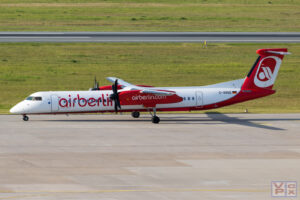
A Bombardier Dash 8 Q400 of Air Berlin (operated by LGW) – at least a new livery awaits the regional fleet of the airline now facing its end.
© Viktor Szontagh
have to commute between Vienna and Innsbruck: while Niki served the route, the ‘state carrier’ Austrian Airlines had to adjust prices to compete with the domestic low-cost airline. Of course, Lufthansa will also offer ‘cheap flights’, as it has founded its own LCC subsidiaries Germanwings and Eurowings within the group. However, they will hardly be able to set their prices independently of the parent company – despite significantly worse employment contracts for employees and other cost-reducing factors.
Lufthansa’s Market Dominance Grows
With the acquisition of parts of Air Berlin, Lufthansa can look forward to a considerable increase in market share. New routes could be opened up by its own aircraft, parallel AB flight routes could be discontinued, and customers thereby forced onto LH Group flights. However, due to a lack of precise figures, only unreliable speculation could be made about numbers and shares – and we prefer to refrain from that at this point. Time will tell where the journey (in this case, the flight) goes.
As things are developing at the moment, everything could be different again tomorrow. But those who have learned from history can rightly suspect: Lufthansa will not be among the losers when it comes to power plays and the division of the spoils. The crane is sometimes happy and always successful in acting as a vulture.
Viktor Szontagh is a lawyer, frequent flyer, and aviation enthusiast.



