Domestic Political Erosion
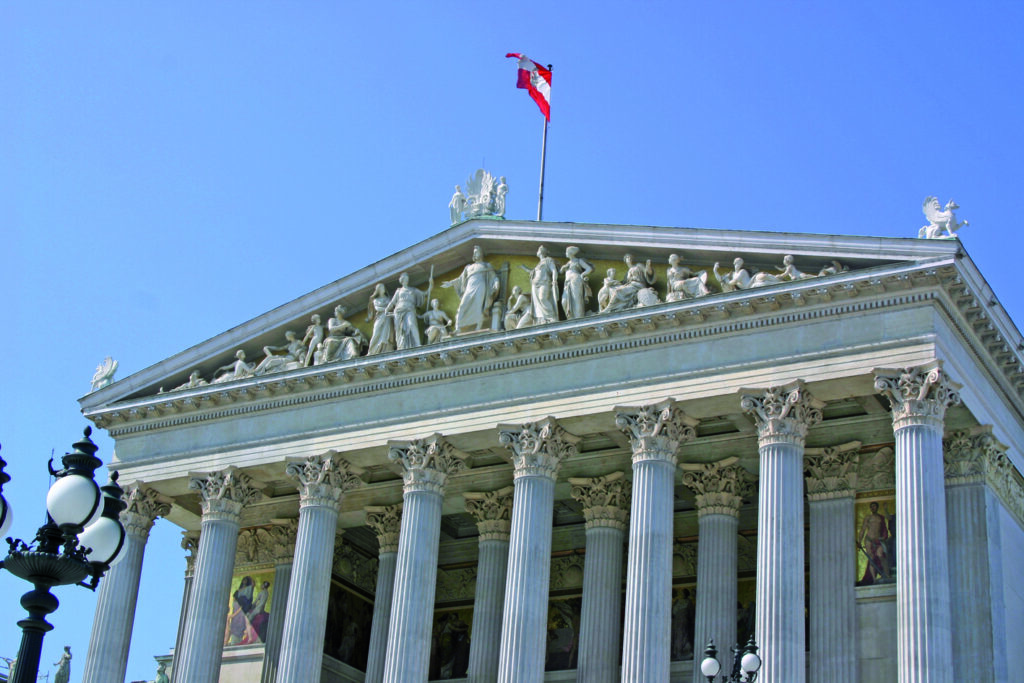
Over decades in power, the government coalition of the SPÖ and ÖVP has worn each other down and become exhausted. The country desperately needs deregulation and a rollback of the welfare state.
An analysis by Paneuropa Secretary General Rainhard Kloucek
Is the political system in Austria being turned on its head? Will a new strongman seize leadership in this country? Must we even fear a renewed outbreak of an authoritarian regime? Is populism experiencing a new dimension? Have political parties become obsolete, and is the age of movements dawning?
Anyone closely observing the media in mid-May this year would indeed have had to fear that a new beacon of hope had not only been appointed to lead a governing party but had long since seized sole power in the state. Yet, to connoisseurs of Austrian domestic politics, it was clear that in a country with above-average alcohol consumption, a sober assessment of the situation must appear almost an insurmountable challenge.
That a party leader of the Austrian People’s Party resigns is hardly a sensation. That a relatively young politician becomes the beacon of hope for his party should, since Jörg Haider and Josef Pröll, no longer be a real sensation. That someone takes over the leadership of the ÖVP only on condition of being granted far-reaching powers should not surprise any observer of the party landscape. That a party campaigns in elections under the name of its lead candidate and beacon of hope is not truly new. That a new name at the head of a party helps it to soar in the polls is probably an expression of a rather intractable political situation, but can no longer be considered a surprise.
Perverted Democracy
Austria will elect a new parliament on 15 October. This is a good thing. Austria will not elect a new Chancellor or a new government on 15 October 2017. Herein lies the first contradiction between the constitution and political reality. In the spirit of representative democracy, the elected representatives in parliament should protect citizens against a government striving for an expansion of power. In political reality, however, it is about electing a lead candidate (most voters do not know the MPs for their constituency; many do not even know what constituencies are), who, provided he and his party or movement secure a sufficient majority, is then supposed to become Chancellor. The effect is that the government is aligned with a parliamentary majority that supports it. Representative democracy is thus perverted. Governments, or the parties forming them, are interested in extending their power over the country’s citizens; the aligned parliamentary majority sees its task as promoting this expansion of state power. Over-regulation, bureaucratisation, and extremely high tax burdens are the consequences of this constitutional reality.
The next national election would regularly have been in autumn 2018. However, in the second half of 2018, Austria holds the EU Council Presidency. Even if Austria is administered (and often governed) by high bureaucracy, it would be hardly conceivable to fight an election campaign during a Council Presidency – which is, after all, about ensuring that EU policy functions. On the one hand, one would have to strive for a united front in EU bodies; on the other hand, one would differentiate oneself from opponents in the election campaign to try and win favour with voters.
What speaks for the new designated ÖVP leader and Foreign Minister Sebastian Kurz is that he had already – before taking over the party leadership – noted in several statements that an election during the EU Council Presidency would probably not be wise. Whether Kurz actually succeeds in breaking the law that states whoever triggers early elections will then be punished for it at the ballot box remains to be seen. Voting is not among the Austrian’s favourite pastimes. For if the government – naturally with the participation of the aligned parliamentary majority – were doing a good job, one would not need to cast one’s vote, such is a widespread attitude.
Permanent Government of SPÖ and ÖVP
What distinguishes Austria from all other European countries is the fact that since 1945 – that is, more than 70 years, or at least three generations – this country has been dominated by the same party constellation, even if government coalitions have changed. What was necessary in 1945 purely out of a will for national survival has, in the meantime, proven to be the greatest impediment. The People’s Party and the Socialists (later Social Democrats) have formed a government together for a total of 46 years out of the 72 years since 1945. In the remaining 26 years, one of the two parties governed alone for 17 years, and the FPÖ – or its splinter group BZÖ – participated in government for nine years. Yet, even during this period, the ÖVP or SPÖ, excluded from government, remained a dominant factor in domestic politics through social partnership – the so-called shadow government. Not even the communists in the former Eastern Bloc managed such continuity (even if the significance of old networks in these countries should not be underestimated even today).
While in other countries a governing party could recover in opposition after an electoral defeat, in Austria, Red and Black have worn each other down and become exhausted in their grip on state power. Hopes placed in each new leader of these two parties are based, among other things, on the suggestion that the new top man offers the only prospect of political change.
Acquisition and Retention of Power
This effect was observed both in the ousting of Werner Faymann by the current SPÖ Chancellor Christian Kern and in the election of Reinhold Mitterlehner as People’s Party leader after Michael Spindelegger’s resignation. In both cases, the new men at the top quickly became exhausted in the daily work of government. Social Democracy and the People’s Party have become so similar that they can no longer find fact-based solutions for the country and its citizens, transcending party lines and ideological divides. The government has degenerated into an ancien régime, whose sole purpose is the preservation and securing of power for its own functionaries. Both parties are victims of their past successes. Even when individual representatives of either party recognise and confront current challenges, their proposed solutions fail due to the system’s intractability.
An example of this is the Trade Regulation Act. Sepp Schellhorn, economic spokesperson for the opposition party Neos, praised Emperor Franz Joseph as a liberal in an article about the Trade Regulation Act. In 1859, there were 14 licensed trades. Meanwhile, there are 82 regulated trades. With the new Trade Regulation Act, regulation was not to be reduced; instead, another trade – namely that of farriers (!) – was to become subject to licensing.
Trapped by Perpetual Power
The social partnership is caught in the same trap as the two governing parties. The chambers are ossified; what keeps them alive is compulsory membership. In the Chamber of Commerce, reform fails, among other things, due to the bunker mentality of individual functionaries who refuse to allow mergers and thus streamlining of the apparatus simply because they might lose positions and titles. The Chamber of Labour sits on gigantic financial reserves, squandering the money of its compulsory members on ideological propaganda and pointless projects, yet fights tooth and nail against a reduction in compulsory contributions. What the socialist functionary once gets his claws into, he never lets go. In the second part of the socialist half of the social partnership, the Trade Union Federation, there is no compulsory membership. Membership numbers have been declining for a long time. Something similar would happen in the Chamber of Labour. The Chambers of Agriculture are today part of a gigantic redistribution and subsidisation apparatus, as well as – with upstream interest groups very close to the dominant Farmers’ Association – an extremely efficient lobbying organisation for agricultural business sectors that are not viable in a free market.
That Austria still functions despite this is due to an evidently very resilient population, which, despite extreme tax burdens and bureaucratic restrictions, still produces high achievers. A recently presented study showed how brutal taxation in Austria is. According to it, someone earning €3,600 a month would have €400 net more in their account each month if taxation were still at the 1990 level. The idea of what the country’s diligent entrepreneurs could achieve if regulatory hurdles were removed is probably the nightmare of the redistribution-envious collective.
It was therefore entirely logical that Chancellor Christian Kern, in his first statement after Vice-Chancellor Reinhold Mitterlehner’s resignation, attempted to offer Foreign Minister Sebastian Kurz a partnership and win him over as Vice-Chancellor. From his own experience, Kern knew how quickly his own star would fade in the given government constellation. It was equally logical that Sebastian Kurz did not accede to these two tactical wishes of the Chancellor and, after being appointed acting party leader, wanted to go for new elections. Only in this way could he escape the danger of being worn down himself in another year of coalition with the SPÖ. The shorter the time until the election, the better for the young hopeful.
The Powers That Be as Reformers?
It also seems entirely logical that Kurz wants to do many things differently within his party. From the name under which they campaign to the right to intervene in list compilation. The situation Austria finds itself in is the result of the policies of those two parties that have governed the country for more than 70 years. Anyone who wants to convince voters that, as a lead candidate, he will now make everything better, must overcome the argument that there is no reason to assume that precisely those parties responsible for over-bureaucratisation, high tax burdens, etc., would now be the saviours from this very predicament.
Opinion polls, even before Mitterlehner’s transition to Kurz, had already shown the high potential (figures of up to 35 percent were mentioned) of the People’s Party with Sebastian Kurz as lead candidate, and they confirmed it after the change. This is partly because the Foreign and Integration Minister very skilfully addressed topics that had previously been a unique selling point of the FPÖ (which was therefore leading in the polls until then), such as the issue of immigration or EU reform. Whether this surge of the ‘New People’s Party’ will last until 15 October remains to be seen; four months – even with the summer break in between – is a long time.
It remains to be seen how the parties will position themselves for the election campaign. The Greens and the Social Democrats are currently the most predictable. Although the Greens are always good for minor surprises. For instance, the former Green leader Eva Glawischnig justified her withdrawal from politics by stating that her family needed her, among other things, as a mother to her children. In doing so, mother Glawischnig confirmed a family image that was disparaged and rejected by the left-wing ideologue and party leader Glawischnig as ‘heteronormative’. The Greens pursue an ideology of gender mainstreaming (which the ÖVP also pursues, although it is unclear whether the People’s Party has understood what that means), according to which a person’s gender is in reality merely a social construct. However, the reshuffling of the Green leadership can only be seen as proof of the party’s totalitarian orientation. The Social Democrats’ programme remains the same despite all the Chancellor’s plans: the paternalistic welfare state takes care of every detail in its citizens’ lives (and makes them pay dearly for it).
It will be exciting for the Neos. The party is still struggling with its own identity. On the one hand, it wants to be liberal in the best sense, as shown by efforts to liberalise trade regulations or the fight for free entrepreneurship and against compulsory membership, but on socio-political issues, it remains shackled by the former Liberal Forum, thereby contradicting the ideal of freedom and self-determination. Why alleged liberals advocate for state-sanctioned gay marriage, instead of replacing state marriage generally with free contracts in the spirit of true liberalism – such a solution would have no impact whatsoever on the sacrament of marriage – remains a mystery. Advocating for an EU social union may suit representatives of the paternalistic welfare state, but not a liberal approach to Europe. However, by rejecting the totalitarian EU Weapons Directive, the Alde faction (to which the Neos also belong) in the European Parliament has proven that it is capable of learning.
It is no secret that, besides the LIF, the Neos have a very strong contingent of former ÖVP activists. That Sebastian Kurz attempted to entice Neos economic spokesperson Sepp Schellhorn with the offer of becoming Minister of Economy can be interpreted as proof of Kurz’s tactical shrewdness. At the same time, it casts a brutal spotlight on thinking within the power categories of party politics. Party-political thinking today is based much less on substantive principles or considerations of how to benefit the country and the freedom of its citizens, but rather on the question of what someone can become through the party. The crucial question for the outcome of the New People’s Party will be how far it can succeed in winning back former voters who have defected to the Neos, the FPÖ, and non-voters. Sebastian Kurz’s poaching attempts could also have the opposite effect. Poaching attempts confirm the prejudice that ‘those at the top’ will sort things out for themselves anyway, and are not yet proof of the ‘new’ in the New People’s Party. Indeed, in the election on 15 October, the Neos will face the challenge of establishing themselves as a political movement.
Although members of the National Council are elected, it is actually about who will form the government.
This question is settled for Team Stronach. For the FPÖ, the decisive question will be whether they can actually achieve first place in the election, or whether the New People’s Party can challenge them for it. The previously easy ride for the opposition party – pointing out grievances, naming problems, skilfully expressing criticism – is likely over for at least three reasons. Firstly, parts of the governing parties have also identified and named individual problems; secondly, much indicates that the FPÖ is preparing for governmental responsibility. The third reason is the party’s internal composition. Generally, the FPÖ is described as right-wing populist. However, both in the composition of its electorate and in its substantive orientation, it is strongly shaped by social democratic tendencies. The ‘Blues’ still achieve their greatest successes in working-class districts; programmatically, they stand for statism and the welfare state. Their close cooperation with Putin’s party in Russia is further proof of the ideology of the total state.
The Question of Possible Coalitions
Since no party, regardless of how old or new, will achieve an absolute majority to form a government alone, there will again be a coalition after 15 October.



