The Elections in France – First Round
Presidential elections in the European Union carry varying significance. Some are rather symbolic, with the president in certain countries serving as a representative and diplomat devoid of political power. However, when the president is elected in a country currently under a state of emergency following devastating terrorist attacks, and which maintains the EU’s largest army and NATO’s third-largest, then the entire election could prove more decisive than elsewhere.
An assessment by Stefan Haböck, Advisor for International Relations within the Presidium of the Paneuropa Movement Austria.
France, with approximately 67 million inhabitants, is the largest country in the EU by area, an economic power facing challenges, and a society that has long ceased to be as ‘égalité’ as the motto of the now 5th Republic proclaims.
In France, the President is elected by direct popular vote – the first round for the election of the 11th President of the Fifth Republic took place on 27th April. The left-wing camp is fragmented, and the rise of the Front National continues. The radical left-wing Jean-Luc Mélenchon, with his Left Party, displaced the Socialist candidate, Benoît Hamon. The Conservatives became entangled in disputes and mutual accusations.
The run-off election on 27th April 2017 concluded at 8:00 PM – around 8:30 PM, François Fillon conceded defeat. This confirmed who would compete in the second round on 7th May: Emmanuel Macron (39, En Marche!) and Marine Le Pen (48, Front National).
Marine Le Pen, a Member of the European Parliament and embroiled in an expenses scandal there (she refuses to repay approximately €400,000 which she allegedly paid unlawfully to staff), is unlikely to achieve 50.01% to become President. Yet, she commands all attention. It is her against everyone (the system?), or rather, everyone against her. Meanwhile, the radical left-wing Mélenchon has stated that Le Pen should not be elected. He has so far refused to endorse Macron.
The Front National, a right-wing, nationalist, economically socialist party that aims to make the country ‘great again’ ‘as it used to be’.
The Conservatives, now calling themselves ‘Les Républicains’, entered the race with François Fillon. Fillon, an experienced politician, seemingly stumbled over irregularities concerning gifts received and his wife’s employment. On election night, he declared his support for Macron and announced his (temporary?) withdrawal from politics the following day.
Macron, 39, is considered a newcomer and not entrenched in the system like the other candidates – despite being a graduate of the elite ENA academy, a former minister, and Secretary-General of the Élysée Palace, and having been politically active since at least 2006. His programme is oriented towards the Scandinavian model of a social market economy with a strong welfare state. Macron, who was also rather popular as a minister, likely benefited from Fillon’s entanglements, as Fillon had previously been considered the next president, allowing Macron to position himself as a reformer. He is clearly pro-European.
The election now stands between two candidates who could hardly be more antithetical. Not just between two parties and two models of a state, but, crucially, concerning France’s relationship with Europe, specifically the European Union.
How does France stand with the European Union?
Marine Le Pen (in the European Parliament, she is part of a faction with, for example, the FPÖ) stated bluntly that the destruction of the EU is her political goal. Her pursuit of withdrawal from the Euro and NATO comes as no surprise. Le Pen’s party, whose leader openly admires Russian President Putin, received a €9 million loan from the First Czech-Russian Bank in 2014.
Emmanuel Macron, a member of the Socialist Party from 2006 to 2009 and later Minister of Economy, implemented a liberalisation course with tax breaks for businesses. At the same time, however, he also called specifically on the German federal government for more state investment to stimulate the economy. A law liberalising labour law ultimately led to his downfall among the left. At the end of 2016, Macron announced his candidacy as an independent.
On 7th May, the run-off election will therefore take place between these two political models. On the evening of the first election, the left-wing candidate Hamon spoke out in favour of supporting Macron, even if ‘he is not a leftist’. Former Prime Minister Raffarin and current Prime Minister Cazeneuve followed this call.
In 2002, another Le Pen was in the second round – Marine Le Pen’s father, Jean-Marie. At that time, the left-wing parties called for a vote for Jacques Chirac, who was re-elected president with almost 82%.
Whether there will be a ‘pro-European united front’ this year, given the extreme fragmentation of the predominantly left-wing party landscape, remains to be seen. The fact is that this polarisation towards a ‘yes’ or ‘no’ to the European Union is probably unique in elections in European countries in recent years. One must also remember that UKIP, with its star Nigel Farage, plays a role in British domestic politics but has not won a single seat in the British Parliament. Even in the election between Norbert Hofer and Alexander Van der Bellen, a concrete withdrawal from the European Union was not the main objective, if one disregards campaign rhetoric.
How does France stand with Russia?
The significance of the election outcome is also reflected in the fact that a conflict has now arisen between representatives of the Russian government and Macron’s team: the state-funded broadcaster Russia Today and the Sputnik portal were denied accreditation. For the Russian Ministry of Foreign Affairs, this was a scandal and an attack on press freedom; for Macron’s team, it was protection against a Russian smear campaign. [1]
Indeed, in Russia, as in almost every European country, the election is being followed with particular tension. In a recent poll (26th/27th April), 61% of respondents stated they would support Le Pen, 8% Macron. [2]
On 7th May, it is precisely about this – will one of Europe’s largest and most powerful countries get a president who clearly commits to the EU, or a president who will destroy the EU? It will certainly be exciting, as the extreme left-wing candidate, Jean-Luc Mélenchon, announced on election night that he would by no means call for a vote for Macron, leaving his 19% of votes up for grabs.
[1] http://www.n-tv.de/politik/Russlands-Medienkrieg-gegen-Macron-article19813378.html
[2] https://themoscowtimes.com/news/russians-take-a-keen-interest-in-french-elections-support-le-pen-poll-57879
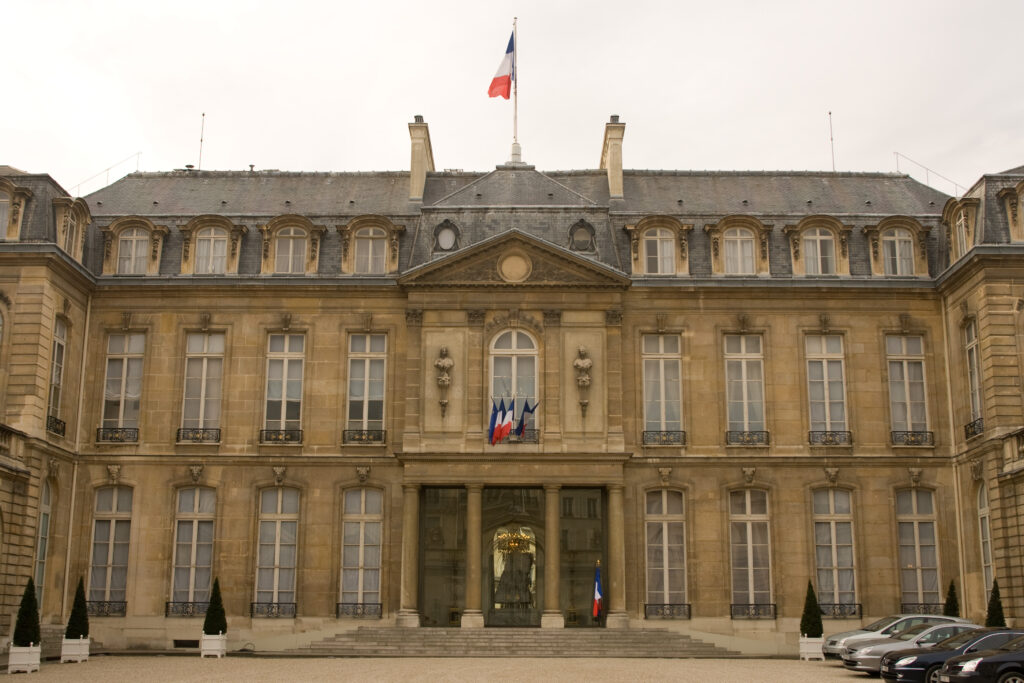
The featured image shows the Élysée Palace in Paris, seat of the President of the French Republic (c European Community 2008)



