Between East and West
If any European country should know where ultra-nationalism leads, it is Serbia.
A commentary by Charles Joseph Steiner
Lessons could be learned from recent history. This is particularly true for EU candidate Serbia, with its wonderful culture and cuisine, steeped in a rich fund of Western identity with hints of the Orient. Listening to Serbian music, one senses a certain oriental melancholy. Serbia has lost much in the past – due in no small part to the burgeoning nationalism following Tito’s death. In the late 1980s, Slobodan Milošević dreamed of a resurgent Serbia. The flashpoint for a conflagration that led to war only a few years later was Kosovo. On the 600th anniversary of the Battle of Kosovo – known as Kosovo Polje in Serbian and Fushe Kosova in Albanian – where Serbian, Bosnian, and Albanian troops faced the Ottoman Empire in 1389, Milošević made no secret of his convictions. With fatal consequences. Yugoslavia collapsed; a bloody war claimed tens of thousands of lives. And Srebrenica remains seared into the collective memory to this day. What did this ideology bring the country? Yugoslavia collapsed, and Serbian territory along with it. Montenegro and Kosovo are independent; Serbia is cut off from the sea.
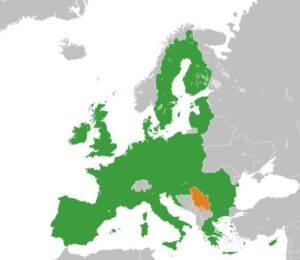
The EU-28 (green), Serbia, and the Republic of Kosovo. The recognition of its former province is one of the prerequisites for enabling Serbia’s accession to the European Union. Geographically and culturally – as the map illustrates – this enlargement would certainly be consistent.
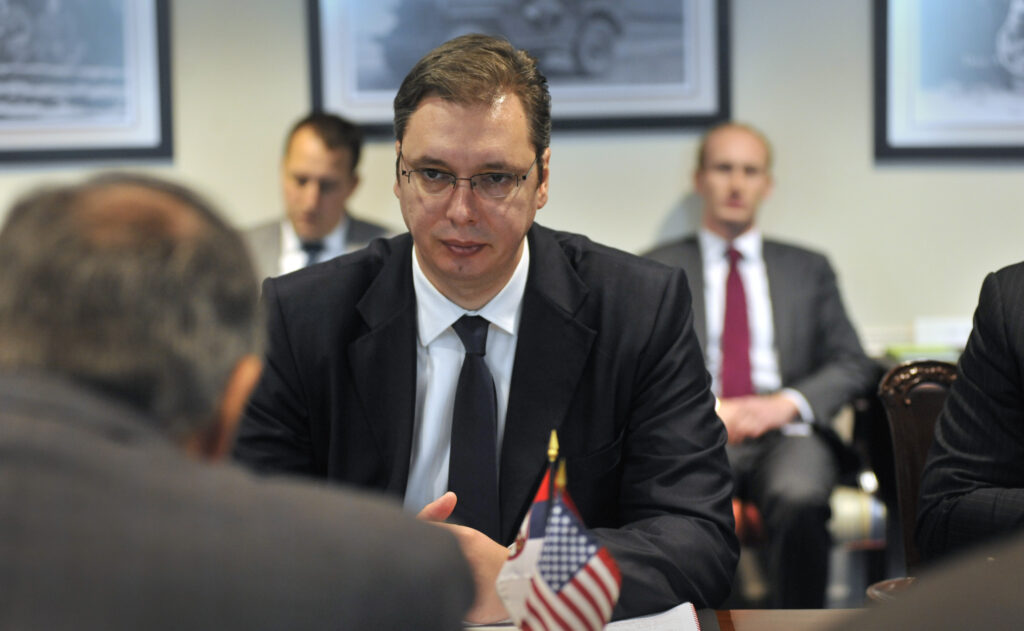
An object lesson in the massive consequences that exclusionary national pride can have. The newly elected President, Aleksandar Vučić – who served as Minister of Information under Milošević – should know this. While he presents himself as emphatically pro-European, doubts arise when trains bearing the slogan “Kosovo je Srbija” are sent towards Kosovo and he flirts with the idea of establishing a presidential democracy. Such a confrontational stance can quickly escalate into a conflagration once again, especially when the wounds of the Yugoslav Wars – which remain fresh following the Bosnian War – have not yet healed. A domestic political dilemma. There is a desire to orient towards Europe while simultaneously restoring the Serbian nation to its former strength – and in the East, Russia waits with open arms, a country with which Serbia rightly shares a traditional cultural bond. This makes the situation even more complicated, as it is domestically ambivalent.
Economically, Serbia has adapted well to European standards. Following the Kosovo War and the subsequent change of regime, the privatisation of state-owned enterprises began, banks were sent into insolvency, and the financial market was thus opened to foreign investors. With success. Today, Serbia is a liberal market economy with largely Western standards and, following the embargo during the war years, has either initiated or renewed memberships in the IMF and the WTO. Austrian companies, in particular, are considered the strongest group of investors. It was not least due to the orientation towards Europe that numerous foreign corporations were attracted. And the forecasts are good. Analysts estimate that the economy continues to gain momentum. The market is no longer viewed as volatile, but as very stable.
However, the political system remains torn between the national legacy of the 1990s and the Western orientation after 2000 – and, of course, the traditional friendship with Russia, which further fuels domestic political tensions. Following the West’s recognition of Kosovo, a group led by Tomislav Nikolić split from the radical SRS and founded the SNS, the Progressive Party. Aleksandar Vučić was elected chairman from these ranks in 2012.
The SRS, as an ultra-nationalist party under the leadership of Vojislav Šešelj, remains a dominant factor in Serbia – burdened by a heavy legacy from the war, when paramilitary troops from its circles participated in ethnic cleansing and war crimes. This brought Šešelj before the Hague Tribunal and into long-term remand. The party drifted into insignificance and was ousted from parliament in 2014. Following Šešelj’s surprising acquittal, he led the SRS back into parliament.
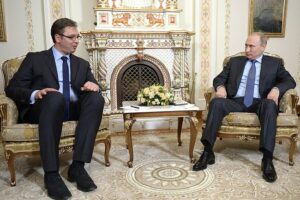
Vučić in 2014 with Vladimir Putin. Serbia’s close ties to Russia often leave observers concerned, but also offer opportunities.
Copyright: By Kremlin.ru, CC-BY 4.0, https://commons.wikimedia.org/w/index.php?curid=34663545
Then there is the Socialist Party (SPS), a successor to that of Milošević, which became a marginal force after the regime change but managed to recover in 2008 through a renewal towards a social-democratic programme. It is now the second-strongest force in Serbia. Then there is the Democratic Party (DS), which, as the opposition at the time, swept Milošević from office with a coalition. A significant role was played by Zoran Đinđić, who was later assassinated. Subsequently, Boris Tadić took over the leadership of the party and was able to win both a government majority and the presidency in 2008. This was short-lived: four years later, both offices were lost again. The social-democratic party SDS, led by former President Boris Tadić, split from the DS and only narrowly managed to enter parliament in 2016. Three years ago, former Economy Minister Saša Radulović founded the economically liberal movement “Enough is Enough” (Dosta je bilo), which initially saw little success but entered parliament last year as the strongest opposition force.
Resolving both domestic and foreign political tensions is a Herculean task. However, it is possible, and specifically at a diplomatic level. Serbia could, for instance, be granted a mediator role due to its ties to both Europe and Russia, simultaneously relieving the country of its internal conflict between Europe and Russia by actively involving it. Before that, however, certain mental barriers must be broken down – between Serbia, Kosovo, Bosnia, and Croatia. One could argue that only in a common Europe without borders does every single country have a chance for a future, and it is therefore worthwhile to invest in good relations with neighbours.



