150 Years of the Austro-Hungarian Compromise

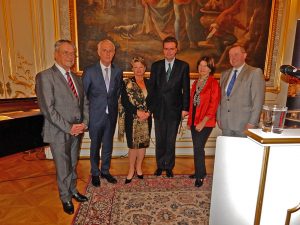
In the Marble Hall of the Hungarian Embassy, from left: Stefan Radda (President of the Round Table of Hungarian Organisations in Austria), Ambassador Dr. János Peréni, Elisabeth Ulm (Vice-President of the Paneuropean Movement Austria), Georg von Habsburg, Marika Radda (President of Club Pannonia), Rainhard Kloucek (Secretary General of the Paneuropean Movement Austria).
In a joint event organised by the Hungarian Embassy, Club Pannonia, Donauphilharmonie, and the Paneuropean Movement Austria, Georg von Habsburg spoke on 29th March about the 150th anniversary of the Compromise between Austria and Hungary, which established the Habsburg Dual Monarchy.
Just hours after the British Ambassador in Brussels handed his country’s withdrawal letter to Council President Donald Tusk, Georg von Habsburg, who lives in Hungary, drew a historical arc from 1526 (when Hungary fell to the Habsburgs) to the present day.
To understand the Compromise, one must delve further back into history, knowing the events both before and after it. For Hungarians, for example, the use of their own language was always important, which is why Emperor Joseph II made himself so unpopular in Hungary by mandating the German language.
In assessing the Compromise, Georg von Habsburg stated that one should not only consider the establishment of the Dual Monarchy but also evaluate the gestures of reconciliation following the 1848 Revolution. For instance, his grandfather Archduke Karl (the later Emperor Karl, King Karl in Hungary) led the funeral procession for the commander of the Hungarian revolutionary troops.
The Compromise, with the December Constitution of 21st December 1867, also had its effects on Austria. At that time, the general rights of citizens, the principle of equality before the law, freedom of residence, freedom of association and assembly, and the necessity of a judicial order for arrest were enshrined. Article 19 established the equality of all ethnic groups and all languages. Therefore, anyone speaking of a “prison of nations”, according to Georg von Habsburg, clearly had no idea of the rights prevalent at that time.
Georg von Habsburg criticised nationalist currents. Nationalism, he argued, had always led only to deterioration. Concluding his speech, Georg von Habsburg advocated for closer cooperation in Central Europe, also to give renewed impetus to the development of the European Union.



