Balkanisation of the EU?
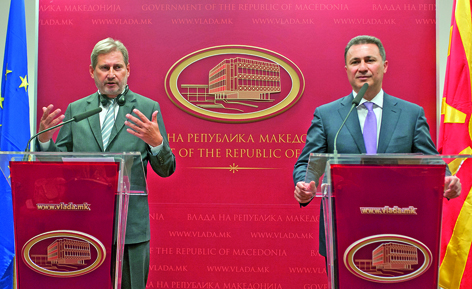
A failure of European Union policy is emerging in the Balkans. Extra-European powers are increasingly pushing into this geopolitically vital region. The old socialist networks are clawing their way back to power.
An analysis of the situation in South-Eastern Europe by the Secretary General of the Paneuropa Movement Austria, Rainhard Kloucek
Since 2003, the European Union has promised accession to the countries of the so-called Western Balkans. The term ‘Western Balkans’ is EU jargon and comprises the countries of the former Yugoslavia, excluding Slovenia, plus Albania. In Austria, the region would be called South-Eastern Europe. In EU jargon, South-Eastern Europe refers to San Marino. At the Thessaloniki summit in 2003, the prospect of accession was opened for the countries of South-Eastern Europe. This is why people also speak of the Thessaloniki Process.
Not much has happened since then – that is, in the past 14 years. Croatia is the only country from this group to have joined the EU so far. Macedonia was granted candidate status in 2005, which is now twelve years ago. Since then, the Macedonians have been waiting for a date to begin concrete accession negotiations. However, Greece has successfully prevented this so far. This highly corrupt and long-bankrupt country has even managed to insist that Macedonia may not use its own name on the international stage. Instead, it is called FYROM (Former Yugoslav Republic of Macedonia). At the European Union level, there is a lack of necessary pressure on Greece. People are too preoccupied with themselves and national egoisms.
Added to this is an enlargement fatigue that is noticeable at all levels of the EU. De facto, the institutions have agreed that there will be no progress on enlargement during the 2014 to 2019 legislative period. At the 2016 Paneuropa Congress, the Presidents of Albania, Kosovo, and Macedonia spoke, among other things, about the motivation for reforms provided by the prospect of accession, but simultaneously expressed their disappointment that no further steps are being taken by the EU. Macedonian President Gjorge Ivanov even feared that instead of a Europeanisation of the Balkans, we would now see a Balkanisation of the EU. (See also the documentation of the speeches by the three Presidents in “Paneuropa Österreich” 1/2017.)
The Balkans remains a geopolitically explosive region in which several extra-European powers are attempting to expand their influence. The USA, with its intervention in the Balkan wars of Slobodan Milosevic, contributed to the establishment of a post-Yugoslavia order. Their presence in the region cannot be overlooked. Anyone taking the gigantic complex for the new US embassy in Pristina, the capital of Kosovo, as an example, can sense the dimension of the American presence. Influence on the internal politics of individual countries is also documented. It remains to be seen how far the new US administration under President Donald Trump will make a withdrawal here.
The influence of Turkey is impossible to ignore. The country on the Bosphorus was active in the region as a colonial power for centuries. Many a mosque was paid for with money from Ankara, Turkish companies are involved in infrastructure (for example, at the airport in Pristina) and are otherwise a welcome investor. Turkey skillfully exploits the weakness of the EU and creates offerings for the countries in the education and medical sectors. Citizens of Kosovo, for example, still need a visa for the EU, but not for Turkey.
Russia increasingly active in the Balkans
Since Vladimir Putin has been turning Russia back into a militarily active great power, Moscow’s ambitions in the Balkans are once again clearly visible. A traditional ally is Serbia, where Russia maintains a large military base in Nis. When a criminal gang fought a battle with the police over several days in Tetovo (Macedonia) two years ago, some whispered that Moscow had its fingers in the pie. Obviously, Russia is reaching out its feelers very intensively towards Macedonia. A few weeks ago, reports came from Moscow claiming that the EU and the USA were destabilising Macedonia. During a conversation in Kosovo with a high-ranking government representative, when asked about the influence of extra-European powers in the region, he said: “The influence of Turkey is overestimated, but the interference of Russia is underestimated.”
The EU, by contrast, seems to be acting in the region without a concrete strategy. The recent visit by EU foreign policy chief Federica Mogherini to the Western Balkan countries was friendly but yielded no concrete results. After several years in which, among other things, EU policy had a stabilising effect on the region, increased unrest has been noticeable again recently. This is partly due to the effects of the policies of the EU and some of its member states.
Kosovo, for example, is still not recognised by all EU countries. Furthermore, unnecessarily high bureaucratic hurdles have been imposed on the country for ending the visa regime. The arrest of former Kosovo Prime Minister (and former KLA commander) Ramush Haradinaj by French police does not necessarily serve to calm the situation. The arrest took place on the basis of a Serbian warrant from 2004. In 2008, Kosovo declared its independence. Haradinaj had previously been indicted before the International Criminal Tribunal for the former Yugoslavia in The Hague; he resigned as Prime Minister after a short time, surrendered in The Hague, and was eventually acquitted.
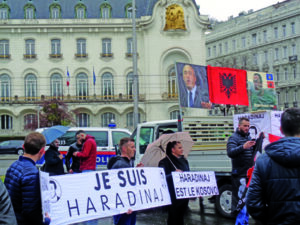
The arrest of former Kosovo Prime Minister Ramush Haradinaj in France (based on an old Serbian warrant) brings additional unrest to the region. Haradinaj had voluntarily surrendered to the war crimes tribunal. He was acquitted. The picture shows a demonstration by Kosovars in Vienna, in front of the French embassy.
For Bosnia and Herzegovina, the Dayton Agreement may have brought peace, but since then the country has remained in a state of frozen inability to reform. For local politicians, there is no motivation to change anything in the current system. Massive financial aid flows from the EU into the state, but it is not tied to the implementation of any necessary reforms. According to the treaty, the country consists of two entities – the Republika Srpska and the Federation of Bosnia and Herzegovina – but in practice, it is divided among the three ethnic groups of Serbs, Croats, and Bosniaks. All political and administrative posts are divided among these ethnic groups in a proportional representation system. As a diplomat from the country reported in a personal conversation, this proportionality is becoming more important again; people are being asked about their ethnicity much more often than in previous years. The secessionist tendencies of the Serbs and the influence of Belgrade are well known and are among the defining factors of unrest. Meanwhile, the Croatian government is also likely to be increasingly using the Croatian ethnic group for its influence. Countries like Germany and Austria remain very attractive to the country’s inhabitants. Anyone who can afford it attends a German course in the hope of finding work in Austria or Germany with good language skills.
The situation in Macedonia is explosive. Although the elections at the end of last year brought a majority for the previously governing VMRO-DPMNE, Prime Minister Nikola Gruevski’s party lost its coalition partners. President Ivanov belongs to the same party. At the beginning of March, he refused to recognise a government coalition of socialists and several Albanian parties. The Gruevski government is considered clearly pro-European. It came under pressure through the publication of wiretap transcripts from the secret service. Gruevski is said to have ordered the spying. However, the published transcripts were incriminating for his own government, not for the socialist opposition. Some Balkan experts therefore suspect old secret service networks behind the action. These old Yugoslav networks are more likely to be associated with the socialists.
Macedonia passed a law, among others, stating that the names of employees of the former secret service should be published. When the name of a leading representative of the Soros foundations appeared on these lists, the USA and the EU put pressure on Macedonia to withdraw this law. Macedonia yielded to the pressure.
Wrong interventions by EU and USA
The EU then intervened to hold new elections; a technical government was installed. The election should have taken place as early as spring 2016 but was then postponed until December. Apparently, the EU and its member states wanted to bring about a change of government. A German expert on Macedonia reports that the German embassy in Skopje advocated for a postponement of the election in Berlin. The reasoning: the socialists were not yet sufficiently positioned to be able to win the election.
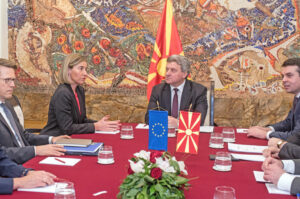
In Macedonia, the introduction of Albanian as a second official language throughout the country, negotiated between the socialists and the Albanian parties, threatens to jeopardise the balance between the ethnic groups. President Gjorge Ivanov has therefore refused to recognise this government coalition. The closure of the Balkan route
When Austrian Foreign Minister Sebastian Kurz appeared in the election campaign for VMRO-DPMNE (the Macedonian government was an extremely important partner for the closure of the Balkan route), he was heavily criticised for this in several commentaries, including the claim that he was betraying European values. During the election campaign, a rumour was launched in several media outlets in EU countries that Gruevski was Moscow’s man. Concrete evidence for this was never provided. However, the current policy of the EU (the Commission in particular) towards Macedonia and the clear interference to bring about a change to a socialist government could actually drive parts of Macedonian politics into Moscow’s arms.
At the beginning of this year, already after Donald Trump took office, the idea was launched from the USA to divide Macedonia. The Slavic part of the country was to go to Bulgaria, the Albanian part to Albania or Kosovo. Albania bears a high degree of blame for the current situation in Macedonia. Nikola Gruevski’s government was a coalition of VMRO-DPMNE with an Albanian party. Following interventions by Albanian Prime Minister Edi Rama, the Albanian parties switched to the side of the socialists. As the price for the switch, the socialists had to promise to introduce Albanian as a second official language in Macedonia. The balance between the two ethnic groups has experienced tensions time and again. With the Ohrid Agreement in 2001, an agreement was reached on the representation of the Albanian ethnic group in the country. The coalition agreement with the socialists would massively disrupt the balance achieved and would not be accepted by the Macedonian population. This is also a reason for President Gjorge Ivanov’s refusal to recognise this government.
Questionable deals in Albania
In Albania, the EU Commission itself has been under pressure for weeks. The reason is a real estate deal for which the head of the Commission office in Tirana, the Croatian socialist Romana Vlahutin, is responsible. According to this, a residence was purchased at a vastly inflated price in a noble area of the Albanian capital Tirana called Rolling Hills. While around 2,000 euros per square metre of living space is normally paid in the area, the EU Commission paid more than 4,700 euros per square metre for the residence. German MEP Ingeborg Grässle investigated the allegations with an inquiry to the Commission. In its response, the Commission argued that the usable area was larger than stated in the inquiry. This would make the price per square metre significantly lower. Apparently, however, the garden area was included here, which does not correspond to local practices in pricing.
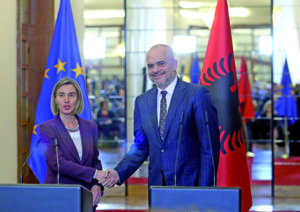
EU foreign policy chief Federica Mogherini during her recent visit to Albania with Albanian Prime Minister Edi Rama. In Tirana, the EU Commission is facing corruption allegations due to a property purchase. Rama, a man of the old socialist networks, has contributed to the destabilisation of the neighbouring country with his instrumentalisation of the Albanian parties in Macedonia. In Albania itself, hemp cultivation has become a lucrative business during his time in government.
GENT SHKULLAKU / AFP
Another problem in Albania is the de facto legalisation of hashish cultivation by the socialist government of Edi Rama. This led to the absurd situation where companies looking for workers could not fill vacancies because people preferred to engage in the cultivation of hemp. While the problem is well known in Albania and the region, it is hardly mentioned in the media in EU countries. Through this branch of business, the government is said to be collecting gigantic sums of money to buy votes in the election scheduled for this year.
The OSCE (chaired by Austria in 2017) – which maintains an office in Albania with around 80 highly paid employees – is dealing with the topic on a scientific level. It is having a study prepared to investigate why Albanians are growing hemp on such a large scale. In the end, as one interlocutor suggested, it might turn out that Albanians grow hemp because they can earn a lot of money very quickly. This conclusion could be drawn without an expensive scientific study. Furthermore, the head of the OSCE office in Tirana, Bernd Borchard, made a strange U-turn. After speaking in a television interview about around two billion euros being generated from the cannabis business for vote-buying in the upcoming election, he revised these statements 24 hours later during a meeting with the Interior Minister, explaining that this did not concern the current government but the previous one.
In addition to judicial reform, the EU Council in December last year made the fight against drug cultivation and the decoupling of politics and organised crime a precondition for the start of accession negotiations. A total of five priorities were listed that must be implemented by Albania before accession talks can begin (perhaps in 2018). In an article in the “Tirana Times” from March, Genc Pollo, President of the Paneuropa Union Albania and opposition MP, compares the politics surrounding these reforms to Matryoshkas (those Russian dolls where each doll contains a smaller doll), i.e., an opaque game. In contrast to the five priorities, Prime Minister Rama speaks only of judicial reform as a precondition for accession negotiations. Vlahutin, the EU Commission representative in Tirana, reportedly supports him in this position.
An EU Commission facing allegations of strange real estate deals is unlikely to be the most credible representative for reform towards the rule of law. Added to this are allegations that in this matter, too, the international community, similar to Macedonia, is taking a one-sided stance in favour of the socialists. For instance, several US senators wrote in a letter to the new US Secretary of State Rex Tillerson about the influence of US diplomacy in cooperation with the Soros “Open Society” foundation (which also receives subsidies from the US taxpayer and the EU Commission) on the judicial reform. In doing so, they suggest that the strategy written by Open Society experts is intended to secure power over the judiciary for the Prime Minister and left-of-centre forces. This could lead to the destabilisation of a NATO country where government corruption is increasing again, as is drug trafficking.
There have been blockades and protests by the opposition for weeks. Elections are due in June. The opposition is demanding the resignation of the government and the installation of a transitional cabinet to prepare for fair elections. This approach was apparently copied from Macedonia. There, the EU had insisted on the installation of such a transitional government. It was indeed installed. In the case of Albania, a corresponding expression of will by the Commission is missing. In Macedonia, a non-socialist party governed; in Albania, the old socialists are in power.
Photos: Paneuropa Archive and European Union



