The Treaty of Rome Turns Sixty
Sixty years after the EEC was founded by the Treaties of Rome, the EU is in crisis. It is not merely a novel nationalism that paralyses Europe. A return to the principles of the market economy would be beneficial.
A commentary by: Rainhard Kloucek
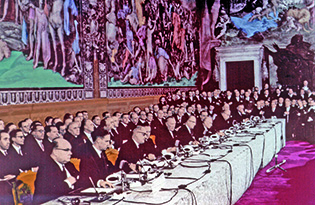
Sixty years ago, on 25 March 1957, the Treaty establishing the European Economic Community was signed in Rome. This treaty became known as the Treaty of Rome or the Treaties of Rome. Belgium, Luxembourg, the Netherlands, France, Germany, and Italy thereby laid the foundation for European unification, which, through several new treaties and a number of enlargement rounds, became today’s European Union. The Treaties of Rome also created a first ‘constitution’ for a united Europe, whose core elements were the four fundamental freedoms.
While a planned economy approach had previously been pursued with the European Coal and Steel Community (the coal and steel industries were placed under common control to prevent further wars in Europe), the four fundamental freedoms laid the foundation for a market-based Europe.
The free movement of persons, the free movement of services, the free movement of capital, and the free movement of goods were intended to make it impossible for nation-states (member states of the then EEC and today’s EU) to pursue the protectionist isolationist policies with which they believed they could export their own problems in the interwar period, but which in reality only led to a massive increase in problems. Economic freedom always and everywhere leads to an improvement in the situation and to greater prosperity.
However, 60 years after Rome, these four fundamental freedoms are more endangered than ever. Because political short-sightedness has led to the failure to establish effective protection of external borders, or even to its obstruction, national border controls are being reintroduced. The increasing regulation at national (and consequently also at European) level is a general attack by bureaucracy on economic and civil liberties.
Yet, member states have been, and continue to be, extraordinarily inventive in restricting the freedom to provide services. The employment bonus planned in Austria is a bureaucratic-protectionist measure and a clear violation of the free movement of workers.
A law against so-called wage dumping came into force at the beginning of the year, requiring, for example, drivers of transport vehicles to demonstrate a minimum wage. This undermines the freedom to provide services. Of course, states like France or Belgium have long had such protectionist laws.
Given the crisis the EU finds itself in, a return to the four fundamental freedoms would be necessary. Europe is a project of freedom. Without freedom, a united Europe loses its legitimacy.



