“A region without which Europe is not complete” – Western Balkans panel at the Com.sult Congress
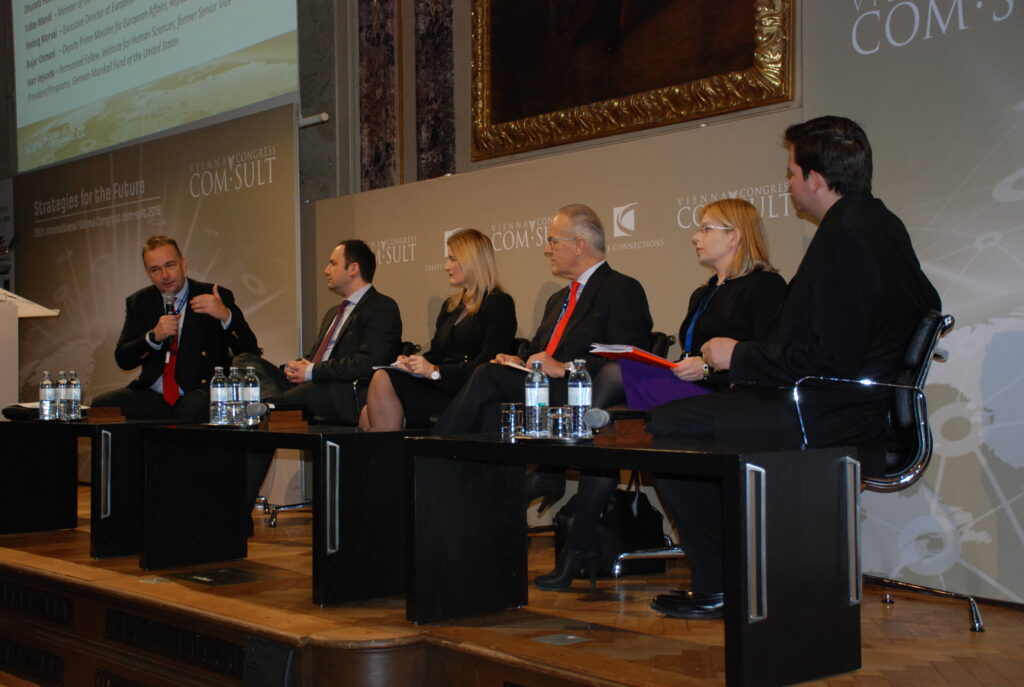
In EU jargon, the Western Balkans is the term for the countries of the former Yugoslavia plus Albania that are not yet members of the European Union. These six countries – Albania, Bosnia-Herzegovina, Kosovo, Macedonia, Montenegro, and Serbia – were one of the focal points of the Com.Sult conference, which took place in Vienna at the end of January. A report by Rainhard Kloucek.
Conference organiser David Ungar-Klein (Com.Sult took place for the fifteenth time this year) is himself closely connected to the region as Honorary Consul for Kosovo. Just under a week before the presentation of the European Union’s new enlargement strategy (an assessment will follow in the next issue of our magazine), the topic was highly topical. Furthermore, with Bulgaria in the first half of 2018 and Austria in the second half of 2018, two countries hold the EU Council Presidency this year which, due to their geographical location and historical significance, have a special connection with the region.
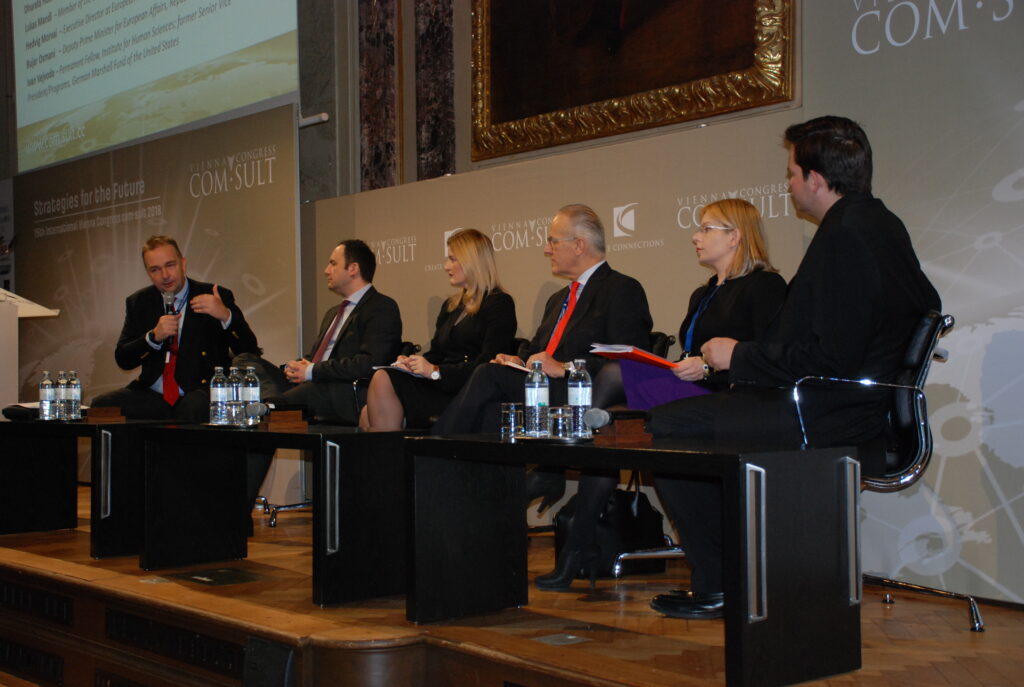
The panel – moderated by Paneuropa President Karl von Habsburg.
© lukasmandl.eu
The naming “Western Balkans” was also addressed by several speakers during the event. Karl von Habsburg, who moderated the discussion, recalled the invention of the term back when he was a member of the European Parliament and a member of the South-East Europe delegation. When he asked the ambassadors of these countries at the time what they thought of the term Western Balkans, one of the diplomats replied by asking what the Eastern Balkan states were supposed to be. He pleaded for the use of the term South-East Europe.
Ivan Vejvoda from the “Institute for Human Sciences”, who previously worked for the German Marshall Fund, recalled his experience in London, where the region was referred to as the East Adriatic.
The Deputy Macedonian Prime Minister responsible for European integration, Bujar Osmani, argued that the crucial part of the term Western Balkans is the word “West”. This makes it clear that the integration of these countries must take place into Western structures. He thus clearly advocated for Euro-Atlantic integration, i.e. his country’s (and the region’s) membership in NATO and the EU. He gave a clear rebuff to ideas of a possible alternative through Eastern structures (without naming Russia and Turkey).
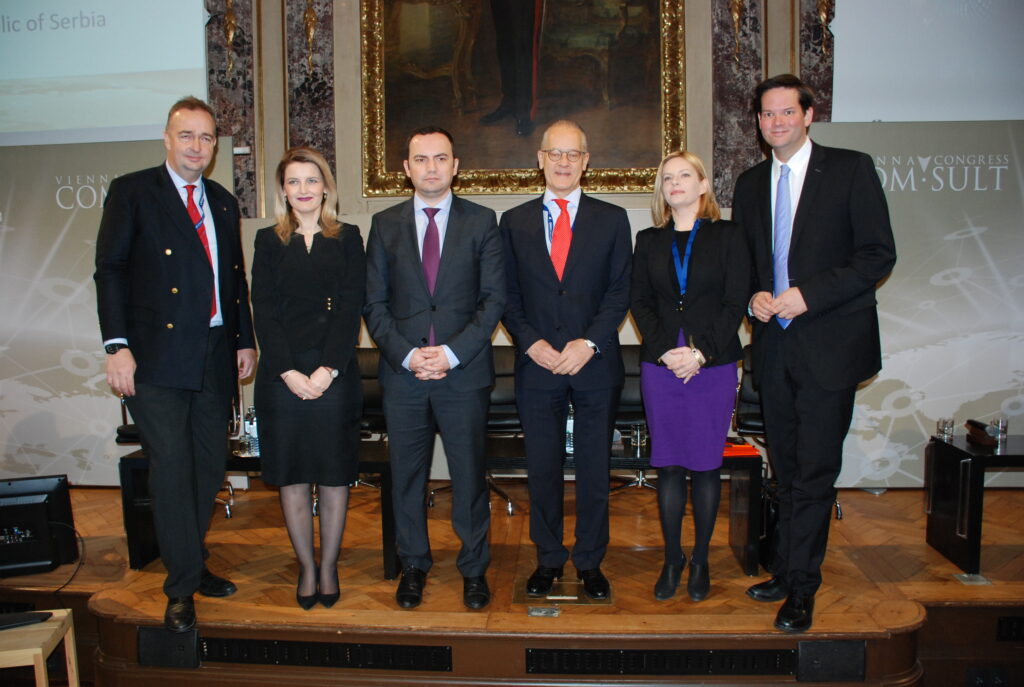
Karl von Habsburg, Durata Hoxha, Bujar Osmani, Ivan Vejvoda, Hedvig Morvai, Lukas Mandl
© lukasmandl.eu
Already in his opening speech, the Deputy Macedonian Prime Minister (who comes from the Albanian part of the population) emphasised the importance of EU membership for the political stability and economic prosperity of his country. In political rhetoric, one must move away from nationalism towards a functioning democratic structure. While the region was long considered a factor of uncertainty in Europe, today one can say it is stable after many conflicts. This, too, is a consequence of the EU perspective.
Despite all the scepticism prevailing in EU countries due to enlargement fatigue, it is clear that membership for the countries of South-East Europe is also a gain for the EU member states. The costs of admission must be weighed against the costs of non-admission. Osmani was not only alluding to the danger that rejection by the EU could reinvigorate old conflicts and nationalist aspirations, but also to the interest of non-European countries in the region that seek to weaken Europe as a whole.
The Minister for European Integration of the Republic of Kosovo, Dhurata Hoxha, argued similarly, emphasising her country’s main goal of consolidating the nation and developing a mature market economy through the path to the EU. She made it clear that the necessary reforms were not to be carried out for the sake of the EU, but for their own country. “We need reforms because our people need reforms!”
According to the Minister, Kosovo is the most pro-European country. All studies show a clear and distinct majority in favour of membership in the European Union. Together in Europe, we are stronger. Dhurata Hoxha was alluding to European unity in diversity. Despite the optimism with which she awaits the publication of the enlargement strategy, she also warned of those forces that remain active and wish to prevent the success of integration.
In addition to the two ministers, the discussion moderated by Karl von Habsburg included the Austrian MEP and Paneuropean Lukas Mandl, the aforementioned Ivan Vejvoda, and Hedvig Morvai, Director of the Balkan Fund.
Lukas Mandl, who is also Chairman of the Austrian-Kosovar Friendship Society, pointed to an additional handicap for Kosovo. Europe’s youngest country – which declared its independence ten years ago on 18 February 2008 – is the only country in the region for which a visa regime still exists.
The MEP also alluded to non-European states that apply less bureaucratic criteria to the visa issue than EU countries do. (Note: five EU countries still do not recognise Kosovo’s independence.) Mandl emphasised the stabilising effect of EU enlargement and places his hope, among other things, in the Austrian EU Council Presidency, which has defined the Western Balkans as one of its three priorities alongside security and subsidiarity.
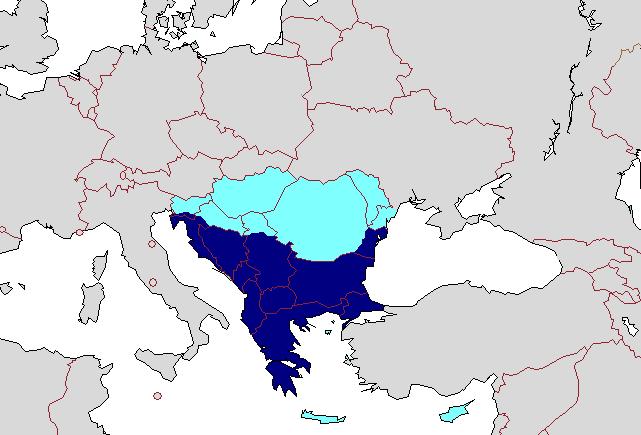
The states or regions designated (in the broadest sense) as South-East European.
© By Südosteuropa_2.png: User:Olahus. Original uploader was Olahus at de.wikipedia derivative work: Seader (talk) – Südosteuropa_2.png, CC BY-SA 3.0 de, https://commons.wikimedia.org/w/index.php?curid=15019050
Hedvig Morvai drew attention to the peculiarity of the South-East Europe region (Western Balkans) visible on every map. These states are surrounded by the EU from all directions. Additionally, she brought another vital aspect into the discussion concerning the future of the EU. 2018, she said, would be very important for the Western Balkan states. The entire question of how the EU will handle the countries’ emphasised willingness to join is not only important for these countries but a decisive one for the future design of the EU.
Ivan Vejvoda – who is based in Vienna through his work at the “Institute for Human Sciences” – pointed to a fact that is very important from a Viennese perspective: “We are talking about our direct neighbourhood here.” Therefore, he assumed that Austria will play a very important role in this specific enlargement question.
Regarding the dispute over the name of the Republic of Macedonia, which has lasted for decades, he places great hope in the recent rapprochement between Macedonia and Greece. Greece had previously blocked all of Macedonia’s efforts to join the EU and NATO because it wanted to prevent Macedonia from using the name Macedonia as its state name. Now, talks have taken place between the governments of both countries, offering hope for a solution. Vejvoda also expressed optimism regarding the dialogue between Serbia and Kosovo. It is clear to both countries: “Their future is in the EU.”



