A Historic Disgrace / A Historic Disgrace
The Pan-European Picnic and Its Message for Europe / The Pan-European Picnic and Its Message for Europe
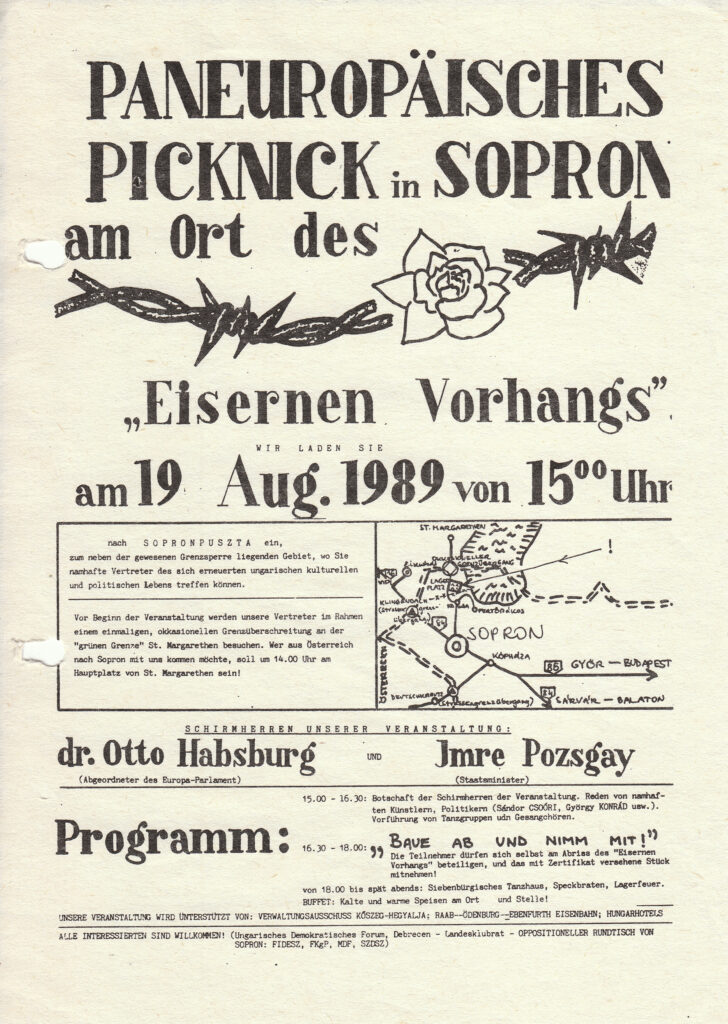
The Pan-European Picnic on 19 August 1989 on the Austro-Hungarian border heralded the end of the division of Europe into an East controlled by the Moscow colonial empire and a free West. European unification was thus intended to be open to all European peoples and states.
36 years after this historic event, it appears as if the ghosts of this policy of division are active once again. The European Union must counter this with a clear policy that includes the following priorities:
Enlargement policy is part of a strategic European foreign policy.
Europe instead of nationalism.
Freedom instead of totalitarianism.
Rule of law instead of political arbitrariness.
A policy of peace instead of a policy of war. This means, however, that the party under attack has the right to defend itself, and that the free world has the right, or even the duty, to support them. If this were not the case, the messages of freedom instead of totalitarianism and the rule of law instead of political arbitrariness would be thwarted, as the aggressor would prevail.
Hungary, which was still ruled by communists at the time, made the Pan-European Picnic possible. ‘It is a historic disgrace,’ said Rainhard Kloucek, President of the Pan-European Movement Austria, ‘that the current government of this very country, Hungary, now wishes to deny its neighbour Ukraine its rights to freedom – by which I mean territorial integrity as well as accession to the EU and NATO.’
A comprehensive assessment of the Pan-European Picnic and its significance for the freedom of Europe can be read here https://pan.thatscommunication.de/das-picknick-und-seine-bedeutung-fuer-die-freiheit/#more-3359 and heard here: https://www.youtube.com/watch?v=2r4MDaoWhjw&t=13s
The Pan-European Picnic on 19 August 1989 on the Austro-Hungarian border initiated the end of the division of Europe into an East controlled by the Moscow colonial empire and a free West. European unification was thus intended to be open to all European peoples and states.
36 years after the historic event, it appears as if the ghosts of this policy of division are active again. The European Union must counter this with a clear policy that includes the following priorities:
Enlargement policy is part of a strategic European foreign policy.
Europe instead of nationalism.
Freedom instead of totalitarianism.
Rule of law instead of political arbitrariness.
A policy of peace instead of a policy of war. This means, however, that the attacked party has the right to defend itself, and that the free world has the right, or even the duty, to support the attacked party. If that weren’t the case, the messages of freedom instead of totalitarianism and the rule of law instead of political arbitrariness would be counteracted because the aggressor would prevail.
Hungary, then still ruled by the communists, made the Pan-European Picnic possible. ‘It is a historic disgrace,’ said Rainhard Kloucek, President of the Pan-European Movement Austria, ‘that the current government of precisely this country, Hungary, now wants to deny its neighbour Ukraine its civil liberties – by that, I mean territorial integrity and accession to the EU and NATO.’



