A Message from the Pan-European Picnic
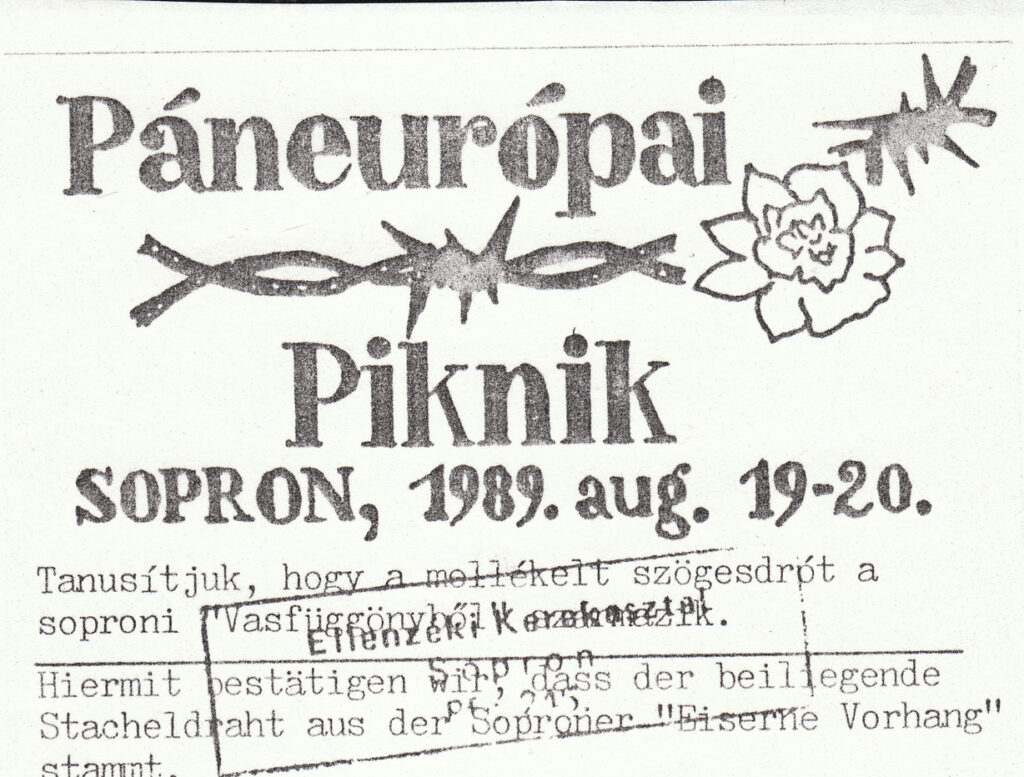
On 19 August 1989, the first hole was torn in the Iron Curtain at the Pan-European Picnic on the Austro-Hungarian border. It was the beginning of the end of the division of Europe. This made European integration possible for the countries of Central Europe. However, it was also a clear signal against Russian imperialism. This message seems to have been lost on some countries today. A commentary by Rainhard Kloucek, Secretary General of the Paneuropa Movement Austria.
Find the English version below.
19 August 1989 – at the ‘Pan-European Picnic’ on the Austro-Hungarian border, 661 citizens of the former GDR flee to freedom.
The Neue Zürcher Zeitung remarked at the time that it was surely an irony of history that Austria and Hungary were leading the Prussians to freedom. The picnic was the first major breach in the Iron Curtain that had divided Europe after the Second World War into the Russian-Soviet occupied East and the free West. Hungary was the first country in the former Eastern Bloc that – aware of the economic situation – decided to dismantle the Iron Curtain. Its repair would have been too expensive.
This paved the way for the end of the division of Europe. In November 1989, the Berlin Wall fell. The divided Germany could be reunited. Finally, the dissolution of the Warsaw Pact and the Soviet Union followed in 1991. The Baltic states were able to regain the independence they had lost as a result of the Hitler-Stalin Pact. The states that achieved their independence from Moscow sought a path into NATO to be secure from future military attacks by imperialist Russia, and they sought a path into the European Union because they aspired to a market economy instead of a socialist planned economy, as well as democracy and the rule of law instead of despotism and the law of the jungle.
The end of the division of Europe was not only a victory for the free West over the despotism of the East, but also a temporary victory over Moscow’s imperialism and its Great Russian ambitions, regardless of the ideological cloak under which they were propagated. Russia had to withdraw its colonial troops from Central Europe. This end of Russia’s colonial rule over half of Europe, the withdrawal of the Russian soldiery, was celebrated in all the countries of Central Europe that had now gained their independence. This was especially true in the country that was the first to dismantle the Iron Curtain, and which still proudly remembers the 1956 uprising against the Soviet Union today.
Thirty-four years later, Russian imperialism – the dream of a Moscow despot regime of a new Russian Great Empire – is once again a reality in Europe. Russian troops are currently attempting to destroy that western neighbouring country to which the path to the EU and NATO had not yet been opened. People are dying daily in Ukraine because, for the despot in Moscow, the end of the Soviet Union was the greatest geopolitical catastrophe of the 20th century, and because this despot and his propagandists dream in an imperialist frenzy of bringing Europe – or at least the eastern part – back under his control.
In a bloody manner, the people of Europe have had to learn the lesson that the idea which blossomed in 1989 – that war in Europe had been overcome – was merely an illusion. Russia is the last colonial empire in Europe, still holding its colonies in the East under control and attempting to bring former colonies in the West back under its control. United, the governments of the free European countries have sided with Ukraine, ready to support Kyiv in liberating the citizens of Ukraine and their own country from colonial troops.
Only one EU and NATO country in Europe apparently has no problem at all with accepting, through calls for an immediate ceasefire, that one of its neighbouring countries remains (at least partially) occupied by a murderous colonial army. It is perhaps a particularly malicious irony of history that the Prime Minister of this country was among those who particularly celebrated the end of the Russian colonial troops in Budapest in 1989.
(This article was originally written for the European Letters of the Coudenhove-Kalergi European Society.)
A MESSAGE FROM THE PAN-EUROPEAN PICNIC
19 August 1989 – at the ‘Pan-European Picnic’ on the Austro-Hungarian border, 661 citizens of the so-called GDR fled to freedom.
The Neue Zürcher Zeitung said at the time that it was probably an irony of history that Austria and Hungary were leading the Prussians to freedom. The picnic was the first big hole in the Iron Curtain that divided Europe after the Second World War into the Russian-Soviet occupied East and the free West. Hungary was the first country in the then Eastern Bloc that – knowing the economic situation – decided to dismantle the Iron Curtain. It would have been too expensive to repair.
This paved the way for the end of the division of Europe. In November 1989, the Berlin Wall fell. The divided Germany could be reunited. Finally, in 1991, the Warsaw Pact and the Soviet Union were dissolved. The Baltic states were able to regain the independence they had lost as a result of the Hitler-Stalin Pact. The states that were able to achieve their independence from Moscow sought a path into NATO in order to be safe from military attacks by imperialist Russia in the future, and they sought a path into the European Union because they wanted a market economy instead of a socialist planned economy, as well as democracy and the rule of law instead of despotism and the law of the jungle.
The end of the division of Europe, however, was not only a victory for the free West over the despotism of the East, but also a temporary victory over Moscow imperialism with its Great Russian ambitions, no matter under what ideological cloak they were propagated. Russia had to withdraw its colonial troops from Central Europe. This end of Russia’s colonial rule over half of Europe, the withdrawal of the Russian soldiery, was celebrated in all the countries of Central Europe that had now gained their independence. Especially in the country that was the first to dismantle the Iron Curtain and that still proudly remembers the 1956 uprising against the Soviet Union.
Thirty-four years later, Russian imperialism – the dream of a Moscow despot regime of a new Russian empire – is once again a reality in Europe. Russian troops are trying to destroy that neighbouring country to the west, which until now had no way into the EU and NATO. People are dying daily in Ukraine because for the despot in Moscow the end of the Soviet Union was the greatest geopolitical catastrophe of the 20th century, and because this despot, with his propagandists, dreams in an imperialist frenzy of bringing Europe – or at least the eastern part – back under his control.
In a bloody way, the people of Europe had to learn the lesson that the idea that war had been overcome in Europe, which blossomed in 1989, was only an illusion. Russia is the last colonial empire in Europe, still in control of its colonies in the East, and is trying to bring former colonies in the West back under its control. United, the governments of the free European countries have sided with Ukraine, ready to support Kyiv in freeing Ukraine’s citizens and their own country from colonial forces.
Only one EU and NATO country in Europe seems to have no problem at all in accepting, with a call for an immediate ceasefire, that one of its neighbouring countries will again remain (at least partially) occupied by a murderous colonial army. It is probably a particularly vicious irony of history that the Prime Minister of this country was among those who particularly celebrated the end of the Russian colonial troops in Budapest in 1989.
(The article was also published as a ‘European Letter’ by the Coudenhove-Kalergi European Society.)



