A Stable and Strong Europe
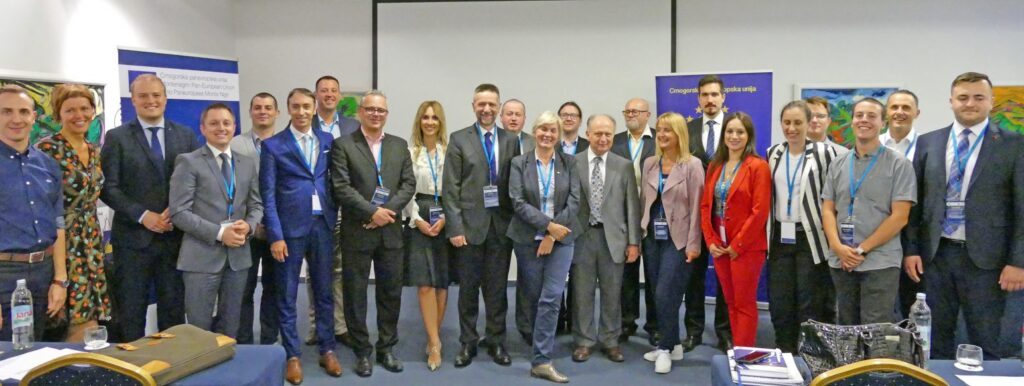
The integration of the countries of Southeast Europe was the focus of a conference held by the Paneuropa-Union Montenegro in Zagreb. Better communication of the enlargement strategy is just as necessary as a return to Europe’s fundamental principles. By Rainhard Kloucek
The resolution adopted during the conference can be read in its original English version here. A Montenegrin version can be found here. A German translation is available at the end of the article.
Montenegro, alongside Serbia, is the second country in Southeast Europe – usually referred to as the Western Balkans in EU jargon – for which a potential EU accession date is set for 2025. Achieving this goal is one of the primary activities of the Paneuropa-Union Montenegro. “Focus on the work” was therefore the core message from Gordana Djurovic, President of the youngest Paneuropa organisation, which is also one of the most active. The economics professor, who previously held a ministerial post in an earlier government, places great emphasis on a clear communication strategy. Part of this strategy was the second conference, which took place in cooperation with the Paneuropa-Union Croatia at the end of September in the Croatian capital, Zagreb. The first conference was held in November of the previous year in Podgorica, the capital of Montenegro (see “Paneuropa Österreich” 6/2017, page 8ff).
MONTENEGRO AIMS TO ACHIEVE EU MEMBERSHIP BY 2025
Gordana Djurovic explained what this work specifically means for Montenegro with a numerical example. If Montenegro genuinely intends to join the EU by 2025, then, she assumes, accession negotiations must be concluded by 2023. For this to succeed, it is necessary to complete six to eight chapters each year. So far, three chapters have been provisionally closed.
However, Croatian MEP Tonino Picula emphasised that this not only requires the willingness of the accession countries. He spoke of the necessity of a “rebranding” of enlargement. Enlargement, according to the MEP, was one of the most successful projects. Dejan Hribar, Secretary General of the Paneuropa Movement Slovenia, recalled survey figures that clearly show that approval for the EU in Albania, Bosnia-Herzegovina, Kosovo, North Macedonia, Montenegro, and Serbia is higher than in many EU countries. In times of economic prosperity, everything is always fine, but in a difficult situation, populists and nationalists emerge.
JUNCKER WAS FORCED TO CORRECT HIS STATEMENT
The EU is also called upon to act on this issue. Hribar recalled Commission President Juncker’s inaugural speech, in which he had ruled out enlargement for the next five years. He has now corrected this statement in his latest State of the Union address.
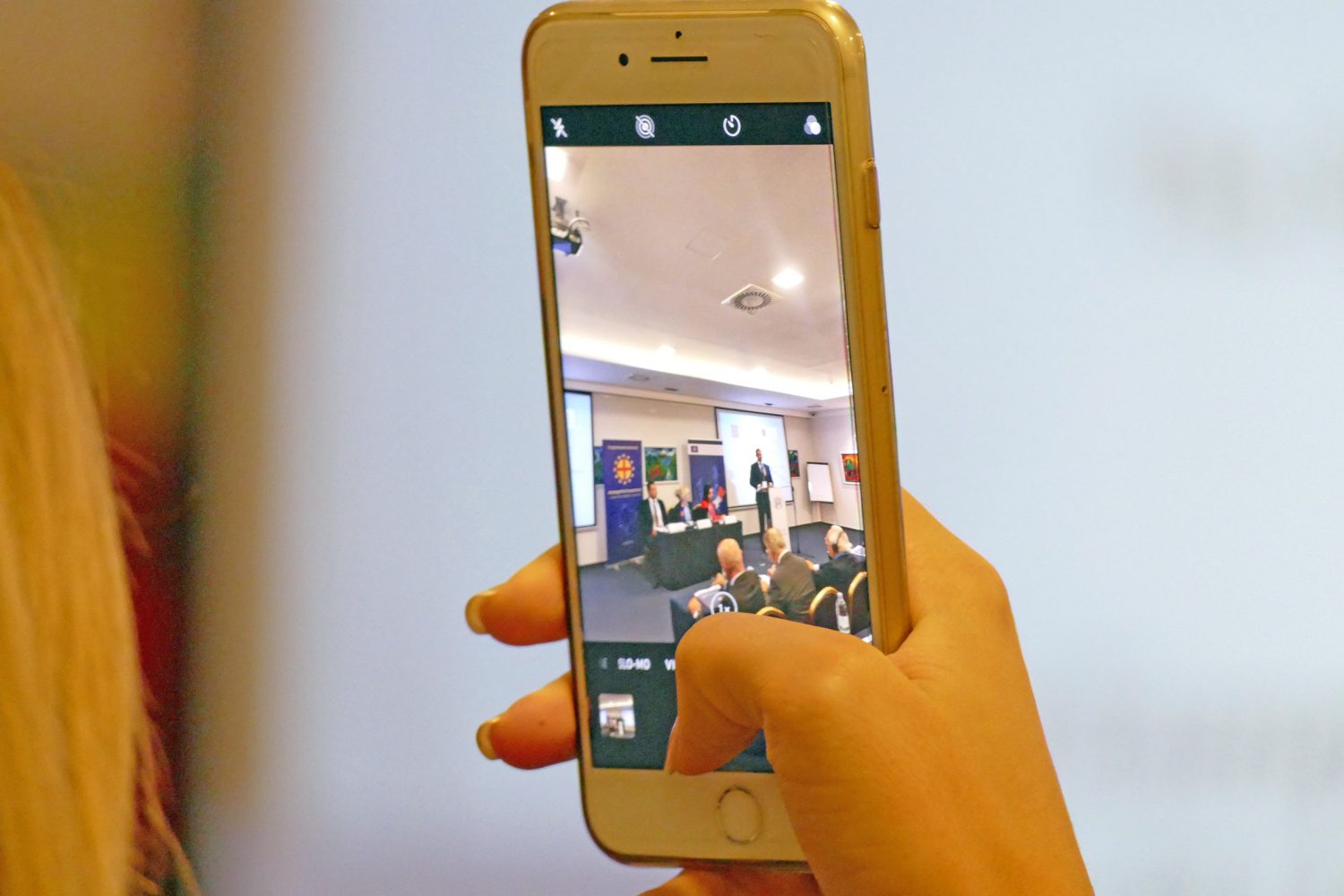
So-called social media is a decisive factor in political communication today.
The conference frequently emphasised the necessity for European politics to return to Europe’s true values and the original idea of unification. Alain Terrenoire, President of the Paneuropa-Union, criticised the EU for becoming a “bureaucratic aristocracy”, yet stressed the importance of making Europe capable of action on the political world stage again and prioritising European security policy. Pavo Barisic, Secretary General of the Paneuropa-Union, demanded a fact-based discussion about values, and criticised that the values enshrined in the treaties, which are a prerequisite for EU accession, are now being questioned. Bernd Posselt, President of the Paneuropa-Union Germany, called for an end to the monopoly of nation-states.
A dedicated panel, moderated by Paneuropa Youth, addressed how young people can contribute to the enlargement process. Here too, aspects of security and the fight against corruption were discussed, for example by Stefan Haböck, the expert for international relations in the Paneuropa Movement Austria.
THE POLITICAL DEBATE MUST BE IMPROVED
A unanimously adopted resolution called for “an improvement of political debates in the region to support the achievement of EU criteria in our countries, to contribute to faster EU integration, and to form a united, strong, and stable Europe.” An improved “dialogue between European institutions, EU member states, and the countries of Southeast Europe” is defined as one of the tasks of the Paneuropa-Union.
UTILISE THE SOFIA AGENDA FOR FURTHER STEPS
The efforts of Bulgaria during its Council Presidency are highlighted, where new steps were taken with the Sofia Agenda. Building on this and the work of the Austrian Council Presidency, the path to the integration of Southeast Europe must continue during Romania’s Council Presidency, in order to achieve further progress at the next Western Balkans Summit in Croatia in 2020. If the EU forgets the region, the clear statement (quoting Commission President Juncker’s speech) is, “other forces will shape our immediate neighbourhood in their own way.” “In this spirit,” the statement concludes, “we advocate for a stable, strong, and united Europe, including the countries of Southeast Europe – once and for all!”
Declaration of the Participants of the Second International Conference of the Paneuropa-Union Montenegro
For Europe: Communicating European Integration between EU Member States and Enlargement Countries
CEPES Project – Communicating Europe in Paneuropa Organisations, co-financed by Erasmus and EU programmes
Zagreb, 22 September 2018
We, the participants of the second international conference of the Paneuropa-Union Montenegro, held in the Croatian capital Zagreb, express our will to support better communication about the European integration process between the European Institutions, member states, candidate countries, and potential candidate countries in Southeast Europe, thereby supporting the dynamic integration process of Montenegro and all other countries in the region into the European Union. We advocate for:
For Europe through Better Communication
By disseminating European values and achieving the main goals of our organisation, we strive to improve political debates in the region, to support the achievement of EU criteria in our countries, to contribute to faster EU integration, and to form a united, strong, and stable Europe. We are convinced that better communication is a powerful tool for improved dialogue between European institutions, EU member states, and the countries of Southeast Europe. In this spirit, Paneuropa organisations should foster dialogue among all stakeholders, including governments, the academic community, civil society, citizens, and media.
Implementation of the Sofia Agenda
Advocating for a renewed enlargement process, we welcome the conclusions of the EU-Western Balkans Summit on 17 May 2018 in Sofia. They confirm the European perspective of the region and set out a series of concrete actions to strengthen cooperation in the areas of connectivity, security, migration, and the rule of law. The Sofia Agenda supports socio-economic development and places a special focus on youth, promotes a digital agenda for the region, and supports reconciliation and good neighbourly relations. The EU held its first summit with representatives of the region in 15 years. This increased engagement brings more security, stability, and prosperity, and connects economies and people.
A Europe that Protects, Strengthens, and Defends
We recognise the need to place a stronger focus on issues of security and the fight against illegal migration, to ensure prosperity and competitiveness through digitalisation and stability in the European neighbourhood, which is promoted by the Austrian Council Presidency. One of the three priorities is “Stability in the European Neighbourhood – the EU Perspective for the Western Balkans/Southeast Europe.” Following the aforementioned activities of the Austrian Presidency, it will be crucial that Romania, a Balkan country, places the Western Balkans at the top of its priority list, including accession negotiations and further steps concerning the EU integration of all countries (Sibiu Summit on 9 May 2019). The increased commitment to enlargement should be continued by Finland in 2019, and particularly intensified with regard to the EU-Western Balkans Summit in Croatia in 2020.
For Increased Engagement in the Region
We acknowledge and appreciate the significantly increased engagement of the European Commission over the past year. In February 2018, it proposed an ambitious Western Balkans Strategy. This approach by the Commission enables further progress. A historic agreement to resolve the name dispute was reached between Athens and Skopje. The border agreement between Kosovo and Montenegro has been ratified. The Commission has proposed to the Council the opening of accession talks with Albania and North Macedonia. Montenegro and Serbia are making progress in their talks, while Bosnia-Herzegovina is taking small but important steps in the right direction, specifically by answering the Commission’s questions regarding its membership application, which allows the Commission to continue its work. And the recommendation for visa liberalisation for Kosovo was confirmed by the Commission in 2018.
For a More Stable Region Integrated into the EU
We welcome the statement by EU Commission President Jean-Claude Juncker in his 2018 State of the Union address, in which he emphasised that “we must not lose a second when it comes to working towards a more united Europe. Europe can export stability, as has already happened with previous enlargements of the Union. For me, these enlargements are and remain success stories, because we have succeeded in reuniting the geography and history of European countries. But much remains to be done. We must arrive at an irrevocable stance on the Western Balkans once and for all. Otherwise, other forces will shape our immediate neighbourhood in their own way.” In this spirit, we advocate for a stable, strong, and united Europe, including the countries of Southeast Europe – once and for all!
Montenegrin Paneuropean Union
Paneuropa Union Montenegro



