Albania: The Religious Showcase Country Has Voted
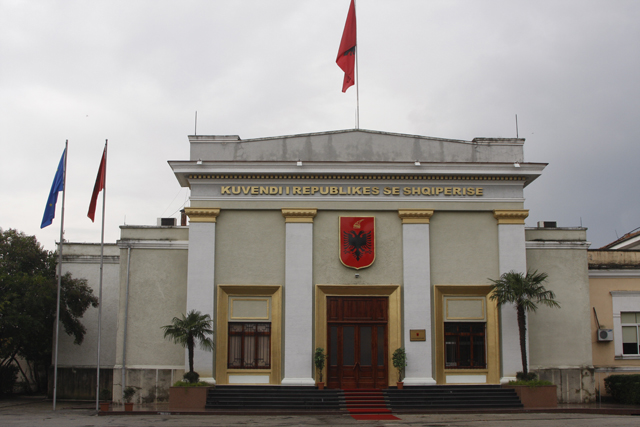
Ruined by socialism, now on the rocky road to Europe: For the eighth time since the fall of the socialist regime in 1991, Albanians voted on Sunday for the 140 members of the Kuvendi i Shqipërisë, the parliament.
A commentary by Stefan Haböck, International Officer of the Paneuropa Movement Austria.
Prime Minister Edi Rama’s Socialists are on the verge of an absolute majority and will emerge as the strongest force. The opposition Democratic Party of Lulzim Basha achieved around 35 per cent. The LSI, traditionally a ‘kingmaker’ for one of the two major parties, is considered the decisive factor with its approximately 11–15 per cent. Both the Socialists and the PD targeted the LSI in the run-up to the election. A grand coalition in Albania? Unprecedented! The final election results are yet to be confirmed.
Ruined by the socialist dictator Enver Hoxha, the country grapples with the classic problems of transitional nations. Poverty and corruption are rampant. Cannabis cultivation has become one of the most important economic sectors. Simultaneously, the country boasts a rich history, beautiful nature, and access to the sea.
From Fascism to Stalinism
After the attempt to establish a democratic state failed in the 1920s, Albania fell into the clutches of fascist Italy. Mussolini annexed the country in 1939. Until 1944, the Axis powers, led by the German Reich and its allies, occupied the country, until it gained independence in the same year after years of partisan struggles.
Enver Hoxha, the leader of the Communist Party, established a brutal socialist regime in the Stalinist tradition, making Albania one of the most isolated countries in the world until 1990.
The 1990s – A Time of Upheaval
Like every transitional country, Albania went through a period of unrest in the 1990s. The path to a democratic state governed by the rule of law was more than rocky after approximately 60 years of communism. In the first free elections in 1991, the communists won, but from 1992 onwards, attempts were made to democratise the country. In the 1990s, Albania was also considered one of the most dangerous countries in the world – the Albanian mafia was feared.
In 1997, state structures collapsed after a popular uprising, and from 1998, the country became part of an OSCE mission. This was followed by a Stabilisation and Association Agreement with the European Union in 2006, accession to NATO in 2009, and since 2014, the country has been an EU candidate – and thus subject to strict conditions.
Since 1991, the country has struggled with significant irregularities in elections. Outdated voter registers and the large proportion of eligible Albanian voters in the diaspora further exacerbated the situation. The 2013 election was considered a turning point here – it was internationally recognised as fair, and for the first time, a party accepted its defeat.
Poverty, Drugs, Corruption – No Easy Battle
Today, the country battles ‘classic’ problems such as state-level corruption and the success of drug mafias. Albania is considered one of the largest producers of cannabis. The fight against illegal drug cultivation was one of the main goals of the Rama government. So far, it has not been crowned with success.
One of the main causes is quite simply identifiable: poverty in the country. Corruption stifles investment. Drug cultivation and trade offer many poor families an income. If the government fails to eliminate corruption and establish market-based structures, the illegal alternative will always remain more attractive for Albanians.
Moreover, the old Albanian clan system remains deeply rooted in society and politics. The 2016 EU-Albania Progress Report criticises the insufficient conviction of individuals involved in the drug trade. The rule of law is a major issue here too, still requiring sharp reforms.
Religion: Tolerance and Tradition
Despite all the problems this country faces on a political level – in one area, which is hotly debated in many other European countries, Albania is considered a role model: religious tolerance in Albania, proclaimed the ‘first atheist state in the world’ in 1967, is very high – possibly a consequence of decades of Stalinist rule.
Even if most Albanians do not officially profess a religion, they live traditions and reflect on the history of their ancestors. Muslims (just under 55 per cent of the population), Christians, atheists, and others live together without conflict. The influence of Saudi Arabia and Turkey on the country’s religion was unsuccessful; radicalisation failed.
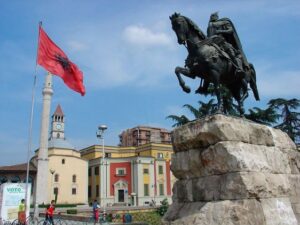
Skanderbeg Monument: Skanderbeg Monument (Tirana), 15 July 2009, EgzonNikqi, License CC BY-SA 3.0
On this issue, the Balkan country is considered stable, tolerant, and peaceful, as is neighbouring Kosovo, which is also ethnically Albanian majority. Incidentally, a Catholic saint is revered in both predominantly Muslim countries: Mother Teresa. Main streets and cathedrals (Pristina) are named after the ethnic Albanian (born in present-day North Macedonia).
Tourism: Potential Exists
In the future, tourism will also play an important role in Albania. The landscape is beautiful, the sea is too, and the culinary offerings are rich, diverse, and attractive. For many people in the Balkans, the country is a primary holiday destination, naturally also due to its price level. Here too, it remains to be seen how Albanian politics will shape the country in the future – whether it sells itself to dubious investors due to corruption, or whether structures are created to ensure legal certainty and a market economy prevail in this sector as well.
The Road to Europe: Reforms and Legal Certainty
The challenges facing the next government are enormous. The European Union can certainly exert pressure – as in Kosovo, Albanian politics is pro-European. EU accession is the main goal. Visa liberalisation for Albanian citizens was achieved some years ago. Scepticism within EU states regarding accession negotiations was high, but Austria, in particular, supported Albania on its path.
With the 2014 decision, the EU-28 expressed its willingness to support the country in the fight against organised crime. However, the Albanian government must, for its part, meet the tough reform requirements. This, like the Kosovar government facing similar challenges, is something no one can take away from them.
As is often the case with Albania, the guiding principle holds true: a stable, peaceful, and secure Europe can only exist with a stable, secure, and peaceful Balkans. Albania is an important part of this. In matters of religious coexistence, proof has been provided, but much remains to be done regarding the rule of law and anti-corruption.
Cover image: Parliament: By Kris Hodaj [Public domain], via Wikimedia Commons



