Austria and Kosovo
Austria and Kosovo have maintained relations for 330 years. The record of these more than three centuries is positive, even though Kosovo was not yet an independent state at the time. By Faruk Ajeti
If there is one region in Europe where Austria has been and remains particularly active in foreign policy, it is undoubtedly Southeast Europe. If there is a constant in Austrian foreign policy and diplomacy, characterised for centuries by active engagement, and a region where Austria’s voice is heard, then it is Europe’s backyard: the Balkans. Austria is traditionally closely connected to the region. This connection is based on geographical proximity, as well as close historical, economic, cultural, and personal ties. Developments in Southeast Europe play a central and decisive role for Austria due to significant foreign and security policy interests. Austria’s close relationship with Southeast Europe has been and remains one of the most important focal points of its foreign and security policy.
If there is one state in the Balkans where Austria has played a pioneering role, it is undoubtedly the young Republic of Kosovo. The first experiences of Habsburg Austria in Kosovo can be traced back to 1689. Following the Second Siege of Vienna (1683), with the aim of pushing back the Ottoman troops as far as possible towards the Adriatic Sea, the first Habsburg troops entered Kosovo. This occurred as part of a Habsburg-Austrian counter-offensive in autumn 1689. This cooperation was further developed and deepened significantly in the decades that followed.
Pioneering Role in Kosovo Policy
Due to rising Serbian nationalism and the deteriorating political and economic situation in Yugoslavia, Austria undertook numerous measures and launched many initiatives to internationalise the Kosovo question in various regional, European, and international bodies. Austria, as a neutral country, clearly positioned itself against human rights violations not only in Kosovo but also in other areas of Yugoslavia by the Belgrade regime: human rights violations cannot be an internal affair of a state.
Kosovo’s political leadership, under the direction of its first President, Ibrahim Rugova, enjoyed particular sympathy and support from Austrian decision-makers.
Austria was the first European state to receive the political leadership of the (internationally unrecognised) “Republika e Kosovës”. The Austrian government provided support for Kosovo in many ways, including the recognition of diplomas and certificates from the University of Prishtina, humanitarian aid, diplomatic services, acting as a door-opener and advisor for Kosovo’s political leadership, and offering asylum to Kosovo-Albanian politicians, refugees, and their families.
Austria’s Active Engagement
The escalation of the conflict in Kosovo through ethnic cleansing by the Belgrade regime—the same methods applied in Croatia and Bosnia-Herzegovina—best demonstrated Austria’s early warning function, which maintained that the Kosovo question could only be resolved through the involvement of international mechanisms. Through its EU membership—but not exclusively—Austria showed active engagement, which represented a key focus of Austrian foreign policy.
Both Austrian politicians and diplomats, as well as the Austrian capital, are connected to the founding of the Republic of Kosovo. The status negotiations between Kosovo and Serbia (Vienna Talks) were held in Vienna in 2006/07. Austria recognised Kosovo as an independent and sovereign state in 2008, immediately after its declaration of independence—as one of the first states—and has since maintained friendly and close relations with Prishtina in all areas.
After 330 years of shared history, Austria and Kosovo are bound by common interests. Austrian Kosovo and Balkan policy, as a “constant of Austrian foreign policy”, also represents a central area of responsibility for Austria. One thing is certain: the train of EU integration for the Western Balkan states, as the last European enclave, is running via Vienna (with the aim of continuing to Brussels). Metternich was probably right that the Balkans begin on Rennweg, in Vienna’s third district. Austria’s engagement in Kosovo is a clear example of how much smaller states can achieve in specific international issues due to their expertise and wealth of knowledge.
Dr. Faruk Ajeti is an Austrian Marshall Plan Foundation Fellow at Johns Hopkins University in Washington and an Affiliated Researcher at OIIP in Vienna. He recently completed his dissertation at the University of Vienna on “Austria’s Kosovo Policy in the Years 1986-1999”.
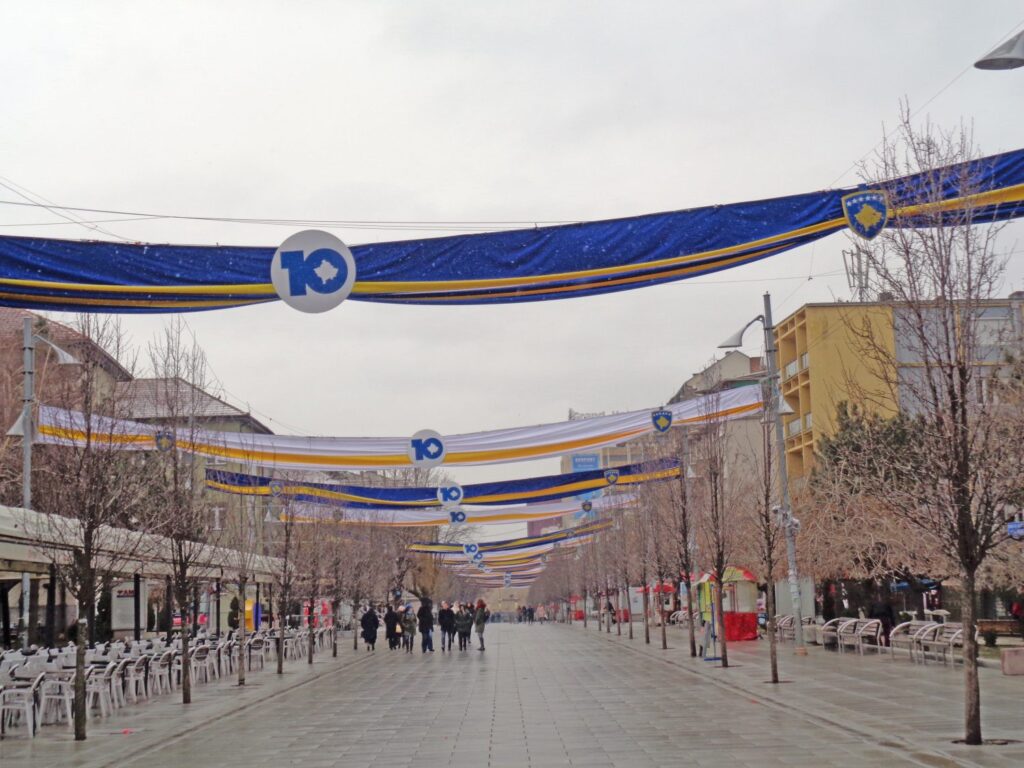
In 2008, Austria was among the first countries to recognise Kosovo’s independence. The featured image shows the decorated Mother Teresa Boulevard in the capital Prishtina on the occasion of the tenth anniversary celebration (February 2018) of the declaration of independence.



