Beacon of Freedom
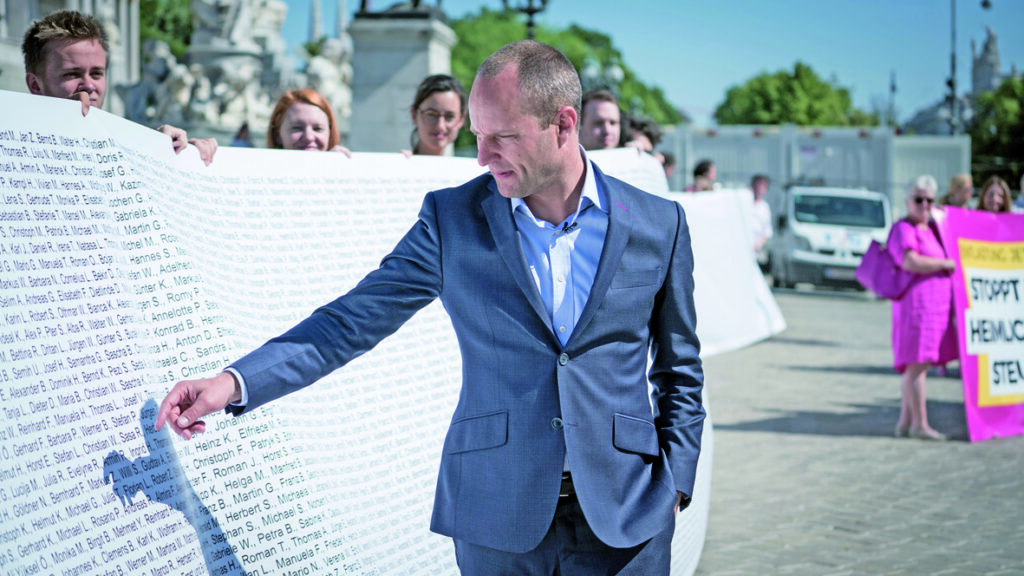
For the 2017 National Council election, we asked the top candidates of the parties standing for election for interviews for the magazine “Paneuropa Austria”. SPÖ leader Christian Kern gave no response, nor did Peter Pilz. Sebastian Kurz and Ulrike Lunacek could not find time for a personal interview (which is why we will only publish a few questions and answers in the print edition). Interviews were conducted with FPÖ leader HC Strache and NEOS leader Matthias Strolz. In a detailed interview with “Paneuropa Austria”, NEOS leader and top candidate Matthias Strolz talks about concepts for tax and electoral reform, enthusiasm for Europe, fatigue with freedom, and a vibrant parliament.
Paneuropa Austria: The legislative term would normally have run until autumn 2018. Is it good that we are now voting a year earlier?
Matthias Strolz: Austria needs clarity. For me, it makes sense that the election is happening now. This tragedy of Red-Black has brought people nothing but strife and deadlock. But it doesn’t fit with the extension of the legislative term, of course.
PÖ: What few people know is that in this election we are voting for members of the National Council. That is, those representatives of the citizens who, according to the original idea of representative democracy, should represent the interests of the citizens against the expansion of state power. In reality, it’s about who forms the government, which then controls the parliamentary majority. Is that what we should understand by parliamentarism?
Matthias Strolz: No, it is not. Austria has some design flaws in its system regarding the separation of powers. Of course, Austria needs a vibrant working parliament, from which we are miles away. We need an end to this Red-Black power cartel, which is mirrored in every fibre of the republic, down to every football club and ambulance service. I predict that this will come; the question is only how quickly. But it won’t take 70 years. This power cartel is dying, and the new thing is not quite here yet. Ideally, that will have something to do with a lively, pulsating working parliament.
PÖ: What distinguishes Austria from other countries in Europe is that there is effectively no alternation between government and opposition here. De facto, the same two parties have governed since 1945, either directly in a coalition or through social partnership. Not even the communists in the Eastern Bloc achieved such continuity. How do we break out of this paralysis?
Matthias Strolz: The lack of change is a big problem. Here we have little in common with other countries in Europe; we are a democracy sui generis, a unique creation with a Red-Black power cartel. That had its legitimacy after the Second World War, but has become increasingly dysfunctional over the past decades. How do we get out of it? Apparently, smashing this power cartel is no longer even necessary; they can’t work together anymore anyway. So Red-Black has run its course. Now the question is, what will a new power dynamic look like? That’s where NEOS’s offer comes in: a government needs more new forces than old ones, we are convinced of that, and it needs a deeply pro-European anchoring there. When I say there are two options for change in Austria, the first is a strongly pro-European orientation, open-minded, liberal in its basic attitude, and the other is a national narrowing with a tendency towards an authoritarian government. We will make clear what our offer is for this country, and I believe it is highly attractive.
The interview with Dr. Matthias Strolz was conducted by the Secretary General of the Paneuropa Movement Austria, Rainhard Kloucek.
PÖ: Last year, Sepp Schellhorn, NEOS spokesperson for economic affairs, wrote an article on the trade regulations and described Emperor Franz Joseph as a liberal because there was significantly less regulation back then than today. Today, we are in the process of bringing new trades under regulation. What is the specific goal of NEOS to reduce bureaucracy?
Entrepreneurial spirit is the father of prosperity
Matthias Strolz: The goal is that we want to place greater value on entrepreneurial spirit. Why? Because entrepreneurial spirit is the father of prosperity. Prosperity does not fall from the sky, does not come from the ATM, but is earned by entrepreneurial people. When I say entrepreneurial people, that naturally includes both employers and employees. It’s a basic attitude, simply getting things done. Our goal is to reduce the trade regulations to 26 branch trades. Regulations should only exist where life, limb and finances are potentially threatened. Otherwise, there should be a free rein for entrepreneurial spirit. That would also create new jobs. We need new jobs, which only arise through companies. The trade reform passed at the end of June is just a tiny step in the right direction – we are miles away from the demands of the 21st century and genuine entrepreneurial freedom. The second thing is: entrepreneurial spirit also means lowering the tax burden. I want people to have significantly more money in their pockets at the end of the month. We have detailed concepts for that. Where others make announcements, we have a clear statement with our tax reform concept, where in a reform stage over eight years we would cut 19.1 billion euros annually, on the expenditure side. But we would also invest. First, pay off debt, and invest 3.5 billion euros per year in education, research, innovation. We have a detailed plan of over 27 pages where we also set out the concepts.
PÖ: Every tax is de facto an encroachment on a property right.
Matthias Strolz: It is, and a steering mechanism. Taxes should also steer.
PÖ: The original concept of the state and taxes was not based on using taxes to steer citizens’ behaviour, but rather that taxes bring in what the state needs for its tasks. But it is not the right of the state to steer the free citizen, even if it has become fashionable today to steer with taxes.
Matthias Strolz: I understand the starting point, and we also have to be very careful about where, when, and how steering happens. Because it is of course an interference with a right to freedom, namely the freedom to keep 100 per cent of my income. That is curtailed in favour of a commitment to a commonwealth. Man is a social being. We need communally organised tasks. NEOS, as a liberal force, stands clearly behind that. There are common goods, public goods, that we manage together. We consider education a public good, or health. Infrastructure, too, of course. It makes no sense to say the state doesn’t feel responsible for tunnels or whatever, and to leave these tasks to the free play of the market. I believe the market needs a strong counterpart in the state. The market doesn’t regulate everything. There are public goods, there are external effects in economics. A state is needed there. For example, I consider steering in a socio-ecological area to be legitimate. I consider it legitimate that we also say we have a progressive tax system. Those who earn more also make a higher contribution. But I do not consider it legitimate to say the state takes more than 50, or now 55 per cent from you. That moves towards expropriation.
PÖ: Although that is de facto the case. The tax burden is now over 40 per cent. But in Austria, only just over 20 per cent – under 25 per cent – of the population are net contributors to the system. That means 75 per cent or slightly more than 75 per cent – including children and pensioners – are transfer recipients, net transfer recipients. That means for someone who does not receive any transfers but only pays in, who is in a higher income bracket, they easily reach a tax burden of 70, 80 per cent with consumption taxes.
We need massive relief for the population
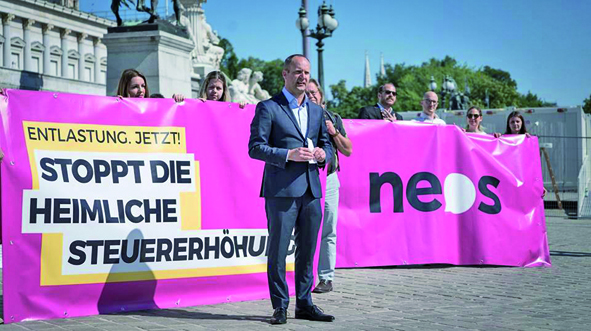
A progressive tax system is fundamentally correct according to Matthias Strolz, but his party wants to eliminate the creeping tax increase caused by cold progression.
Matthias Strolz: That’s why we say we have to go down. Clearly. So we have to come down by at least ten per cent. When we say we want to cut 19.1 billion on the expenditure side, that means massive relief for the population. That is only possible in an eight-year reform stage with a reform pace like Schüssel I, in terms of reform density. But we are of the opinion that it is possible, and we also believe it must be done. Time is running out for us. Why? Because we have naturally gained a temporary buffer through the low-interest policy or de facto zero-interest policy. We pay around seven billion euros just for interest payments, in a historically unique low-interest phase. On the day – and it will come, as sure as amen in church – when interest rates rise again, we will be massively over ten billion. Then we will spend more on interest payments than on 1.1 million school pupils, 120,000 teachers, 6,000 schools, 300,000 students at universities of applied sciences and universities across over 20 university locations. We have the same problem with the cost escalation in the pension system. That means we have to reorganise these systems. Otherwise, our children won’t be able to stand up because we will be putting another millstone in their rucksack every year for 55 years.
PÖ: One of the causes of this high tax burden is the fact that politicians like to distribute favours.
Matthias Strolz: Yes.
PÖ: Classic clientelist politics.
Matthias Strolz: Absolutely. Patterns of structural corruption, even.
PÖ: Schumpeter said that the socialists will win because they always promise more than they can collect, and people will vote for those who promise them more. Is that a democratic necessity, or a danger?
Matthias Strolz: We have a dilemma of democracy here. We don’t yet know exactly how to deal with it. One also has to be historically clear here.
PÖ: But interestingly, it’s not like that in Switzerland. There is more democracy there.
Matthias Strolz: That’s why I say it’s not necessarily the case that the situation is completely hopeless. I believe that democracies are also capable of learning. But we simply do not have the historical experience of whether we can achieve a reset of the social systems from a democratic renewal force. Historically, we have one experience: a reset of social distribution or other things usually happens through war. Now we agree: we do not want to choose that option! But we don’t know, because democracy is not old enough yet, whether we can manage it. We only know we have 55 years of debt now. We reliably make new debts every year. We have some shining examples like Sweden, which pulled itself out of the swamp of the debt spiral by its own bootstraps in the 1990s. That gives hope. So if the Swedes could do it, even with the Social Democrats, then I say: all is not lost yet.
PÖ: Western democracy has produced something we call the welfare state. The welfare state is a political concept to make citizens dependent on the state – with their own money, no less. So a concept of etatism, of paternalism. Today we talk about nudging and all these things. That contradicts liberalism.
Matthias Strolz: Absolutely. So I also believe that Austria suffers from a great fatigue with freedom. We have become a people weary of freedom. The drug that brought us there naturally has something to do with socialism and the promise that we’ll organise everything for you, from the cradle to the grave. It was never mentioned that you would have to pay the bill yourself. It was never mentioned that we would hang part of the bill around our children’s necks. It is always suggested that we have achieved the turnaround. That is a lie.
PÖ: Austria is a federal country. In your latest book “My New Austria – Homeland of Great Opportunities”, you criticise, among other things – similar to the economic journalist Josef Urschitz in his book “Stagnation” – the design flaw of Austrian federalism, where those responsible for expenditure are not also responsible for revenue. So, the states spend money, the federal government has to collect it, the states get the money through fiscal equalisation. How do we solve the problem?
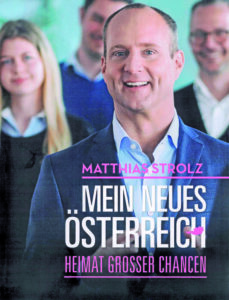
In spring, the NEOS leader presented a book with his ideas for Austria.
Elect 100 MPs directly in single-member constituencies
Matthias Strolz: From several sides, pragmatically. I don’t believe in the big administrative reform from the Austria Convention and other events. The most important federalism reform would be halving party funding, which is the highest in Europe, and a new electoral law that strengthens personal voting. We want to elect 100 MPs directly in single-member constituencies to parliament. Why is that the most important thing? Because it would bring people into parliament who are no longer on the leash of a state governor and state party leaders. They would no longer have shackles.
We are passing an education reform. Among 183 MPs, you won’t find anyone, not a single person I claim, who thinks it’s good how the education directorate is being cobbled together as a hermaphrodite authority, a mixed authority, where the state governor can make himself the boss again, where the state governor can also choose the education director. That is a bit glossed over with some commissions. But ultimately, the state governor still stands in the school with his party book. There is no one who will defend that in a four-eyes conversation to the best of their knowledge and conscience, and yet it comes into being. I discussed this with the new ÖVP leader, I discussed it with the negotiation leaders of the ÖVP and SPÖ. They all have a guilty conscience. Yet they pass such gross nonsense. It is a pattern of structural corruption that is being passed here. Why is that? Because when they vote, they don’t switch on their conscience and knowledge, but their mobile phone and ask, ‘Mr Governor, what must I do?’ He says, ‘If you want to be on the list again next time, then you have to vote as follows.’ But if we say they no longer control the money and no longer control the lists to that extent, then we will suddenly arrive at completely different solutions in all policy areas. That would be the greatest federalism reform one can imagine.
PÖ: To come back to tax once more, would tax subsidiarity be an option for NEOS?
Matthias Strolz: I am clearly in favour of tax autonomy. There are areas like infrastructure, for example, where there should clearly be state expenditure if they are willing to assume tax autonomy. They must also take responsibility, for example for their state civil servants, pension systems. Häupl and Vassilakou maintained civil servant privileges in Vienna until 2042, where every Styrian and every Tyrolean has to pay. Outrageous. That too is structural corruption. We can only abolish that through tax autonomy.
Clear positioning for a united Europe
PÖ: Let’s move on to European policy. NEOS is a political movement that is very clearly positioned on Europe. A study by the Austrian Society for European Politics has now been presented, according to which for 52 per cent of Austrians the question of ‘reform of the EU’ is also important for their decision in the National Council election. What is the core element of European unification for NEOS? Why is this project of European unification so important?
Matthias Strolz: It’s about togetherness, that is our deep conviction. I believe we are fellow travellers with the Paneuropa Movement here. Now some say, but you don’t have to be against each other if you’re not for working together. To that I say, but that’s just the way human dynamics are. So either there is a commitment to working together, or we will – whether we want to or not – slide into opposition. That was the reality on this continent for centuries. And one thing must be clear to us: by virtue of geography and population density, we are a community of fate. We can’t choose that. The houses are so close together on this continent that if one hut burns, the neighbouring hut burns down too. I don’t want our hut to burn down, I don’t want our house in Austria to burn. But then we have to do something for togetherness. We must also see ourselves as a community of opportunity. Community of fate is given, by virtue of geography, population density; community of opportunity, on the other hand, is a conscious decision. We are the pro-European force in the Austrian parliament.
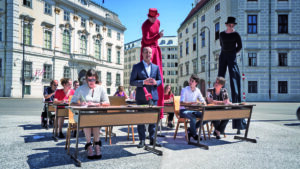
On the education reform: ‘Among 183 MPs, you won’t find anyone, not a single person I claim, who thinks it’s good how the education directorate is being cobbled together as a hermaphrodite authority, a mixed authority, where the state governor can make himself the boss again, where the state governor can also choose the education director. That is a bit glossed over with some commissions. But ultimately, the state governor still stands in the school with his party book.’
We stand clearly for togetherness on many levels: common foreign policy, common security policy, common asylum policy, jointly controlling and organising the external border, jointly coordinating economic policy, of course, and resolute common monetary policy. But we can have concentric circles. Not everyone has to be involved in everything with the same intensity. We already live that. Not everyone is in the euro, not everyone is in Schengen in the same form. We want to drive this unification project forward. We want a common constitution. We want common institutions. We naturally also want, and that is our vision at the end of the road, to move towards a European Republic, and that should be a federal republic. That means there is a European people at the end of this path. Not 27 states will be there from the start. We have always proceeded in groups of the determined. That is how Europe has grown and that is how it should and can continue to grow.
PÖ: What is the target vision of a liberal Europe? Which policy areas should be Europeanised so that they can be decided at European level – without crossfire from the member states? Security policy?
Matthias Strolz: Security, foreign policy, asylum policy, i.e. migration policy overall. Naturally with very strong participation of the regions or also the member states, in a confederation or a federal state. Various intermediate steps are possible there. The EU is a creation sui generis …
PÖ: … just like Austria …
Matthias Strolz: … exactly. What else belongs in there? Common monetary policy. We have to organise monetary policy so that a temporary exit from the eurozone is possible. We also need insolvency law, like the United States have for their federal states. We need responsibility and freedom here. We also need high subsidiarity. For example, with infrastructure, you can’t just say, does this belong at European level or regional level or nation-state level? Of course, we have to have certain central project management for transit routes. But we also need subsidiarity for small-scale infrastructure matters.
PÖ: Subsidiarity has been in the treaties since Maastricht. But it is often misinterpreted as if it only applies between the EU level and the nation state. But it must run through to the areas of responsibility of the family or personal responsibility.
Matthias Strolz: Yes, absolutely. So we do not see a centralised European state here. That is an abomination. The terrain is far too large for that. The organically grown energy field of this continent is far too strongly anchored in the regions, partly in the nation states, for that. But we also know that the regions as organically grown units are even stronger. I would naturally massively strengthen regional cooperation, as Tyrol exemplifies, exemplarily, Trentino, South Tyrol, North Tyrol, as the Lake Constance region exemplifies, even including Switzerland. So we can organise our coexistence in multiple ways without it becoming opulent. Switzerland has a highly complex organisation. Not only federal with relatively small units, but they also have a magic formula for forming a government. Now I’m not saying we have to copy that exactly.
Subsidiarity is freedom and responsibility
Where do we reduce administrative effort? NEOS has many proposals for that. For example, a very pragmatic proposal: we have almost 20 billion euros in subsidies in Austria. Direct and indirect subsidies, many important, great subsidies, and then a lot of dodgy deals. Triple funding, structural feeding of circles of friends. The day we activate the transparency database, these dodgy deals will disappear. Our proposal is very clear, and if 183 MPs sit in parliament who follow their conscience, no one will be able to find it bad: those state governors who continue to refuse to populate the transparency database will automatically have 50 million deducted from their fiscal equalisation from January 2018. Then all that will stop. Then we will have already cut out some fat and can use the money for sensible things. That’s how you can ensure subsidiarity at every corner. Subsidiarity means freedom and responsibility.
PÖ: Let’s return to the monetary union once more. It is often understood as a political project that is now being foisted on people in Europe. With all the upheavals we have had because of it. But a currency must be able to breathe. A country like Greece, which is not fit for the monetary union, cannot be kept in by force. Currently, the treaties are such that they can only leave the euro if they also leave the EU.
Matthias Strolz: That the currency was also seen as a political instrument, I am a pragmatist about that. Of course it is, because it has such high symbolic power. Of course Europe has made mistakes here. It is allowed to make mistakes, even for Europe, just like for every child and every adult, but one should not make the same mistake twice, but learn from the first time. That’s why I am convinced: just as we demand insolvency law for federal states in Austria – after the Hypo and Salzburg disasters – we need insolvency law for member states in the EU. We need a restructuring of the architecture for the euro and we need temporary exit options. Economic policy should also be communitised, but not completely, as should fiscal policy. Tax competition is allowed, but within a certain corridor.
PÖ: We now have 28 states in the European Union, soon probably only 27. We have a number of countries in Southeast Europe – the Western Balkans, as it is called in EU jargon – to whom the path into the EU was promised back in 2013. We have countries that are clearly European but are excluded from the accession process in the neighbourhood policy. Neighbourhood policy means many things, but not accession. What is NEOS’s position on this? Do we have to see this Europe as larger than we currently have in the sense of the EU? What would that mean, for example, for Ukraine or all the countries of Southeast Europe?
Matthias Strolz: Of course, the Balkans needs a clear European perspective, otherwise the countries will slide away and turn to other powers, which we do not wish for. They would turn more strongly towards a Russia under Putin, more strongly towards the Arab world, which is triggering questionable developments with mosque financing and other things. They would turn more strongly towards a Turkey and other authoritarian voices and increasingly authoritarian regimes. None of us can want that. At the same time, I say that talking about new imminent members now would overstretch the European Union because we haven’t finished our internal homework yet. We have to do one thing after another and things in parallel at the same time. We have failed to signal more honesty towards Turkey. Turkey is an immensely important neighbour. We have nothing to gain – only disadvantages – if something like a questionable religious state or whatever emerges there. And Turkey is heading in that direction, even if the god may be an earthly one. That could have gone differently if we had set the course differently as Europe. We have the same problem with Ukraine. I am deeply convinced that Ukraine needs a pro-European perspective. But not in demarcation from Russia. Europe would have needed more sensitivity there, and an EU foreign minister, not 28 EU foreign ministers who say, ‘Thank goodness I’m not responsible.’ That’s why it escalated as it did. NEOS has been clearly in favour of a European army for years. We were showered with scorn and laughed at for that in the European elections. Meanwhile, a large part of the EU Commission is in favour, heads of state from Merkel downwards are of the opinion that we need something like that.
PÖ: ‘Superpower Europe’ was the title of a book by Coudenhove-Kalergi, although it was not intended that this superpower would then invade the rest of the world.
Matthias Strolz: No. It should be a peace army, under the control of the European Parliament. So I don’t have the detailed solutions everywhere. But I have a very clear direction. That we need military capacity is completely beyond dispute.
PÖ: We have had elections in several European countries this year, and we will have several more. What conclusions can we draw from the results so far, what do we learn from them for the future of Europe?
Matthias Strolz: That Europe is in again, that you can win elections with Europe and a pro-European message. That’s a hallelujah of a different kind. I welcome that, it gives strength and creates tailwind, also for our movement.
PÖ: Another completely different topic. We see an immense greed on the part of the state to get more and more information about citizens. We have this proposal for a new entry system into the European Union, we have a law in Austria – I don’t even know if it has already passed – that de facto already criminalises political opinion. We have a new law in Germany for monitoring social media, and people are already talking about wanting to be able to control WhatsApp too. So at some point we will have no privacy left. At some point we will only have the transparent citizen and the state controls everything. That cannot be the future of Europe, can it?
Transparent state instead of transparent citizen
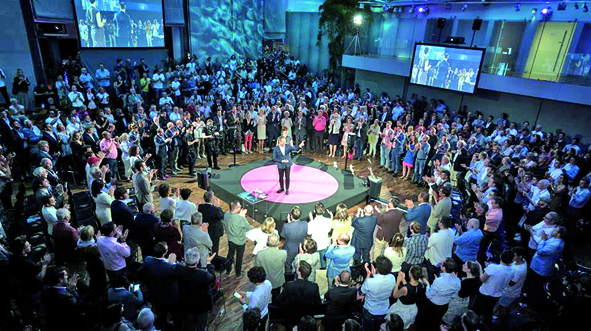
Matthias Strolz: No, quite the opposite: transparent state instead of transparent citizen. That we repeatedly need to sharpen legislation and measures for security policy is completely beyond dispute. NEOS has a clear commitment: We are the advocate for freedom and civil rights in this high house here on the Ring, in the Austrian parliament. We are also at European level. Whether it’s data retention, which we fought massively against, and it fell in Austria. Whether we, as a five per cent movement, got through that the inspection of account registers cannot happen without a judicial warrant. We achieved that as a small force. We can strengthen the freedom and civil rights movement in the Austrian parliament that bears the name NEOS. We are the advocate of freedom and civil rights. We are uncompromising here when it comes to these rights. Also now again in the fight against data retention, which is coming in through the back door. We fought in the State Security Act, we pulled some of its venomous fangs. Some are still in there: for example, that informants can also be criminals. We consider that wrong. Of course, we repeatedly need sharpening in the fight against terrorism, for example. We are very clear and determined in favour of cooperation between intelligence services in Europe. If only seven EU states report to the jihadist database, while the jihadists come from 77 states, then that is grossly negligent, ridiculous, and leads to deaths on this continent that could have been avoided. If we allow people with tenfold identities even among immigrants, then that is an imposition. That is a merciless irresponsibility that must be stopped. That’s why we are clearly in favour of fingerprints, of biometric data here. In the year 2017, we must be able to guarantee – and that is also reasonable for every asylum seeker – that we carry out identity verification in such a way that it can be traced at any time and anywhere in Europe.
PÖ: For the last question, although the last question is actually not a question, but a request for commentary on a quote from Richard Coudenhove-Kalergi from his speech on the soul of Europe: ‘The European ideal is freedom, European history a single slow struggle for personal, intellectual, national and social freedom. Europe will endure as long as it continues this struggle; as soon as it abandons this ideal and is unfaithful to its mission, it loses its soul, its meaning, its existence; then its historical role is played out.’
Matthias Strolz: That could be the refrain of the NEOS anthem. Europe is the beacon of freedom on this planet. And if we no longer honour and defend this highest value, then we will no longer shine, and then it will become dark on this planet. We no longer carry the radiance of Europe into the world with the sword and with cannons, but with an attitude. No one else on this planet can do that, and that is why it is not only our legacy, but also our mission for the coming decades.
PÖ: Thank you for the conversation.
Photos: Paneuropa Movement, NEOS



