Blockchain – A Megatrend in Austria?

So-called cryptocurrencies appear to be on the rise worldwide. But what lies behind them? What are the opportunities and risks? An analysis by Lukas Leys.
The digital currency Bitcoin recently reached the $4,000 mark, bringing it back into the public eye. Since its creation in 2009 by an unknown inventor as a reaction to the financial crisis, this virtual currency has increasingly become a serious alternative to traditional forms of investment. The problems often perceived by outsiders—such as sharp price fluctuations, potential bubbles, use in illegal transactions, hacker attacks, and loss of funds—are receding into the background.
These issues distract from the actual technological revolution behind Bitcoin and other cryptocurrencies. Cryptocurrencies are based on the solution to a long-standing problem in information technology: “How do I enable trust between parties where none exists?” This was solved by blockchain technology. Blockchain makes it possible to turn Bitcoin into a non-manipulable, unhackable, decentralised currency without a middleman (central bank, state, etc.). However, this technology will extend to many more aspects of the economy than most people currently realise.
The Blockchain – Diverse Fields of Application
The blockchain system is based on a decentralised network in which every participant is connected and works on the same database. Cryptocurrencies use the blockchain to collect transaction data in data blocks and create a single chain of information from them. Consensus is found among all participants in the network as to which next possible block in this chain is the correct one. No single actor or group of actors can subsequently manipulate or alter the data blocks—the network agrees on a single truth and stores this information permanently.

Visualised representation of blockchain technology: many hopes rest upon it.
Blocks that do not meet the necessary requirements or contain errors are rejected by the system. In this network, all existing Bitcoins exist on millions of computers simultaneously, yet the system ensures that only the rightful owner can access them via cryptographic codes. Anonymity and confidentiality are guaranteed in the network through encryption. Transactions occur transparently; the entire network can see the transaction, but the identity of the actors is hidden behind a cryptographic pseudonym.
Transparent Transactions – High Security Against Manipulation
In this way, users are enabled to carry out transactions between A and B directly, transparently, and securely, without the need for a middleman such as a bank. Since the blockchain is a decentralised database, there is no central point to attack, manipulate, or hack. An attack on the network is enormously costly and thus virtually impossible.
Consequently, networks with blockchain databases possess a range of highly attractive properties that are of interest for far more than just the transfer of digital currencies. In June 2017, the World Economic Forum published a detailed report on the multitude of possible future applications. For instance, shares, bonds, certificates, or even traditional currencies like the Euro or Dollar could be securely acquired, stored, and transferred from A to B using this system. However, the system can, in principle, store and verify any type of information. Contracts, patents, certificates, or even votes in an election can be cryptographically secured. The fields of application range from electronic data recording and fee billing to supply chain management, automation, document verification, and much more.
Blockchain could thus help verify contract fulfilment and prevent electoral manipulation. Criminal employees cannot manipulate customer data or embezzle money, transactions cannot be concealed, and a mathematically insurmountable barrier can be placed against the theft of patents or other intellectual property. Contrary to the negative reputation that still partly clings to Bitcoin, the World Economic Forum even sees great potential in this technology for combating corruption, fraud, and money laundering—provided there is appropriate regulation and supervision.
All this would be possible without the need for a central authority. No bank, no stock exchange, no company, no government office.
FinTech and GovTech
A significant further development is the Bitcoin successor Ethereum (abbreviation: ETH), which offers a programmable blockchain and thus a platform for executing ‘Smart Contracts’. Ethereum uses the cryptocurrency Ether as payment for the required computing power. Smart Contracts can be described as self-executing code based on a blockchain. With Smart Contracts, it is possible to create so-called Dapps (Decentralised Apps), which enable very versatile fields of application, as they basically allow for the replication of all services currently performed by central authorities. These include crowdfunding, blogging (e.g. a decentralised Twitter), financial services, or even digital companies.
In principle, the fulfilment of contracts, the execution of services, and many other work processes could be linked to code. All of this is always accompanied by the automation of processes and the elimination of intermediaries, which results in a significant reduction in costs and an increase in the efficiency of business processes. Here too, the blockchain ensures trust between multiple parties who could not fully trust each other without a middleman.
The Economy Responds Openly
Accordingly, more and more developments in the economy are moving towards the use of blockchain technology. The IT giant IBM is currently working on a blockchain-based transaction system for several European banks, which offers integrated Smart Contracts. SAP is working on the integration of blockchain and Smart Contracts for supply chain management and process optimisation for multinational companies. The US stock exchange NASDAQ is developing a blockchain transaction platform together with Citibank.
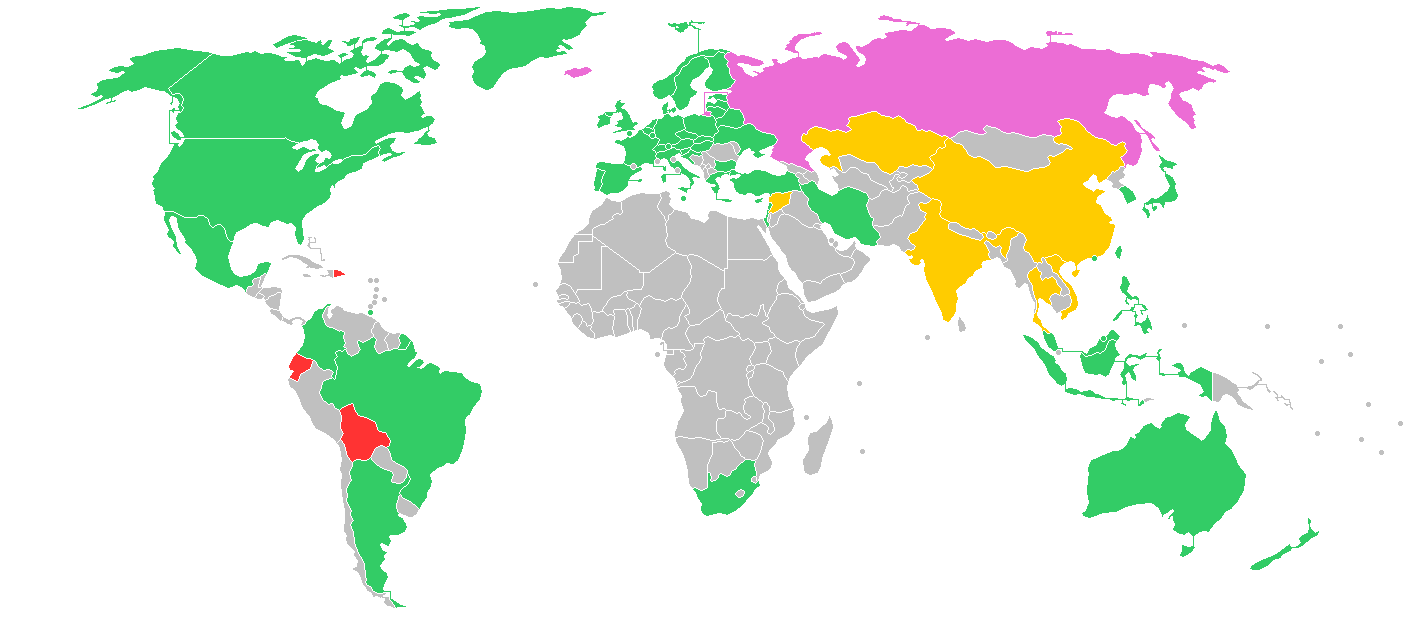
Even today, Bitcoin is more widely used as a means of payment than traditional currencies—outside of state central banks. By Habarithor – CC BY-SA 3.0, https://commons.wikimedia.org/w/index.php?curid=31044329
The public sector is also experiencing this form of digitisation. Estonia already stores patient data in a blockchain and plans to issue its own cryptocurrency, “Estcoin”. Sweden, Ukraine, and Honduras maintain digital land registries using blockchain, and the British Isle of Man already operates a commercial register for companies using it.
Austria’s Potential Pioneering Role
The subject areas of programmable blockchains belong to the second generation of the internet, which—like the internet itself—will result in a massive wave of new business models and changes to existing workflows and processes. Together with technical revolutions such as Artificial Intelligence, automation, and the Internet of Things, blockchain technology is a permanent fixture of digitisation. As early as 2015, the WEF published a survey of 800 technology experts and CEOs in the tech sector, which found that by 2027, 10 per cent of global gross domestic product is expected to be processed and stored on blockchains.

Austria’s Science Minister Harald Mahrer: Untypically open to new technologies and currency issues by Austrian standards. © BMWFW
Recently, Economy Minister Harald Mahrer presented his roadmap for Austria in this sector. Instead of new rules, freedom is to be created for blockchain technology so that it can establish itself. “Blockchain offers gigantic potential. Waiting and seeing is not an option,” said Mahrer. A 9-point plan for Austria is to include pilot projects, subsidies, information platforms, and the involvement of federal, state, and chamber authorities under the leadership of the BMWFW. A key aspect here is the establishment of interdisciplinary research facilities at several universities in Austria to prevent a “brain drain” in this field. A successful implementation of this project could instead mean a “brain gain” in a promising sector of the future.
As is already the case at some of the world’s leading universities and educational institutions, Austria’s teaching facilities should take the initiative and begin researching and teaching in this subject area shortly. In view of the great potential of this technology, this is a very welcome step into the future.
This article appears in cooperation with the local magazine of the ÖCV.
 Mag. Lukas Leys, MSc., studied Banking and Finance in Innsbruck and London and has since worked in the financial sector in Vienna. He wrote his diploma thesis in 2014 on the subject of “Cryptographic Finance” and has since been intensively involved with various cryptocurrencies and blockchain technology.



