Catalonia: Madrid’s Unbelievable Blunder
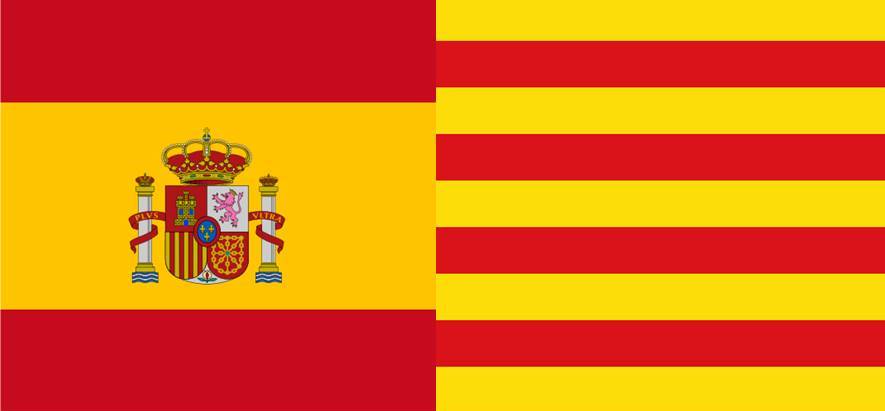
Madrid reacted to yesterday’s referendum in Catalonia with brutal force. This ultimately damaged Spanish unity more severely than a peaceful vote ever could have. A commentary by Philipp Jauernik.
A look back: On 18 September 2014, a referendum on independence took place in Scotland. The final result was 55.3 per cent ‘No’ votes and 44.7 per cent ‘Yes’ votes, with a turnout of 84.59 per cent, meaning Scottish independence was rejected by the majority of voters. Only in four of the 32 districts did proponents of independence win a majority.
The referendum was preceded by months of debate in the United Kingdom: London naturally had little interest at first, the constitutional legitimacy of a plebiscite was questioned, and so on. Ultimately, however, the then Prime Minister David Cameron clearly opted for the referendum desired by the Scots.
With success. The Scots voted with a clear majority to remain, Scotland’s First Minister Alex Salmond resigned, and the issue seemed to be off the table for a long time. Of course: when the Brexit vote had its well-known outcome about a year later, calls for independence were heard again in Scotland, as London had previously, repeatedly and clearly pointed out in its Scotland campaign that the EU membership of their country, which was very important to the Scots, would only be possible together with the United Kingdom. But for the moment, Cameron had a strong success to record on 18 September 2014. A circumstance that makes Madrid’s behaviour last Sunday appear highly problematic.
Madrid Shows Harshness Instead of Dialogue
Firstly: whether Catalan independence would be sensible or not is a matter for the Catalans, just as it was in Scotland two years ago. There are arguments for and against it, but these are ultimately internal affairs. The topic could certainly be discussed controversially and constructively. Could be.
But this is precisely what Madrid refuses to do. The Rajoy government has cemented its position that independence for the Autonomous Region of Catalonia, and a referendum aimed at it, are not provided for in the Spanish constitution. This may be legally correct, but it is a completely misguided argument. For it is precisely this constitution that the separatists wish to break away from.
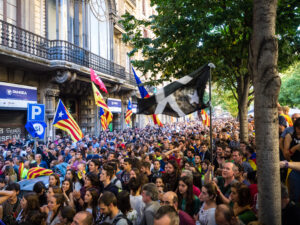
Demonstration by referendum supporters in front of the Catalan Ministry of Economy on 20 September 2017.
By Màrius Montón – Own work, CC-BY-SA 4.0, https://commons.wikimedia.org/w/index.php?curid=62612097
When they then scheduled the (formally illegitimate) referendum, Madrid reacted with harshness. Polling stations were occupied, Catalan officials arrested, the Catalan police placed under Madrid’s control, and so on. No dialogue took place. And when the vote was due to happen last Sunday, Madrid allowed an escalation that represents a new low point in Castilian-Catalan relations: more than 800 (!) injured speak a sad language. Madrid even defended its executive’s harsh actions as ‘proportionate’. Fatal, brutal – and short-sighted.
Rajoy Achieves the Opposite of What He Wants
In other words: Rajoy’s government could not have reacted more weakly. According to media reports, well over 60 per cent of Catalans were against independence before the referendum. If one now considers Scotland in 2014, the lesson for Madrid would have been clear: allow a vote with a clear conscience, run a strong #bettertogether campaign, and point out the many disadvantages of independence (loss of EU membership, no more access to the single market, currency reform, exclusion from Schengen, new state would be recognised by hardly anyone, etc.).
If done cleverly, you secure between 60 and 70 per cent approval for the overall state and celebrate unity. This would have put the issue of separatism to rest for a long time. However, the Rajoy government’s behaviour has now provided everyone who has always been for independence with all the confirmation they needed. And thus, in the medium term, weakened unity more than any referendum could have.
Philipp Jauernik is a historian and federal chairman of Paneuropa Youth Austria.



