Comment: Food is No Laughing Matter!
Europe is supposed to ensure security, become more efficient, reform itself, and protect us from the dangers of the world. Yet, it’s only chips that truly ignite emotion. The priorities of public debate are, at times, astonishing. A comment by Stefan Haböck, International Officer of the Paneuropa Movement Austria.
Have you heard of PESCO? Or JEFTA? CETA is now a familiar term to many. EDIDP and CAP, probably less so. Which isn’t a problem, as abbreviations in the political jungle are often only comprehensible to insiders. What matters isn’t the name, but what lies behind it.
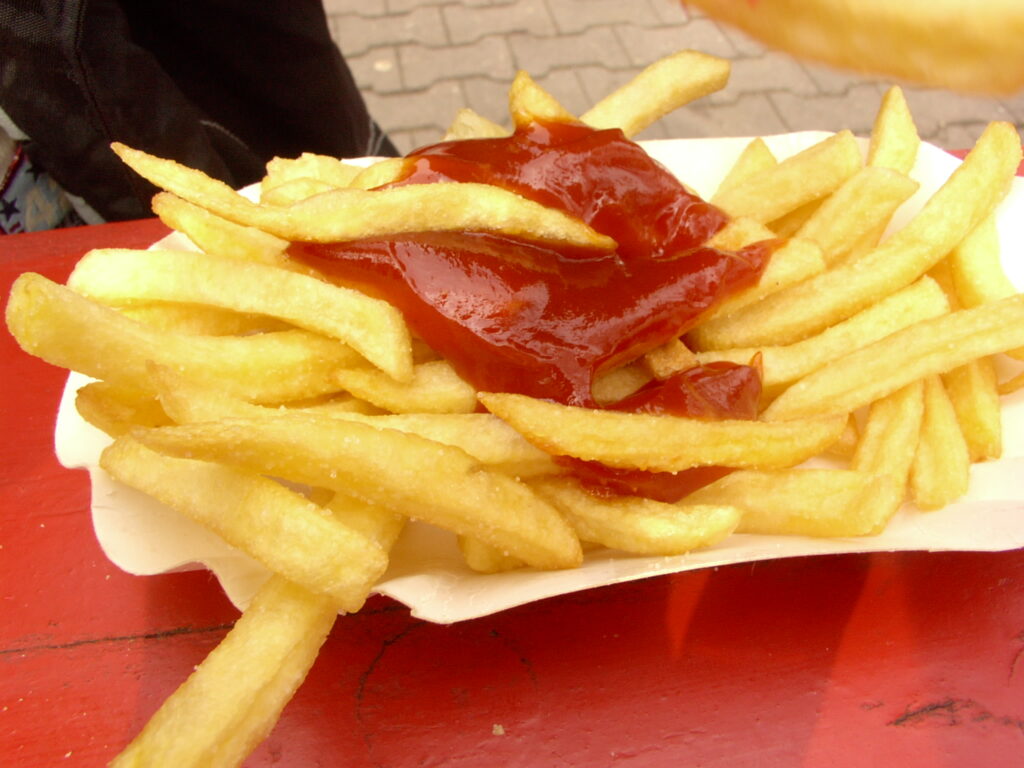
Outrage in Austria and Germany: Chips. (Photo: Treimann from the German Wikipedia, CC BY-SA 3.0, https://tinyurl.com/y9xys7k6 )
Behind these acronyms lies much of great significance. Although, ‘lies behind’ is the wrong expression. Information on each is available in all languages, with regular press statements, informing ministers, and virtually everything one needs to know can be found online. If not, one can inquire with the EU in any language.
This is very rarely done. Astonishing, given the often-expressed desire of citizens for EU transparency. That the European Parliament is one of the most transparent in the world, and, unlike the Austrian Parliament or any local council, its committees are public – that’s a given.
Back to the point: All five topics represented by these abbreviations have recently been decided at a European level and have implications for Austria.
Abbreviations that mean something
PESCO (Permanent Structured Cooperation) was agreed upon by 25 EU member states and is nothing less than the newly established EU security and defence union. Austria is involved with four projects. Security? The top issue for most citizens. Public debate – none.
JEFTA refers to the Japan-European Free Trade Agreement, a free trade agreement between the EU and Japan. Negotiated and unanimously approved. For those wondering why there was an outcry over Canada and the USA but not Japan, one could offer ‘anti-Americanism’ as an argument. But we would never suggest that.
CETA – the free trade agreement with Canada, is considered the most modern agreement of its kind in the world and is intended to serve as a template for all future global trade agreements. The FPÖ (thankfully) decided to stop blocking a trade agreement, desired by all states, fully negotiated, and largely already in force, between some 600 million citizens.
And with the reform of CAP, one of the EU’s largest areas of responsibility was decided on Tuesday, 12th December, in the European Parliament – the reform of the EU’s Common Agricultural Policy.
Russian gas – was there something?
It goes without saying that Russia’s indirect (yet unambiguous) threat to Europe – via a report on RussiaToday titled ‘How long could Europe survive without Russian Gas?’ – as well as China’s billions in investments in Europe via the ‘New Silk Road’ project, also attracted rather little public attention. Electricity, after all, mainly comes from the socket.
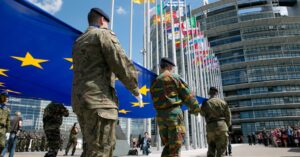
Hardly debated in Austria: Closer military cooperation in Europe via PESCO (Photo: Frederic MAIGROT/REA/laif , Source: bundesregierung.de )
One might say: It’s good that all this is proceeding so harmoniously. Europe works. But that’s not entirely true, because the outrage does exist. While the security union hardly emotionalises anyone, the public’s temper flared: when national health ministers wanted to regulate the browning of chips. Well, they would do that without the EU too, but then who would be to blame?
Even amidst the general anger, it went unnoticed that the EU Commission did not extend the approval of glyphosate purely for fun, but based on a scientific study (which, of course, can be criticised): the EU agency (in Austria, people are fans of EU agencies, but only if they get them themselves) did not find a carcinogenic effect to be proven. But above all – and this is the truly decisive point – because 18 member states – i.e., national governments – agreed to it. Of course, the culprit is in Brussels – but never in Stockholm, Budapest, or Lisbon.
Speaking of Budapest and Warsaw – that Poland and Hungary (for many, the ‘saviours of the Occident’) are in favour of Turkey joining the European Union and assured President Erdoğan of this, also always gets lost in the debate. Because Brussels is to blame.
Never the 27 national governments who do not want to break off accession negotiations – which contradicts the European Parliament. This elected chamber of citizens spoke out more than a year ago in favour of freezing the negotiations.
Doner and Glyphosate
However, ‘Brussels’ did attract attention, because last week the European Parliament voted on doner kebabs. Vertical meat skewers, as they are called in the jargon of the EU Commission. These are said to contain too much phosphate – for preservation reasons. The headlines were huge, because if the EU now bans our doner kebab, that’s scandalous.
Here, too, one could, of course, ask why glyphosate is bad, but acrylamide and phosphate in food are okay (as a non-chemist, I can’t answer that), but never mind. Because the really exciting thing is that ‘the EU’ doesn’t want to ban doner kebabs at all. The EU Commission wants to clarify the regulation so that doner kebabs would no longer be at risk. Some MEPs want to ban them.
Incidentally, if you Google ‘Sicherheitsunion EU’ (EU Security Union) and ‘PESCO’, you get around 4.5 million hits. For ‘Döner EU’ (Doner EU), however, it’s 15.1 million, and for ‘Pommes EU’ (Chips EU), 15.2 million.
So, the priorities are correctly set. Enjoy your meal.
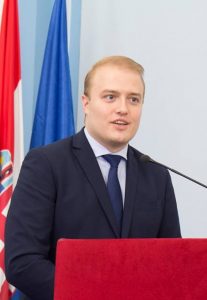
Stefan Haböck is a consultant for European and international affairs on the Presidium of the Paneuropa Movement Austria.



