Courage to Take Responsibility
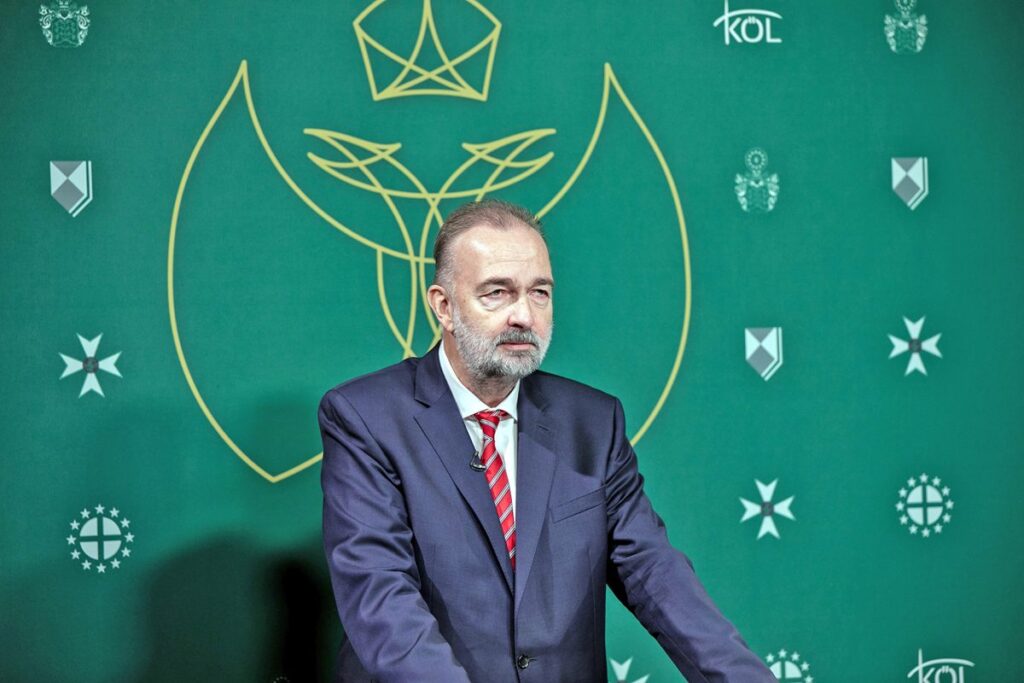
A key focus of Karl von Habsburg’s speech on the future of Europe on 11 January 2024 was Russia’s war of annihilation against Ukraine. Russian President Putin has proven, by switching to a war economy, that he is not interested in peace but is banking on a long war. Europe and the West must counter this with stronger support for Ukraine. The hesitant stance of European politics is being heavily criticised. The matinee “Speech on the Future of Europe” was organised by: St. George’s Order, Ordo Equestris Vini Europae, Catholic Austrian Landsmannschaften and Paneuropa Movement Austria.
In mid-December last year, a friend from Ukraine visited Vienna. Ihor Zhaloba, a historian from Chernivtsi, university professor, member of the Ukrainian Academy of Sciences, co-chairman of the Austrian-Ukrainian Historical Commission, President of the Paneuropa Union Ukraine, and: a soldier. Three days after his 58th birthday, on 24 February 2022, the day of the Russian army’s invasion, he volunteered for the army. With his extensive contacts in several European Union countries, he could easily have gone to the West. But that was out of the question for him.
Again and again, he explained, he had told his students that as responsible citizens, they were themselves accountable for Ukraine’s further development. How could he have gone abroad in such a situation? Would he then have waved to his students from afar, saying: it’s great that you’re defending the country now, but I’m safe. Such an attitude does not suit him.
Incidentally, to come to Vienna, he used up his front-line leave. With special permission, he was able to leave Ukraine. No one, after his almost two years as a common soldier on the front, would have assumed he would desert.
Why do I mention this story? This “Speech on the Future of Europe” is titled “Courage to Take Responsibility”. This is also the motto under which I, my colleagues, and the organisations in which I have taken on tasks, have placed our work for this year. This motto is indeed a challenge. Because as long as life takes its normal course, as long as we live in peace and prosperity, it’s easy to say: I am taking my responsibility, doing my job, getting involved here and there a little. But how much courage does it take to truly assume responsibility in full consequence in an exceptional situation like an attack on one’s own country, on freedom, independence, the value system one believes in, on family, etc.?
Ihor Zhaloba also made something very clear in his discussions, lectures, and interviews in Vienna:
In Ukraine, it is not just a war by Russia against Ukraine; it is a defence of Europe against a despotic system. An axis of Moscow, Beijing, Pyongyang, and Tehran is challenging our value system. A value system based on rules, on international law, and not on violence and destruction.
What if Russia wins the war?
What would happen if Russia wins the war against Ukraine? Not only would a European country be completely destroyed, not only would millions more refugees come to the countries of the European Union, but Russian troops would also be stationed at the borders with Hungary, Slovakia, Romania, or Poland. Europe would be open to any further aggression from the despotic regime in Moscow.
Now many will say, well, NATO won’t attack Putin. I hope that’s the case too.
But let’s be honest with ourselves: the economic giant European Union, the wealthy West, has so far failed to increase its production capacities for various types of ammunition sufficiently to enable Ukraine to achieve a clear fire superiority with corresponding deliveries. I’m not even talking about the delivery of modern weapon systems that would allow Ukraine to develop a technological superiority on the battlefield.
Ladies and Gentlemen,
Some of you will surely remember the name Enrico Berlinguer. He was, back during the Cold War between East and West, General Secretary of the Italian Communist Party. One of the so-called Eurocommunists. My father occasionally quoted him with a statement where he, Berlinguer, said: One must take seriously what the Russians tell us.
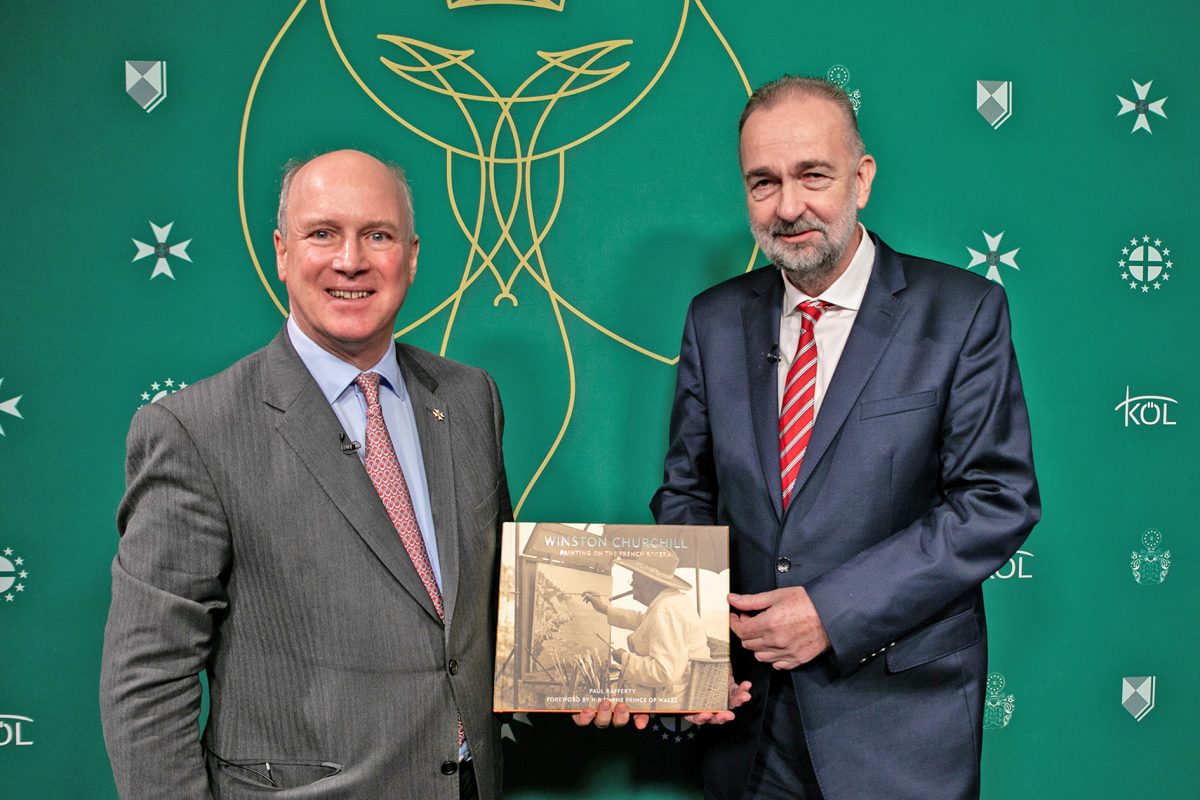
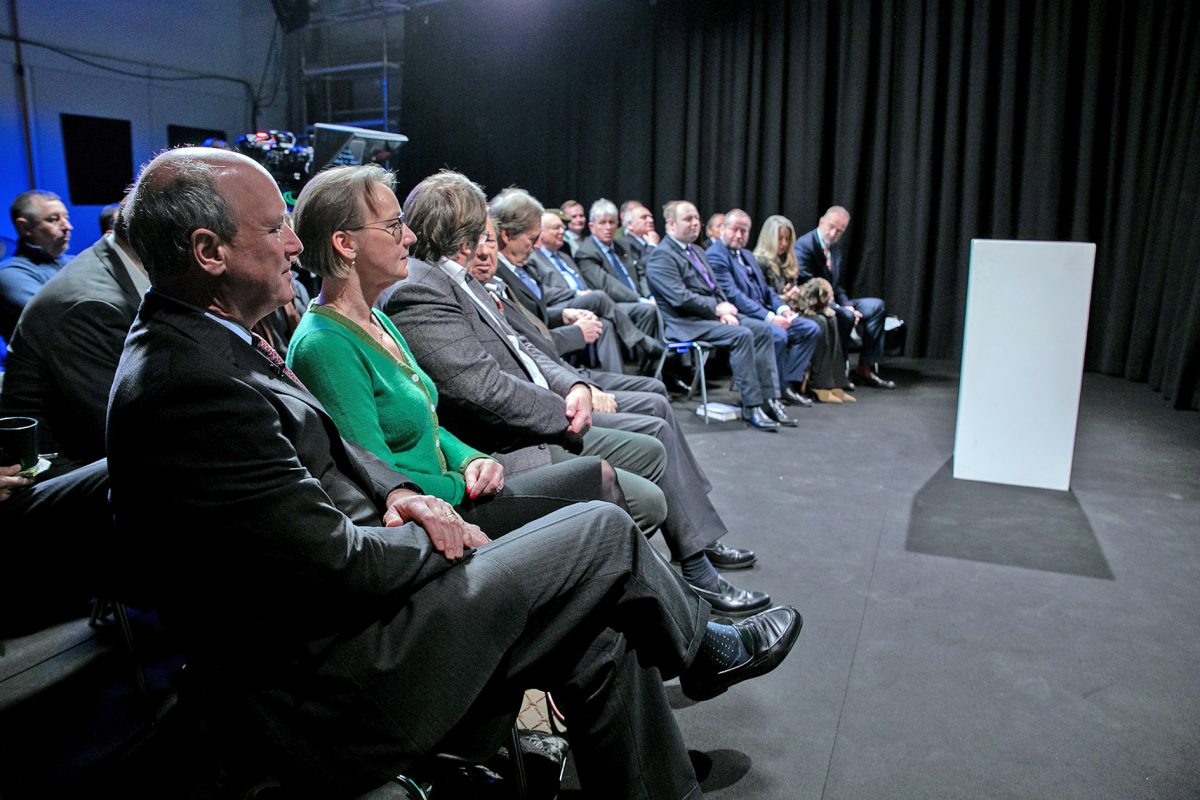
Randolph Churchill, great-grandson of the legendary Winston Churchill, delivered the introductory speech at the matinee “Speech on the Future of Europe”. As a birthday gift for Karl von Habsburg, he received a book with drawings by Sir Winston Churchill.
I advocate listening carefully to what Vladimir Putin himself and his propagandists repeatedly tell us. Not to fall into a paralysis of fear and bury our heads in the sand, in the mistaken belief that if we abandon Ukraine to Putin, everything would be as it was before 24 February 2022, but to be able to make a clear assessment of the situation and once again summon the courage for that responsibility which Europe, the Western world, now needs.
Putin wants a long war
Putin does not want peace. He has completely converted Russia’s economy to a war economy. This means he is counting on a long war. He shows no regard for his population, burning them up in brutal infantry attacks. He clearly tells us that he wants a new world order. He clearly denied Ukraine’s right to exist before the war of annihilation. He and his propagandists clearly and unequivocally tell us that they see at least the eastern half of Europe – that is, what was once the Eastern Bloc – as their sphere of influence.
If we consider these statements from Moscow, it also becomes clear why those voices who believe that every arms delivery to Ukraine would only prolong suffering and cause more deaths are wrong. The opposite is true. The faster we empower Ukraine with our support to drive the Russian army of annihilation out of the country, the sooner the war will be over.
And when we speak of attack, we must not see it only as a military attack. For years, we have observed a massive influence campaign by Moscow on European countries. This includes the attempted coup in Montenegro in 2016, as well as the activities of the so-called humanitarian centre in Niš in Serbia. In reality, it is nothing more than a large Russian espionage facility. Let’s think of the various disinformation campaigns that find their way through European society. Let’s think of the Russian narratives that are still entrenched in many minds in this country. Stories such as that there were civil movements in eastern Ukraine and Crimea for annexation to Russia are just as false as the claim that Russian may no longer be spoken in Ukraine. Nevertheless, these stories keep resurfacing.
Russian Disinformation
Equally persistent is the story that the West promised Moscow at the end of German reunification that NATO would not expand. Even if correspondents in state broadcasters or authors in high-circulation newspapers repeatedly bring up these stories: they are and remain false, they are and remain Russian disinformation.
Such a promise would have been nothing less than a new Hitler-Stalin Pact that would have divided Europe into two spheres of influence.
The countries that gained their freedom and independence following the dissolution of the Iron Curtain, the Warsaw Pact, and the Soviet Union had a choice: either continue a pact with Moscow, or join the EU and NATO to secure security, the rule of law, democracy, freedom, and a market economy.
Precisely this freedom of alliance was enshrined in various treaties, some even with the Soviet Union. Anyone who claims otherwise either doesn’t know or is lying. In both cases, these narratives must be sharply countered, because they are part of a destabilisation of our free, democratic, rule-of-law order.
We must also clearly oppose all those parties that delude us into believing that a peace treaty can be made with the Putin government. Many politicians probably believed this after Moscow’s war against Georgia in 2008 and after the start of the war against Ukraine in 2014. The fact is, however, that Putin has broken every treaty and has only used every pause to prepare for the next aggression.
One doesn’t necessarily have to be a fan of Ukrainian President Zelensky. I, too, have criticised him. I don’t consider all his decisions to be good. But to leave the chamber during a speech by Zelensky in the Austrian Parliament, where he was connected online, only to then demonstrate in front of Parliament with Russian flags for neutrality, shows a serious tendency towards high treason.
But let’s be honest with ourselves: the economic giant European Union, the wealthy West, has so far failed to increase its production capacities for various types of ammunition sufficiently to enable Ukraine to achieve a clear fire superiority with corresponding deliveries. I’m not even talking about the delivery of modern weapon systems that would allow Ukraine to develop a technological superiority on the battlefield.
Anyone who allows such parties and politicians to dictate the content of the political debate has lost all claim to leadership.
Ladies and Gentlemen,
I would like to illustrate this last sentence with a concrete example. Ukraine, among others, asked Austria for equipment for demining in the liberated territories. A party that has an agreement with Putin’s party used this request to twist the facts, claiming that Ukraine was demanding that Austria send soldiers for demining at the front. Instead of vigorously opposing this brazen lie, the Austrian federal government stated: sending soldiers is out of the question due to neutrality.
This is not how political responsibility is exercised. The Ukrainian side never spoke of sending soldiers to Ukraine. And the dispatch of demining equipment for liberated areas is not in contradiction with neutrality.
Neutrality as a concept is outdated
Since the keyword neutrality has already been mentioned, I would like to address it briefly. It is well known that I am not a fan of neutrality.
It is also well known that Austrian neutrality is a concept from the post-World War II era. The geopolitical situation has changed drastically since then, which is why I consider the concept of Austria’s neutrality obsolete. It should also be known that neutrality offers no protection against military aggression. The examples from Belgium to Cambodia to Ukraine are well known.
To get straight to the point: Austrian neutrality now consists of only two elements: firstly, Austria does not join any military alliance; secondly, no foreign troops are stationed on Austrian soil.
It would be an enormous gain in quality for the political debate in this country if one were to decide to accept these facts and not to convey quasi-religious content with the term neutrality.
Precisely this gain in quality in the political debate will be necessary. The European Parliament will be elected in June, and national parliaments will also be elected this year in Austria and other countries. Many people still have the impression that the European Parliament is not that important. Political parties tend to fill the European elections with national or even local issues. Voters use the European elections to spite or confirm the domestic government. This is short-sighted. The European Parliament is a co-legislator at EU level.
If someone now objects that the European Parliament is not a real parliament because it lacks the right of initiative, that is formally correct. However, it does not change the fact that it is a co-legislator. This is apart from the fact that most national parliaments primarily vote on government proposals, which is not exactly an argument for the necessity of the right of initiative.
The composition of the European Parliament determines whether the European Union develops into the geopolitical actor we need given the global situation, if we Europeans still want to play a role on the stage of world politics.
European elections crucial for Europe’s development
Voices repeatedly emerge, mostly from populist movements, that want to reduce the European Union to a mere customs union, that want to abolish the direct election of the European Parliament again to send delegates from national parliaments to Strasbourg instead, that dream of reducing all supranational elements of the EU to purely intergovernmental cooperation, or that want to return to the nation-state altogether.
Putin does not want peace. He has completely converted Russia’s economy to a war economy. This means he is counting on a long war. He shows no regard for his population, burning them up in brutal infantry attacks. He clearly tells us that he wants a new world order. He clearly denied Ukraine’s right to exist before the war of annihilation. He and his propagandists clearly and unequivocally tell us that they see at least the eastern half of Europe – that is, what was once the Eastern Bloc – as their sphere of influence.
Ladies and gentlemen, we no longer live in the 1950s. The world has evolved since then. This return to the nation-state can perhaps be compared to the German particularism of more than 200 years ago. Then came Napoleon. You all know the consequences, right up to Prussian militarism, which brought nothing good to Europe. Today, the threat is no longer Prussian militarism. Many would even be pleased if Germany would abandon its hesitation in European security policy. The threat today lies in the aforementioned axis of Moscow, Beijing, Pyongyang, Tehran. And then there are many powers that have not yet decided which side they want to take.
Certainly, the European Union is far from perfect. The EU needs internal reforms. Without a doubt. The EU was created from the experiences of two world wars. The goal was to prevent wars within this community. This has been successful. The EU has also succeeded in expanding the zone of democracy and the rule of law by admitting new member countries. Think of the admission of Spain, Portugal, or Greece, which previously had military governments. Think of the admission of many Central European countries that were previously dominated by communism.
European unification was to a considerable extent inwardly focused. In the shadow of the East-West conflict, this was justified. In the phase of Europe’s reorganisation after the end of the Iron Curtain, it was still understandable and brought positive political and economic effects through the enlargement policy.
In the current global political situation, however, persisting with this inward focus would be tantamount to an ostrich policy. Therefore, the geopolitical orientation of the European Union is imperative. This geopolitical orientation, incidentally, was already part of the Paneuropa concept for European unification 100 years ago. So it is time for us to begin implementing this.
Ladies and gentlemen, dear friends,
You will surely remember the reports in December last year about missile attacks by Houthi rebels from Yemen on ships in the Red Sea, whose route was supposed to pass through the Suez Canal. You may have read in the business news that companies in Europe extended the Christmas holidays for their staff.
This was not due to a corporate initiative to boost the leisure industry, but a consequence of these missile attacks in the Red Sea. For shipping companies, it has simply become too unsafe to take the short route through the Suez Canal. And the route via the Cape of Good Hope simply takes weeks longer.
In the time of the Russo-Japanese War about 120 years ago, this conflict did not have to concern any worker in any European country. The news was cold until it reached us. Today, a few missiles fired by some terrorist groups at the southern tip of the Arabian Peninsula directly affect the European worker.
A look at the world map is more important than ever
A look at the world map, and the events unfolding around the globe, is now part of the basic equipment for political craftsmanship! Anyone who dreams of returning to the nation-state belongs in a cabinet of curiosities, but certainly not in the European Parliament or any other political office.
We must no longer view conflicts and wars in isolation in our time. The attacks in the Red Sea are directly related to the Middle East conflict, which escalated into a brutal war at the beginning of October last year. The drone attacks on Israeli cities are partly carried out with the same drones used to attack Ukrainian cities. Hamas terrorist groups received some of their training from the mercenary group that brutally conquered Bakhmut and which carries out its terror in African countries directly on behalf of the Kremlin.
When I address this war in the Middle East, it is not because I can now present you with a solution, but because it is just one example of the necessity of a geopolitical orientation for the European Union. A closer examination of this Middle East conflict, this war, would also exceed the scope of this speech, which focuses on Europe. But not on an isolated view of Europe.
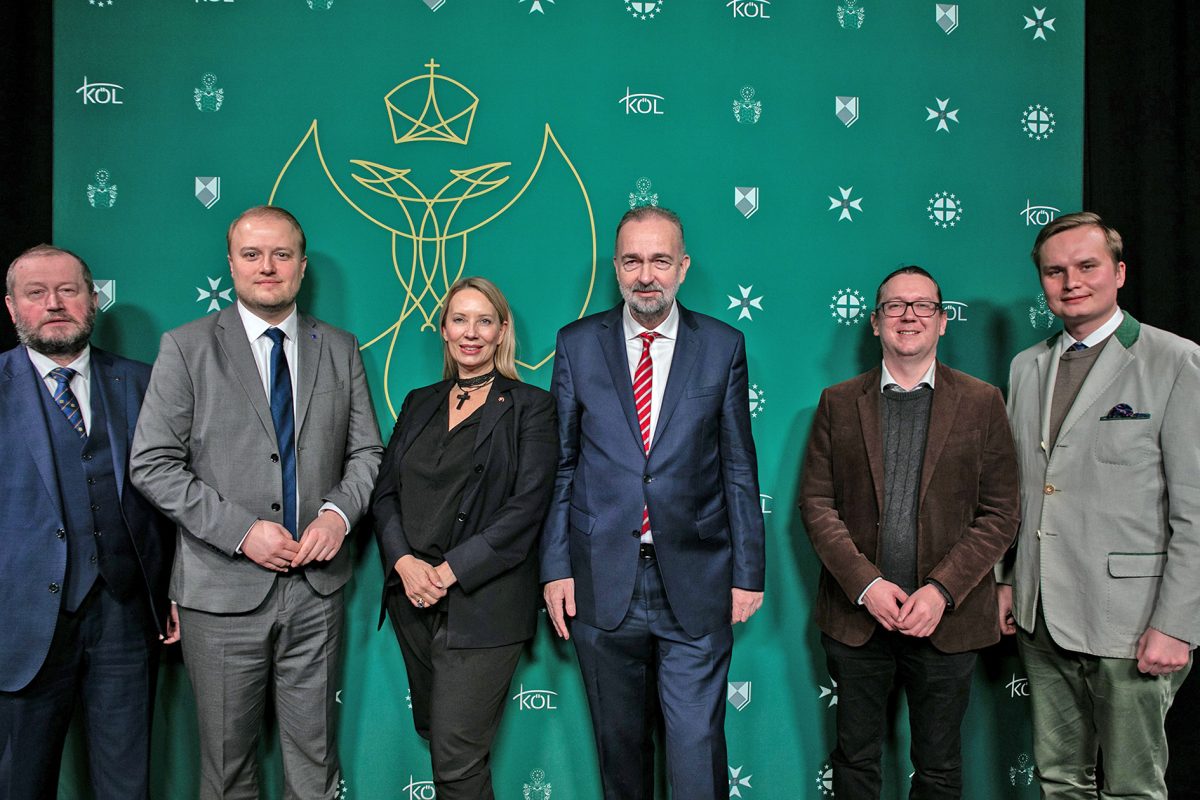
Karl von Habsburg during his “Speech on the Future of Europe” with almost the entire presidium of the Paneuropa Movement Austria. From left: Rainhard Kloucek, Secretary General; Stefan Haböck, Vice President; Gabriela Stimpfl-Abele, Vice President (who also moderated the matinee); Karl von Habsburg; Charles Steiner, Secretary; Maximilian Schmid, Chairman of Paneuropa Youth.
A year ago, in this speech on the future of Europe, which was then titled “Security through Unity”, I focused on China. In dealing with China, too, we need this “Courage to Take Responsibility”, which is the motto of this speech. Many politicians in Europe still do not seem to realise that, firstly, a totalitarian-communist regime rules in China, which, secondly, aims to become the number one world power, and, thirdly, clearly states that it intends to incorporate Taiwan into the country, militarily if necessary. The example of Hong Kong clearly shows us that communists are very flexible when it comes to agreements, but then very determined in enforcing their own system.
The totalitarian-communist regime in Beijing is pursuing a strategy that challenges our familiar system of civil and political freedoms, the system of human rights.
When China speaks of human rights, it means its own interpretation of human rights, which is in clear contradiction to the international order.
China is trying to create a new international order with its own ideology. The extent of China’s influence here was shown when individual EU countries blocked a clear EU stance towards China.
China and the New Silk Road
Now I will probably provoke strong opposition from many representatives of political correctness. But in my opinion, Italian Prime Minister Giorgia Meloni showed courage to take responsibility. She withdrew Italy from the Chinese “New Silk Road” project, because this project for China means not only economic cooperation, but also clear political goals of influence. The EU has defined China as a systematic rival, but no real consequences have yet been drawn from this.
Too many European politicians and ex-politicians still sit in Chinese lobby organisations, just as it was common for many ex-politicians (and probably still is for some) to be on Russian payrolls.
Europe, the European Union, must remember its own strengths. One of these strengths is the rule of law. Despotism, totalitarianism, and the complete ideologisation of politics stand in stark contrast to the principle of the rule of law. The rule of law means that everyone is bound by law, regardless of whether they are king or beggar, man or woman, rich or poor, and whatever other comparisons one can make.
The rule of law made private property possible. With private property, in turn, the prosperity was created that made Europe one of the leading powers for a long time. The rule of law means responsibility for one’s own actions. Responsibility, in turn, enables freedom, because only those who are willing to bear responsibility can be free. At the same time, only responsibility can guarantee freedom, because those who are not willing to bear responsibility must submit to the instructions of others, and thus have no freedom.
We must always emphasise this, because neither freedom nor the rule of law are self-evident. The temptations of convenience are just as dangerous here as those of exercising power.
Precisely this principle of the rule of law is often distorted today at the European level. Not only through the influence of despotic and totalitarian systems, but very strongly through a conflict between statist and paternalistic ideologies on the one hand and the idea of freedom on the other. One could also speak of a conflict between a primacy of politics on the one hand and a primacy of law on the other.
The essence of the liberal rule of law is precisely not the state’s enforcement of a specific idea of happiness and welfare for all. The task of the liberal rule of law is to guarantee law and freedom!
This idea of the liberal rule of law is the best and most effective protection against the massive polarisation that characterises our current society in Europe.
An ideology that follows the primacy of politics claims the right to regulate everything, indeed to be able to regulate everything. However, the more politics does this, the deeper the conflict with the law becomes. This conflict is becoming increasingly sharp because rule-of-law principles – i.e., the rule of law – are less and less governing, but rather power relations. This conflict will ultimately harm Europe in the long run.
The rule of law protects law and freedom
This rule of law, which protects law and freedom and does not impose a specific ideology on all people, is, incidentally, still the outstanding characteristic of Europe’s, and the EU’s, attractiveness. If countries today strive to join the European Union, they do so not because they want to submit to a paternalistic state, but because they seek law and freedom, and the prosperity created thereby.
Ukrainians know despotism and totalitarianism from the time of Moscow’s rule, Albanians know it from the time of communism, as do the peoples of former Yugoslavia.
Precisely for this reason, the European Union’s enlargement policy is one of its strengths that must be used strategically.
One of these enlargement processes has been ongoing for 20 years, but without making any real progress. I am specifically referring to the countries of Southeast Europe, or as it is called in EU jargon: the Western Balkans. In 2003, these countries were promised admission to the EU. 20 years later, negotiations have not even started with all countries.
This is, of course, largely due to the politics in these countries. Montenegro’s policy was more determined in the accession negotiations than it is now. The shortcomings in the rule of law in Albania are undeniable.
However, it is also largely due to the aimlessness of EU policy. If 27 different countries pursue different goals, and if these goals are only obstruction, nothing can move forward. The money flowing into the region partly cements the political structures, keeping the same groups in power who have no motivation to implement reforms because they have access to the money in the given situation. Bosnia and Herzegovina is a good example here. Milorad Dodik, the strongman of the Republika Srpska entity, can continue his destructive policy undisturbed.
At the construction sites in the capital Banja Luka, one can observe how Russian influence grows every day. The Dayton Agreement ended the war but did not create a stable order. Creating that is, among other things, the task of a European foreign policy. Moscow should not be spared consideration here. Moscow’s influence only serves to destabilise Europe.
For years, the strongman of Serbia, Aleksandar Vučić, has been coddled. He comes from the nest of the war criminal Slobodan Milošević. His policy is only better because he no longer plunges the entire Balkans into war. However, his provocations towards the Republic of Kosovo are obvious even to the blind. His government has nothing to do with democracy and the rule of law. The massive manipulations in the elections last December are just one example.
Vučić is closer to Moscow than to the European Union. The aforementioned espionage centre in Niš is just one example; the country’s pro-Russian media landscape is another.
Serbia and Kosovo
In contrast, the Republic of Kosovo is clearly Western-oriented. Now, finally, after countless delays, blockades, and broken promises by EU countries, Kosovars can travel visa-free. This example shows how friends are kept waiting and opponents are coddled.
Let us recall the attacks by Serbian terrorists on the NATO protection force in Kosovo at the end of May last year. Numerous NATO soldiers were injured, some sustaining permanent injuries. What happened? Sanctions were imposed against Kosovo. Something is not right here.
By no means do I want to portray the government of Kosovo as flawless. Prime Minister Albin Kurti is known to be a nationalist and a provocateur. However, this in no way justifies the kid-glove treatment given to Vučić and his system. Serbia will have to decide whether it wants to join the EU or be a Russian or Chinese outpost in the Balkans. The EU must react accordingly.
In the recent past, there have also been decisions that show that the European Union is indeed capable of making correct geopolitical decisions. I am specifically thinking of candidate status for Ukraine, the decision to open accession negotiations with Ukraine and Moldova, and candidate status for Georgia. However, the fact that the decision could only be brought about by a trick, because one country was obstructive, shows how difficult it is to implement this geopolitical dimension of the European Union.
For a long time, the mentioned countries were part of the so-called neighbourhood policy, which excluded accession. These countries’ aspiration to join the EU shows us how attractive the EU still is today. We must nurture and cultivate this geopolitical seedling so that it can grow.
Ladies and gentlemen, dear friends,
When we talk about Ukraine, Georgia, and Moldova, we are talking about a region where the future relationship between Europe and Russia will be decided. All three of these countries have experienced Moscow’s rule. All three countries are striving to join the European Union precisely because of this experience. They seek freedom, democracy, the rule of law, a free economy; they want to escape the despotism of the Moscow mould.
Armenia turns away from Moscow
I would like to mention another country here, namely Armenia. The country was long considered a loyal ally of Moscow. This is historically linked, among other things, to the country’s Christian tradition. In particular, the genocide of Armenians by the Young Turks in the First World War kept these ties strong for so long. For a long time, Armenians wanted to believe that Russia was a protective power for them, especially in the conflict with Azerbaijan. The realisation that Armenia made a serious mistake here is slowly beginning to take hold in the country.
While Russian influence through the security apparatus remains very strong, forces are beginning to form among the population and in some political circles that demand a clear European orientation for the country. The government has taken some small steps, for example, with a commitment to Ukraine’s independence. The European Union maintains a strong mission in Armenia and will hopefully pay even greater attention to this region in its foreign policy.
The term European foreign policy has been mentioned several times in this speech. With this, I return to a demand that I have repeatedly made in my speeches and will continue to make: Europe, the European Union, needs a genuine European foreign policy.
European foreign policy means not only coordinating the foreign policy of 27 member states through the High Representative for Foreign Affairs and Security Policy, but an EU foreign ministry with a foreign minister at its head.
For this, we need a core of a European constitution in which precisely this foreign policy competence for the European Union is enshrined. A point, incidentally, that would also meet all requirements of subsidiarity. Just as every foreign minister is currently subject to the parliamentary control of their country, an EU foreign minister would be subject to the parliamentary control of the European Parliament, directly elected by the citizens of the EU.
Sovereignty also means capacity for action
This is precisely about the question of sovereignty, which many national egoists so gladly talk about. Because sovereignty, ladies and gentlemen, in this specific case means the ability to act and shape. A European foreign policy would, in terms of potential, bring a clear added value compared to a purely nation-state policy.
Of course, this European foreign and security policy includes European protection of external borders. Naturally, Romania and Bulgaria belong in the Schengen area just as much as Croatia. This freedom of travel within the EU is probably one of the greatest achievements of European unification. This has nothing to do with the asylum issue or illegal migration. But it does require European external border protection. This was also envisaged when the Schengen area was created. The European Parliament has taken a very clear position on this.
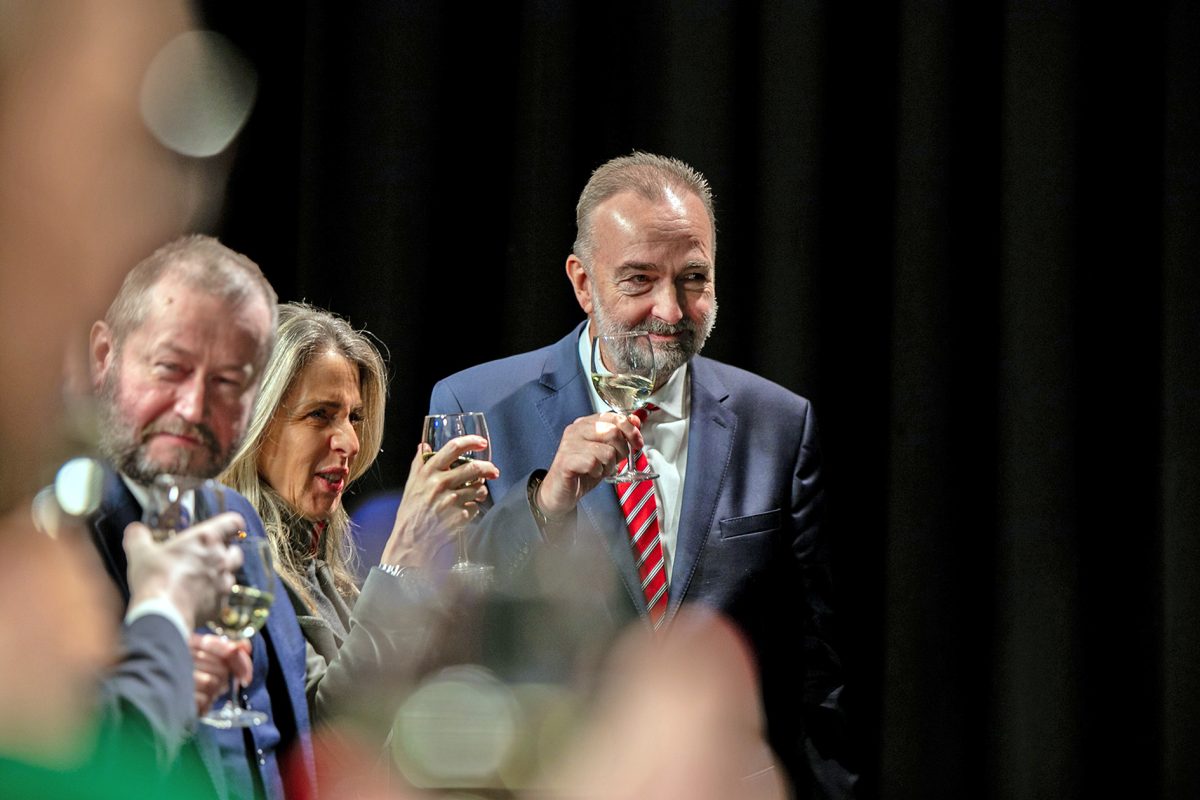
The matinee took place on Karl von Habsburg’s birthday. After the speech, congratulations were offered with a glass of wine.
I am aware that this genuine European foreign and security policy cannot be achieved overnight. It is a long-term goal, but one worth working for. The challenges facing Europe demand breaking out of particularism and thinking in larger dimensions, especially when it comes to foreign and security policy.
I have addressed some of the challenges we face. When I speak of European foreign policy, I also think of an Africa policy, without wanting to go into it now. Then I also think of a Latin America policy and specifically address the trade agreement with the Mercosur states. It has long been negotiated.
Trade agreements, as all experience shows, serve the prosperity of all involved. The fact that, among others, an export country like Austria, in rare unity from left to right – with the exception of a small liberal party – is blocking this Mercosur agreement, shows that political responsibility still requires some courage.
Ladies and gentlemen, dear friends!
At the beginning of this speech, I mentioned the example of Ihor Zhaloba, who teaches his students to take responsibility for their own future.
I would like to revisit this idea in conclusion.
We are at the beginning of a year in which there will be several elections. The European Parliament will be re-elected, and in countries like Austria, as well as in other countries, elections will also be held at the national level.
In a democracy, we cannot relinquish responsibility. Democracy demands that each of us takes political responsibility ourselves.
We must take our responsibility
In a small dispute I had some time ago, the saying came up: the wiser person gives in. Many probably still know this saying from their parents in childhood. The full saying is: “The wiser person gives in, the fool falls into the ditch.” But if the fool does not fall into the ditch and the wiser person gives in, then that leads to the rule of fools.
Therefore, we must bring our issues into the discussion for the European elections. European foreign and security policy, enlargement policy, support for Ukraine, the defence of democracy, a free economy, freedom, and the rule of law.
We must not let the populists dictate the agenda, and we must not be represented by politicians who lack the courage to take responsibility, who are too comfortable to embrace the necessary challenges.
This is my plea to you: Let us show that we are ready to take political responsibility for a free Europe!
Copyright Photos: Matthias Dolenc



