Economic Miracle or New Deal
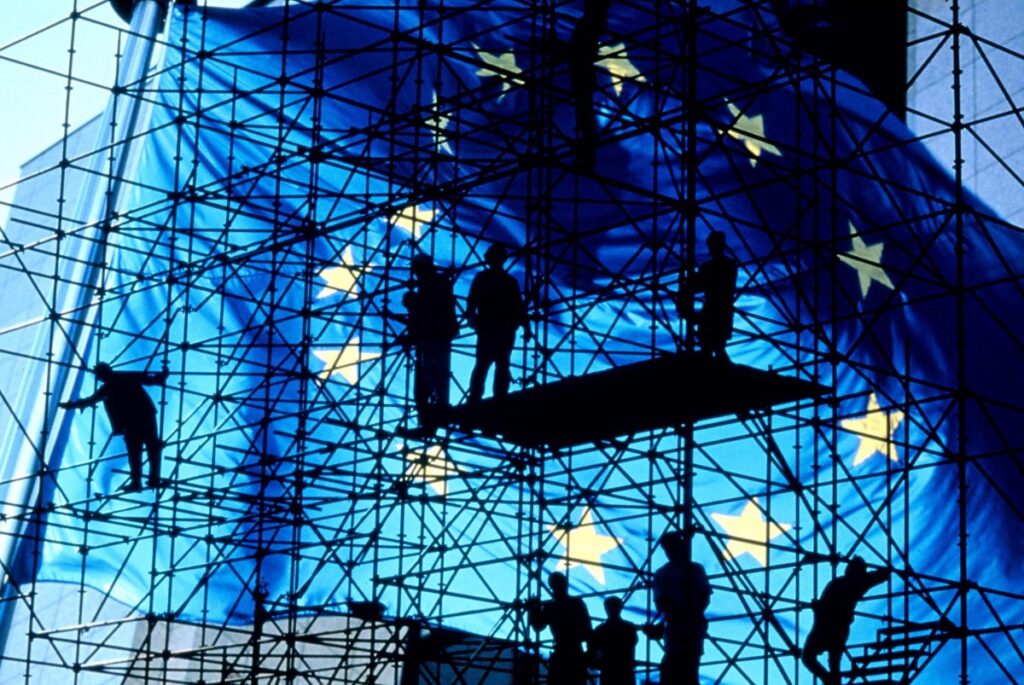
The economic slumps resulting from the Corona pandemic will be massive. How we master this collapse will depend heavily on which path we take. A commentary by Rainhard Kloucek, Secretary General of the Paneuropa Movement Austria.
The International Monetary Fund assumes that the economic consequences of the Corona pandemic could bring the most severe slump since the Great Depression at the end of the 1920s. In a recent publication, Agenda Austria quantifies the costs of the Corona crisis for labour market policy at 6.3 billion euros. 43,000 companies have registered their employees for short-time work. This means that 638,000 Austrian employees are on short-time work. In addition, there are 560,000 unemployed.
For a whole range of ideologues, this is the opportunity to go public with their fragments from the mothballs of state intervention. The demand that “the rich must now pay, because they are also to blame” is being made just as much as the demand for inheritance taxes, nationalisations, and even more regulation. From Italy comes the demand for so-called Corona Bonds, which were already demanded ten years ago as Euro Bonds. The principle behind this is the creation of a liability union in the EU. Piquantly, Italian politicians are demanding liability from all EU countries for these Corona Bonds, which are intended to benefit Italy, but want to decide entirely on their own what they do with the money. An offer of a rescue package amounting to 39 billion euros from the ESM was rejected because it would have been linked to monitoring the Italian government’s financial management.
In fact, the steps taken during the crisis will determine how we cope with the economic consequences of this exceptional situation. If the International Monetary Fund draws a comparison to the Great Depression, many probably think of the New Deal of US President Franklin D. Roosevelt. The examples cited above from the mothballs of state intervention show that many ideologues want to go in this direction. The conceptual leaning of the EU Commission’s “Green Deal” towards the New Deal also fuels fears that a new era of harmful state intervention is imminent. Yet research has long since clearly shown that the New Deal actually prolonged the crisis. It is therefore clearly the wrong path.
The period after the Second World War is a good example of the impact of political principles. Many countries were destroyed. In Germany and Austria, the so-called “Wirtschaftswunder” (economic miracle) occurred, which brought both countries an upswing from the 1950s onwards. In Germany, this was the policy of Ludwig Erhard; in Austria, it became known as the Raab-Kamitz course. The foundation was economic freedom. The state set a framework for the rule of law in which entrepreneurs could act freely.
This will be the decisive question now as well. Do we fall back into state-economic concepts that perhaps serve some oligarchs or companies close to politics, or do we take Ludwig Erhard as an example, whose policy enabled a broad middle class to rise. This, incidentally, is also the best recipe for stable democratic systems, because this policy is based on subsidiarity and the rule of law.
c Featured image: EU



