Europe – A Project of Hope or a Hopeless Case?
Stefan Haböck, Vice-President of the Paneuropa Movement Austria, addressed members of the Order of St. George on European integration, crises and successes, obstacles and progress. The speech is reproduced here in full.
When I spoke on the phone with my dear friend Vinzenz Stimpfl-Abele, the Procurator of your esteemed Order, at the end of 2024, we briefly discussed what the topic of today’s event might be. We discussed it briefly, because it was clear: we do not want unadulterated Euro-optimism, no ‘Europe – quo vadis?’ or to talk about how wonderfully everything is going in Europe and the world.
Because it isn’t. Not at all. The European Union, a project of hope, is in a difficult situation. Not that there haven’t been crises before.
There were plenty. One fondly remembers one’s childhood, one’s youth, a supposedly better time. Nostalgia, if you will. Apparently, memories from the age of 10 to 30 are particularly well retained. I very much enjoy looking back on my childhood and youth. It was a wonderful time.
No crises, except for my parents when a maths test was due. When I was 10 months old, the Chernobyl nuclear power plant exploded. When I turned 10, there was the Norwegian rocket incident. There was a terrorist attack in Tokyo, a bombing in Oklahoma killed 159 people, and the Srebrenica genocide took place in Bosnia-Herzegovina. France experienced a devastating series of attacks, as did Israel. Yitzhak Rabin was assassinated.
In that same year, more than 8,000 people also died in earthquakes. And in Oberwart, a booby trap killed four people. So that was the supposedly good old days.
There have always been crises. And of course, for a 10-year-old, an attack in Tokyo was far away. Very far away. But even for my parents’ generation, all these crises, if they did not directly affect our country – like the Balkan Wars or Chernobyl, when children were not allowed to play in sandpits – were not too close either. The main sources of information were the newspaper one read and public broadcasting. One must not forget that private radio was only permitted in Austria in the mid-1990s.
Today, the information world has completely transformed. The digital world allows everyone to retrieve millions of pieces of information from all over the world in seconds, simply by looking at their mobile phone. Any 10-year-old with a smartphone can consume Hamas propaganda around the clock on a Chinese-controlled platform.
Every crisis in the world suddenly becomes a constant companion. We are flooded with information, news, analyses, and yes, disinformation too. With a smartphone, I can follow troop movements on the Ukrainian eastern front live from the trenches.
There have always been crises. We just experience them much more intensely and comprehensively. This stirs up emotions. Not always joy. And it’s no coincidence that algorithms on platforms react particularly well to anger, not joy. There is also very little cause for joy at the moment. But anger is not a particularly likeable alternative either.
However, I am very concerned about many things happening in Europe.
I am concerned by the increasing centralisation in Europe. At our institute (Institute of the Regions of Europe, IRE, note), we work with hundreds of European regions, cities and municipalities. Decentralisation and strengthening of regions is one of our main concerns. After all, subsidiarity is one of the fundamental principles of the EU! However, I regret to inform you that this principle has long been increasingly pushed back.
And not by ‘Brussels’ alone. It is primarily the nation-states that have an interest in regions and municipalities being weaker. And yes, not every state in Europe is federally and decentrally structured; on the contrary. Germany, Austria, and Switzerland are rather exceptions. In some parts of the Western Balkans, there are no regions in the political sense.
What is the first thing more authoritarian politicians try to do? Disempower municipalities and regions. We saw this in some EU states where municipalities faced financial cuts and there were plans to divide regions, for example, voivodeships, because they became too strong. There are states in Europe where the President’s office decides on school construction in municipalities. That, ladies and gentlemen, is not subsidiarity.
I am concerned that Europe is moving away from its fundamental economic values of free trade, market economy, and innovation.
Politicians can think of nothing more than relying on tax-funded consumption. Premiums here, subsidies there. I am concerned that all entrepreneurs one speaks to complain about de-industrialisation, the relocation of production, and supply chain laws. Buzzwords, often certainly exaggerated in political debate, but all based on the great concern that Europe risks no longer being able to keep up economically with the rapidly changing world. The feeling of over-regulation, which leads to – as a German State Secretary recently gave as an example – stonemasonry businesses in Germany having to factually control and confirm that all subcontractors for marble in India and China comply with all social standards.
What states cannot achieve with India is burdened upon small and medium-sized enterprises. Because with India, the EU has been negotiating a trade agreement since 2007, with the establishment of non-binding environmental and social standards. But a company in Europe is supposed to demand these in totalitarian China? Don’t misunderstand: it is desirable that high social and environmental standards apply in all countries. But this must be implemented politically on the ground, not by SMEs facing tough competition. But how do states intend to implement these goals they impose on SMEs? Since 1999, i.e., for 26 years, the EU has been negotiating a trade agreement with the MERCOSUR states. To this day, there is no agreement. European states are blocking it. Since 2013 – three years before Donald Trump’s first term – the EU and the USA negotiated the TTIP trade agreement. To this day, there is no result.
Yes, caution, or fear, of trade agreements is not new. Yet even Donald Trump’s second term, that of a nationalist protectionist, does not lead to a shift in this matter.
Austria, for example, remains strictly against the agreement with the democratic states of Argentina and Brazil. A country that relies 60% on the export of goods and services worldwide and whose SME-structured economy needs the lowest possible hurdles in other regions of the world.
Speaking of Brazil: there is no desire to conclude a trade agreement with Brazil because it is argued that their political, rule of law, and social standards are insufficient. At the same time, Brazil is asked to mediate in Ukraine. So, it is sufficient for Ukraine, but not for machinery trade. I am concerned that Europe has been stalling for over a decade on the second major geopolitical lever it possesses: active enlargement policy.
Ladies and gentlemen, Europe’s enlargement policy was one of the greatest successes in European history. The enlargement of the European Union to include countries that were themselves borders to the Soviet regime, and later the enlargement to include those countries that suffered for decades under its yoke, was the logical continuation of expanding the idea of Europe as a space of security, freedom, and law. Enlargement was driven by politicians who wanted to see their country as an equal part of Europe and not as an appendage of regimes. They knew that no country could stand alone in the changing world and were convinced that the people of Central, Eastern, and South-Eastern Europe had a right to be part of free Europe and not the ‘backyard’ of an amoral regime.
But the enthusiasm is gone. In 2013, the last country, Croatia, joined the EU. That was 12 years ago. Since then, Croatia’s GDP has increased by 44%. A fine success story. But the optimism has vanished. It has been replaced by short-sighted politics in nation-states, by nationalistic demagoguery, by narrow-mindedness. One candidate country had to change its name, another is under measures.
The front-runner is considered to be the country whose population shows the least approval for the EU and whose politics are most sharply opposed to the EU. Of course, many countries are not yet ready to become members.
A survey from an accession candidate country in the Western Balkans shows that 2% of the population trust the justice system. 2 per cent. But nothing will change unless Europe finally shows genuine interest in the region.
Enlargement policy is reduced to the pragmatic processing of requirements, paragraphs, and regulations. Don’t misunderstand me: this is important. EU legal norms are the foundation of the rule of law; they are intended to reduce arbitrariness and integrate countries into the European system. But who believes that people’s hearts can be won over for a project by telling them about 23 regulations that have been processed?
An anecdote has stayed with me since 2023. At that time, a high-ranking politician from a capital in the Western Balkans said that European funds were out of the question for him. The processing was far too complicated, while China provided money unbureaucratically.
Admittedly, this statement must be taken with – as the Americans say – a grain of salt, given the political situation in that country. Nevertheless, a certain impression remains.
People need hope. An idea they like. Every pro-European in the Western Balkans knows that there are everyday difficulties in the EU too, but they still cling to the idea of Europe. Why? Because they (still) have hope.
In its enlargement policy, Europe no longer fulfils this promise. The dialogue between Serbia and Kosovo is a completely fruitless exchange of incivilities, so far moderated by a special representative whose home country does not even recognise one of the negotiating parties. Instead of solving the problems at the highest political level, they were shifted to a working group.
The enthusiasm for the ‘new candidate countries’ – Ukraine, Georgia, Moldova – has vanished. In Moldova, a pro-European government bravely fights against the still deeply entrenched Soviet spirit in the country and against Moscow’s influence. In Gagauzia – a province where the EU finances roads and schools – 95% vote against the EU.
Ukraine has already had experience in its most difficult hour with the issue on which EU accession will probably fail at the latest, namely the EU’s Common Agricultural Policy.
And the leadership in Georgia has decided, instead of co-deciding at Council meetings in Brussels, to congratulate the Iranian President on his inauguration in Tehran among Hamas representatives.
I am concerned about Europe’s strong dependence on systems and regimes that are far removed from our value system.
There is this nice saying: Europe lived off cheap security from America, cheap production from China, and cheap energy from Russia.
Regarding energy, it is more than doubtful that it was really that cheap. One can assume that Russia would not have given us gas for free. At least not without something in return. And this something in return is what could cost Europe dearly: loss of sovereignty and considerable blackmail potential through dependence on a main supplier. To this day – three years after the start of the full invasion and 11 years after the start of the attack on Ukraine – two EU states are still struggling with the consequences of the changed energy policy situation.
In 2010, I started working as an assistant for a Member of the European Parliament who was also heavily involved in the energy sector. Even then, the position at EU level was clear: European states must reduce their energy dependencies, because other powers would use energy as a weapon (as Ukraine’s experiences already showed in the early 2000s). And payments of up to €500 billion annually would promote the power of political systems that do not share our values.
For comparison: the Saudi oil company Aramco made a profit of €161 billion in 2022. The Italian company ENI achieved €4 billion.
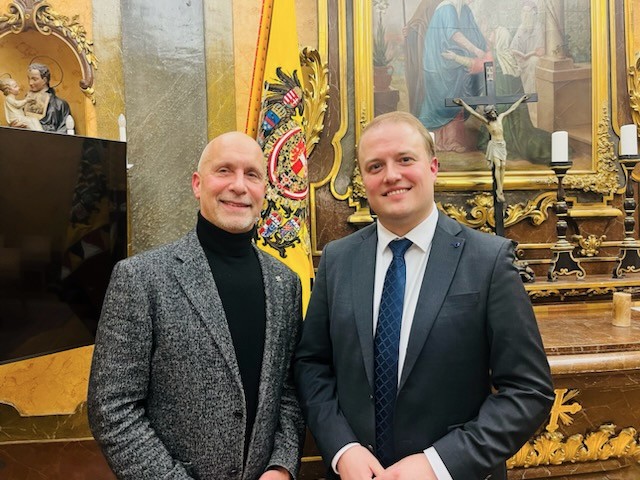
Stefan Haböck, right, with the Procurator of the Order of St. George, Vinzenz Stimpfl-Abele.
However, not only in the energy sector, but also in industry and research, another power has been strengthened through massive outsourcing: China.
It is perfectly clear that private companies must operate efficiently and consider cost structures. The EU will never be able to compete with lower labour costs in large parts of Asia. And private companies should be responsible for the decisions of private companies. But this area is also massively politicised. Because in China, nothing happens without the Party. And like Russia, China has managed to create a complex, deeply penetrating network in European politics.
China produced, Europe consumed. What initially looked like a win-win situation developed into a problem for Europe. Because, unlike the Russian regime, whose core characteristic is primarily corruption, the Chinese leadership did indeed develop a strategy to bring the country to the top technologically, economically, and militarily. China actively recruits the best students from European universities. China focuses on education. Which, in the long term, makes it a greater threat than Russia.
China is flooding the global market with subsidised products, be it steel or electric cars. BYD is now the largest manufacturer of electric and hybrid cars, and is now poised to conquer the European market. The company will build a plant in Szeged, Hungary – and Austrian companies in the supplier industry are already in talks for orders.
It was announced today that Mercedes is joining a lawsuit by Geely (Mercedes’ Chinese joint venture), BMW, and Tesla – against the EU’s punitive tariffs on China. Chinese investors hold a 20% stake in Mercedes.
The reality of the global economy is also overtaking political discussion here: internal combustion engines here, electric cars there – if the world’s most populous state pushes a technology, companies will have to adapt. China is, of course, not doing this solely out of concern for the global climate; it is not yet shutting down its coal-fired power plants, but rather for geostrategic considerations. And it works.
The problem is that, during China’s growth, Europe, due to its arrogance of having a ‘cheap workbench’, never considered it necessary to make it clear to the Chinese that common rules must be adhered to. Reciprocity would be the keyword. Here too, politics acted short-sightedly. In 2010, there was an inquiry in the German Bundestag on Germany and China, which warned, among other things, that the joint ventures in technology between German car manufacturers and Chinese companies would lead to a drain of know-how that would eventually displace German car manufacturers. Fifteen years later, German car manufacturers are suing the EU.
Europe can now forget about reciprocity: China now dominates as both a sales market and a technological and political power, and has long since begun to secure this dominance.
The country is now building self-sufficiency to be able to act independently in a major conflict with the USA. This means: massive expansion of military capabilities. Securing and controlling raw material extraction and raw material supply chains. Control of the most important ports and thus logistics.
No country will ever achieve autarky. China also imports raw materials – 75% of cobalt comes from the Democratic Republic of Congo. Nickel is largely imported from Indonesia. Indonesia was admitted to BRICS in 2025. Autarky is illusory, but it is leading to decoupling. With domestic know-how, own capacities, and sources of supply from partners, it is to be ensured that in the event of export restrictions and possible price increases, the affected industries, and thus the economy and the state, can at least survive.
To illustrate China’s importance to the world: when China shut down magnesium factories in two plants in 2021 due to energy-saving measures, the price of magnesium rose by 260% due to the shortage. Everything China does has a direct impact on the world – and Europe. Currently, 7% of China’s trade surplus comes from photovoltaic systems.
The problematic aspect of this is that Europe’s most important ally – the USA – is also moving in this direction.
Of course, ‘America First’ has always existed – because every US President naturally places the interests of their country above those of others. So far, so unspectacular. But the announcements, personnel, and initial decrees of re-elected President Donald Trump show that this time it is heading in a harsh protectionist direction, thus moving away from cooperation among Western partners.
Until now, much of what US politicians threatened could be dismissed as sharp rhetoric aimed at US voters, as the implementation was usually not so severe, given that the US also felt bound by international agreements and partnerships, and decision-makers were open to arguments and compromises.
But that time seems to be over.
‘Buy American or get punished’ is pure protectionism, which might still be circumvented with cars. For how can EU citizens be forced to buy American cars? However, this protectionism, at the latest with the recent decision to impose punitive tariffs on chips from Taiwan, causes massive disruption in the democratic world: weakening Taiwan, which can assert a certain strong position precisely through its strength in chips, directly leads to a strengthening of China. The crash of technology stocks after the launch of China’s AI program DeepSeek shows what the world is heading towards.
Europe has nothing to counter this and is now merely a spectator in the field of Artificial Intelligence. Europe has no AI corporations, but it does have regulation.
With platforms, the USA has already shown the direction it intends to take: first TikTok was banned, now it is to be split up. A state forcing a sale to its own oligarchs was previously only known from regimes. The fact that Elon Musk rages against Europe around the clock but has no problem with his own company being banned in several countries around the world should perhaps also give Europeans pause for thought about what they can expect. For many influential men in the USA, Europe has now become the enemy.
Tesla operates a Gigafactory in China. And Tesla is suing against EU tariffs on China. Owner of Tesla: Elon Musk, whose company X is banned in China.
Militarily, the hour of reality will soon strike for Europe: for decades, the continent has reaped the so-called peace dividend, relying on US protection. Within NATO, almost all states have failed to meet their self-imposed target of 2% of defence spending. In fact, Europe disarmed even as a war raged in Eastern Europe. What proportion of this was due to naivety and what proportion to Russian influence on European decision-makers will still need to be intensively researched.
The USA’s turning away from Europe and towards the Asia-Pacific region and South America is evident, among other things, in the order of phone calls made by the new US Secretary of State Marco Rubio – still one of the more moderate figures in the US administration – upon taking office. The first EU country was Poland, in 14th place. However, this turning away is not new, but a logical consequence of the changing global situation on the one hand, and the demographic situation in the USA on the other.
The Catholic Joe Biden was considered one of the last classic US politicians who still emphasised his European ancestry – in this case, Ireland – and, due to his political career, still had connections to Europe. As a senator, Biden was intensely involved with the wars in the Balkans and the creation of Kosovo as an independent state. For his Vice President Kamala Harris, Europe was not a priority.
Unfortunately, one does not get the impression that the massive geopolitical upheavals have led to too much rethinking among everyone in Europe.
Many in Europe still close their eyes to the security policy reality.
In Austria, the joint procurement of an air defence system with European partners is under discussion. Under the guise of neutrality, Europe’s military sovereignty is to remain weak. In the coalition negotiations in Austria, SkyShield is up for debate. In Germany, the ‘Zeitenwende’ (turning point) has been cancelled.
Under pressure from the far-right and far-left, German social democracy is caving in. Those who ordered leadership, as Chancellor Scholz promised upon his election, received weakness. While in social democrat-governed Norway all parliamentary parties support an increase in funds for Ukraine, elsewhere a cross-front alliance of opponents of the West and right-wing and left-wing extremists is forming.
The war of aggression and annihilation against Ukraine clearly shows where Europe is also divided: while the Northern European, Baltic, and many Central and Eastern European states have understood what is at stake, politicians, even in the major states, continue to flee into a world of peace that no longer exists – and never did.
‘As long as it takes’ was propagated, but far too little was done to make it ‘as short as possible’. Too little, too late – that summarises the military aid. If the USA now withdraws, the defence of a European country will probably be lost.
When one hears European politicians say that they are ready to step in should Trump reduce military aid, one immediately wants to retort: why haven’t you done it until now?
The war against Ukraine is so symbolic of Europe’s security policy weakness because it is not a regional conflict. Rather, it reflects what great powers stand for, which Europe thought it had overcome: imperialism, völkisch delusion, conquest and control, subjugation and disregard for all rules of international law – and civilisation.
The war against Ukraine is the largest war of aggression in Europe since the Second World War. The Russian Federation is supported by Belarus, Iran, North Korea, and China. In the siege of Bakhmut, 10 times more Russian soldiers died than the USA lost in 20 years of war in Afghanistan. And yet: Europe has still not been able to bring itself to provide unrestricted support. There is a lack of weapons and ammunition. The frozen assets remain untouched after vetoes from several states. The sanctions are leaky – too many states want too many exceptions – and the Kremlin’s most important source of income, gas, continues to be bought by Europe.
Ladies and gentlemen, besides all these issues – do you know what concerns me most?
The division of European society. We see it in Austria, where parties now only exchange nastiness via social media. Where the democratic centre calls Nazis and communists. Where this can lead can be seen in the Western Balkans: there, one of the main problems of the political systems there is the sometimes deep-seated hatred of political rivals and that every compromise is interpreted as weakness.
In the USA, extremists storm the Capitol. Political opponents become enemies of the people.
And while one should be very careful about resorting to dark history, the fact that a politician in Austria can publicly speak of wanted lists for political opponents shows how far the boundaries of what is sayable have shifted.
However, the massive polarisation within society and within politics also reveals a rekindled division of Europe.
A division not between rich and poor, not between North and South. But a division on the absolute fundamental and principled question of whether the democratic system is still capable of responding to the challenges of our time.
While supporters of Russia were quiet and probably in shock at the beginning of the full invasion, all kid gloves have now been removed. Parties, even in the centre, openly support the Russian regime, Chinese dominance, the strengthening of the autocratic BRICS bloc, or openly articulate their rejection of the EU.
Nationalists who deny nation-building. Sovereignists who deny a country its sovereignty. Anti-imperialists who support an empire. Populist politicians who deny a people self-determination.
However, it is also a misconception to constantly point the finger at the political right-wing fringes here. The war against Ukraine serves as a sad but illustrative example.
Anyone who justifies Russia’s war of aggression by claiming that security interests override the sovereignty of other states undermines international law. Anyone who justifies Trump’s annexationist desires towards Greenland undermines the right to self-determination and the inviolability of borders, cementing the idea that large powers can buy or conquer smaller ones. Anyone who seeks to replace agreements between equals with deals between major powers or advocates for the destruction of international organisations weakens all states that are not great powers. This weakens Europe. And thus, Austria.
More and more people are losing faith that democracy can solve the challenges. Reform backlogs, blockades, particular interests, inflation, rising energy prices, while one reads how others save hundreds of millions with yacht-related avoidance schemes. A dangerous mixture that demagogues ruthlessly exploit.
Ladies and gentlemen, even though I have painted a rather pessimistic picture of the current situation so far, I can assure you: I am not at all hopeless.
Because hopelessness is already a pre-emptive defeat.
And since a defeat of the European system is exactly what the autocrats and regimes of this earth want, it is worth not giving up hope and fighting for the European system.
I consider a united Europe – in the form of the EU, but also in the form of peaceful cooperation among European states, the European Convention on Human Rights, and international organisations – to be the success model of human history.
After the horrors of the First World War and the unspeakable crimes against humanity by the Nazi regime, Europe managed to shake off its bloody nationalism (the poison of Europe), renounce imperialism, and consider human rights as binding. The peaceful unification of 27 states that agreed to cede sovereignty and achieve a common goal is unique. Democracy, market economy, rule of law, tolerance and solidarity, the Christian view of humanity, subsidiarity, and individual freedom have made Europe the freest and, on the whole, wealthiest continent. It is no coincidence that the richest, most social, most democratic, and freest states in the world are those based on the Western system.
There is democracy in other regions of the world too. Rule of law. Or prosperity. And I have great respect for other social orders in this world. Because tolerance and openness are also fundamental European values.
Nevertheless, I must honestly say that I reject with every fibre of my being a system in which people are seen as a collective and a regime has to hold it together through pressure.
On the other hand, I also do not want to propagate a societal idea in which ‘survival of the fittest’ is lived to the extreme and becomes a sad reality in Los Angeles between Bel Air and Skid Row, the largest homeless encampment in the USA.
What defines Europe are its fundamental values or, as Pope John Paul II once said, the soul of Europe. The soul of Europe springs from the Judeo-Christian tradition, from which the image of human dignity is derived. A view of humanity that includes subsidiarity as a natural ordering principle and that emphasises the freedom, initiative, and personal responsibility of each individual. From this derive the market economy, but also solidarity towards others.
As I mentioned at the outset: people need hope. An idea they like.
This soul of Europe is the idea of Europe. And allow me to quote the great Otto von Habsburg here: ‘Sustainable political forces are only created by an idea, for this is the soul – even of continents.’
But an idea is only successful if it can also be implemented in practice. And if Jacques Delors once said that one cannot love a single market, the single market is an instrument to implement the idea of Europe.
However, other political measures are also necessary for this.
A genuine common foreign policy that does not make Europe a plaything of foreign powers. A security policy that does not restrict EU citizens and grant oligarchs freedom of travel, but protects Europeans.
An economic policy that rewards innovation and diligence, allows family and owner-managed businesses to flourish, and does not elevate utterly illusory fantasy valuations of tech corporations to idols.
A trade policy that prioritises cooperation, not threats and intimidation. A social policy that promotes personal responsibility instead of state dependency. A liberal rule of law that protects freedom and justice, not ideologies.
An enlargement policy that pushes the boundaries of freedom outwards to make the centre more secure.
Europe needs integrity and morality, but not moralising. Because here lies the danger of quickly sliding into double standards.
It will be difficult enough to explain why an attack by Russia on Ukraine or an attack by China on Taiwan is condemned and sanctioned, but a potential attack by the USA on Greenland is not.
Europe must grow up and shed its naivety. Europe must strengthen the rules-based order with all its might, because only this protects the multitude of small and medium-sized states against the arbitrariness of great powers.
To answer the initial question: I have hope for Europe.
Firstly, I am convinced that Europe is portrayed as worse than it actually is, partly due to disinformation – not exclusively, but sometimes deliberately as part of hybrid warfare.
One gigantic skyscraper after another in the desert is architecturally impressive, but it says nothing per se about the quality of life there. Personally, I prefer a glass of white wine on the Piazza del Duomo in Florence. But that is purely a matter of taste.
However, as a centrist European, I certainly see other factors that make a country, a political system, worth living in:
In Russia, with 143 million inhabitants, 30,000 people die annually from HIV/AIDS. In Germany – 80 million inhabitants – approx. 300. In some Gulf dictatorships, 90% of the workforce are migrants. Honestly, I personally consider it a far greater achievement for a country without raw materials – like Estonia – to build prosperity through education, democracy, and a market economy, than through the pure exploitation of natural resources. In the World Competitiveness Ranking, out of 69 states, 31 are from Europe. Denmark was No. 1 in 2023, No. 3 in 2024 – behind Switzerland and Singapore. In the Global Peace Index, 15 of the top 20 most peaceful countries in the world are European.
One doesn’t have to be naive. Other countries are catching up. Prosperity is improving in many regions of the world. But all these countries also have massive problems.
In China, the economy is weakening, just as the USA has massive discourse on migration. Migration, lack of growth – these are problems in and for Europe, but not genuinely European problems.
Nevertheless, it must be stated that Europe – which is not a state – primarily grows through crises. It is easy to talk about the US President deciding this or that and taking decisive action. Yes, he also has executive power in one country. The EU consists of 27 sovereign states.
The COVID-19 pandemic clearly showed for the first time that states – even after initial national solo efforts – can cooperate. Joint vaccine procurement or the EU’s green lanes demonstrated this.
And in Europe, people could already fine-tune things again, while in China, the homes of the sick were still boarded up and monitored by drones. The full invasion of Ukraine in 2022 also showed that Europe can rethink and cooperate on security and defence policy. Yes, too little, too slow. But uniting 27 states plus dozens of global allies on an issue that Europeans had completely suppressed – namely war – is also an achievement.
Meanwhile, there is a Coordinator for Defence Policy in the European Commission, and with an Estonian at the head of the Diplomatic Service, Europe also gave up the dominance of the ‘large Western states’ in this field and takes the concerns of the Eastern EU countries seriously.
A stricter course has also slowly prevailed on the issue of migration. In 2023, a comprehensive reform in the area of migration was achieved in the EU with the Asylum and Migration Pact. Here too, many have understood that the previous approach was not effective. And here too, one must not forget: migration is an important part of hybrid warfare against Europe! In 2023, the military government in Niger repealed the law enacted in 2015 under EU pressure, which was intended to curb migration to Europe. This had previously reduced the smuggling of migrants through Niger. Now it has been decriminalised again.
An attack on the EU – and on human dignity.
These are just a few examples of issues where Europe grows in crises.
But what Europe urgently needs are Europeans. People who feel committed to the soul of Europe and live these principles themselves. And it needs organisations that not only demand European values but also proudly bear them in their name.
Europe is a project of hope.
For nothing is so hopeless that we cannot find reason for new hope.



