Europe Day: Time to Improve the Union
Paneuropa: European integration needs new momentum – competitiveness for the business location and realistic perspectives for the Western Balkan states as priorities.
Following the frequently expressed scepticism towards European integration and the European Union as a result of national solo efforts in managing the Corona pandemic, the Paneuropa Movement Austria proposes using Europe Day 2020 (9 May) as an occasion for new impulses for European integration. “We should not forget,” says Karl von Habsburg, President of the Paneuropa Movement Austria, “that the question of security stood at the beginning of European integration. We finally need bold initiatives for a genuine European foreign and security policy that enables Europe to act as a political entity in the diverse geopolitical conflicts.” In this context, Habsburg recalled the challenges posed by the policies of Russia, China, and also the USA.
Regarding the management of the economic consequences of the Corona pandemic, Rainhard Kloucek, Secretary General of the Paneuropa Movement Austria, warns against a relapse into state-interventionist concepts. “If we are looking for examples of reconstruction, then let us look at the policies of the Economic Miracle. Entrepreneurial freedom is the best recipe for a new upswing. Politics does not intervene here; it sets the framework and creates legal certainty.” For the Paneuropa Secretary General, this also includes a re-industrialisation of Europe, making it attractive again for companies to produce at the European location. Sustainable growth and job creation are priority challenges for Europe right now. The answers lie in a commitment to free trade, the completion of the Single Market, and a mechanism that scrutinises all regulations for their impact on the competitiveness of the location.
From the perspective of Youth Chairman Philipp Jauernik, appearing as a geopolitical actor requires a courageous enlargement offensive towards South-Eastern Europe. “For far too long, the so-called Western Balkan countries have been repeatedly put off with promises. What is needed here is an offensive EU policy to export stability to a region that is still restless and disputed. The stronger the pressure of an EU foreign policy, the higher the pressure from the population of these countries on their governments to push through the necessary reform steps – to name the rule of law and the fight against corruption.” The long-promised visa liberalisation for the citizens of Kosovo is just as much a part of such a policy as an accession perspective for Ukraine.
“With the four fundamental freedoms,” says Karl von Habsburg, “the EU has a solid foundation. This must now be supplemented by a foreign and security policy identity for the EU.”
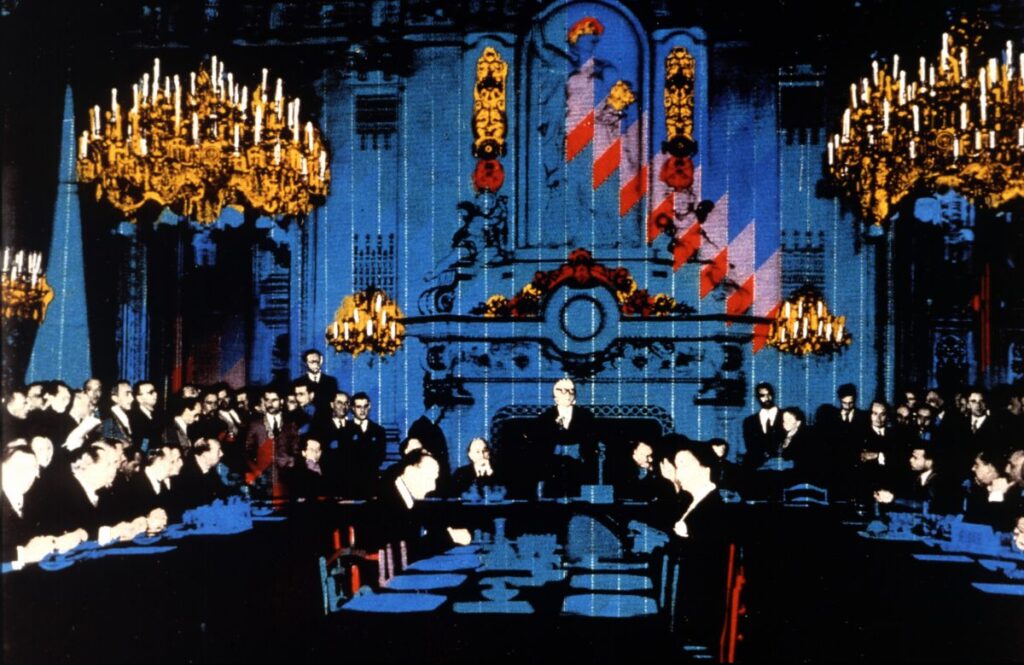
Featured image: Schuman Declaration 9 May 1950, © European Community 1962



