European Leadership: Achieving a Just Peace for Ukraine
Russia’s war against Ukraine has already lasted more than ten years. It will soon be three years since the regime in Moscow launched its war of annihilation against its European neighbour. Will it be possible to achieve a just peace? A commentary by Carlos Uriarte Sánchez.
The year 2025 begins with a new European Commission, elected on 1 December, and a new President of the United States from 20 January, who already declared during the election campaign that he would end the war in Ukraine.
All experts agree that the war cannot continue indefinitely, as it not only costs lives on both sides but also incurs economic costs in both the Ukrainian and Russian economies, which have a negative impact on the European and global economy as a whole. Up to this point, we are in agreement; however, to achieve a ceasefire that leads to talks aimed at a final and lasting peace, both parties must naturally make concessions, and the party under attack must, of course, receive security guarantees. There are many alternatives, such as the accelerated integration of Ukraine into the European Union, whereby it would be protected as a member state by the mutual defence clause of Article 42(7) of the EU Treaty, which states: ‘If a Member State is the victim of armed aggression on its territory, the other Member States shall have towards it an obligation of aid and assistance by all the means in their power, in accordance with Article 51 of the United Nations Charter.’
This article of the TEU is supplemented by Article 222 of the Treaty on the Functioning of the European Union, which establishes the solidarity clause. This governs the obligation of member states to act jointly if one of them is the object of a terrorist attack or the victim of a natural or man-made disaster. Therefore, the Treaty of Lisbon introduces a clear obligation to defend a member state if it is attacked. We possess the legal instrument and must therefore equip ourselves with the appropriate means to make this European defence capability credible. Consequently, we are indeed facing an important element of deterrence against possible future aggression. In my opinion, Article 42(7) TEU is much more mandatory than Article 5 of the NATO Treaty and Article 4 of the same treaty, which merely calls for consultations with the organisation’s member states.
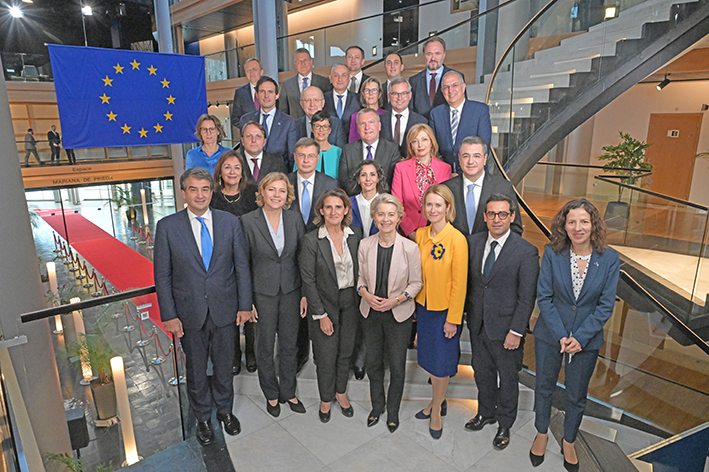
The European Union, led by a new European Commission that includes a Commissioner for Defence, the former Lithuanian Prime Minister Andrius Kubilius, as well as a new High Representative for Foreign Affairs and Security Policy and Vice-President, the former Estonian Prime Minister Kaja Kallas, must take on a stronger role in supporting Ukraine and finding possible solutions to end the conflict, including future relations with the Russian Federation. At the same time, we must, in some way, integrate Russia into the future European security architecture through stable dialogue and confidence-building mechanisms.
Another alternative would be the integration of Ukraine into NATO.
All these alternatives and security guarantees requested by Ukraine must be supported by the European Union and NATO. It must be examined what compromise Ukraine can achieve in negotiations with Russia. What is clear is that we must support Ukraine with all the means at our disposal so that it is optimally positioned for these future peace negotiations with Russia.
Therefore, it seems necessary to respond to the debate between various member states of the European Union regarding the possible deployment of troops to Ukrainian territory as security and deterrence mechanisms to guarantee a credible ceasefire. This would be the beginning of talks that, over time, lead to a permanent and sustainable peace.
Until we reach that point, yesterday’s adoption of a new sanctions package (the sixteenth already) seems correct to me. The European Union will continue to support Ukraine. Given the doubts surrounding Trump’s position on the conflict and the role of the United States after he takes office, the European Union must maintain its own defence and security policy, as set out in the Strategic Compass for Security and Defence. The document known as the ‘Strategic Compass’, which defines the concept of strategic autonomy that the EU has been working on for some time, must be implemented at an accelerated pace.
Every cloud has a silver lining if we finally leave our comfort zone and take a reality check. The world is becoming increasingly complex, and the EU must take a step forward if it wants to remain useful and successful rather than falling into insignificance. The American umbrella has allowed us to live very peacefully for a long time. But it is time for us Europeans to become masters of our own destiny—in cooperation with our partners and allies, of course, but with a clear European accent that takes European interests into account.
Furthermore, there is a debate about whether Europe should send troops to Ukraine for deterrence and as a security guarantee to effectively support Ukraine in its peace talks, and about the need for a genuine European defence industry.
The debate is therefore open, and it is always positive. It seems that Europe is finally beginning to exercise its leadership, even if it is still tentative regarding security and defence. The next EU Council Presidency, which Poland will take over on 1 January 2025, has made strengthening European security in all its dimensions—external, internal, economic, information, energy, food, and health—one of its priorities. Decision-making is slow, but the European project has emerged stronger from crises. That is why European leadership is more necessary today than ever.
Carlos Uriarte Sánchez, Secretary General of Paneuropa Spain, member of the Presidency of the International Paneuropean Union, and Vice-President of the Coudenhove-Kalergi European Society.
Featured image: The newly elected European Commission. © European Union 2024 Dati Bendo



