Generation What: Europe, What Is It?
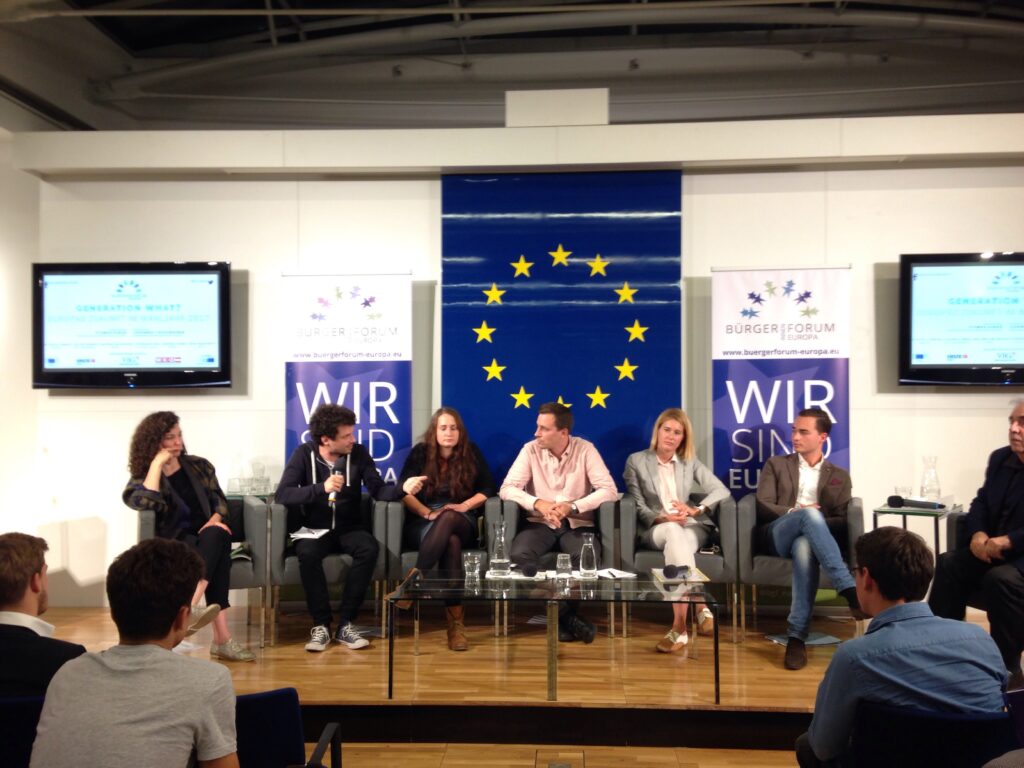
Young candidates in promising positions for the National Council election discussed the significance of the Union and its future. Richard Gansterer listened and reports.
“Solidarity is not a one-way street”
At the invitation of the Citizens’ Forum Europe, a panel discussion took place on Wednesday, 6th September, at the House of the European Union. MEP Othmar Karas delivered the introductory remarks. He highlighted the European Union as a community of law and values and emphasised the influence of the National Council election on its functioning. The future government, with its vote in the Council, will be part of European legislation. Particularly in view of Austria’s upcoming Council Presidency, the election will have decisive implications for budget planning and key priorities in the coming years.
More Europe? Not Without Controversy!
“The European Union is the most important project of the 21st century,” underscored Nico Marchetti (ÖVP). He believes the role of MEPs as direct representatives of citizens should be strengthened through the right of initiative for members of the European Parliament. Furthermore, he calls for additional sanctioning possibilities for violations of existing treaties such as Dublin or Maastricht, to guarantee the credibility and rule of law within the Union.
Julian Schmid (Greens), in addition to strengthening the EU Parliament, also demanded a training guarantee up to the age of 30 and binding requirements for climate protection. To adequately increase the EU budget, he proposed Europe-wide reductions in armaments expenditure and a financial transaction tax.
National Council Member Claudia Gamon (NEOS) highlighted the EU’s crucial role as a guarantor of stability and peace in regional conflicts such as those in Belgium or South Tyrol. She calls for deeper cooperation on security and foreign policy issues. Her goal is a European Republic with a universally elected parliament and increased involvement of the regions. As a first step, she envisions the creation of a European intelligence service and a common army. “We must be convinced of our community of law and values to persuade other states of our democratic path.”
Maximilian Krauss (FPÖ) held a critical stance. While he supports Austrian EU membership, he misses opportunities for direct democracy and citizen influence, pointing to low voter turnout in EU elections. He described the negotiations with Great Britain as “unfair” and advocated for “building bridges instead of slamming doors on our English friends.”
The Hope of a Generation
A survey revealed that 67 per cent of Austrian pupils consider the EU a “good thing” and 26 per cent are neutral towards it. This is an enormous approval rate and highlights the Union’s significance for young people.
This was also evident in the discussion, as European unification represents a central element for all candidates. They expressed their happiness at being able to live in a borderless Europe of freedom, security, and peace. They are aware of global challenges and want to shape international policy leading the way with a common European voice. The young candidates are determined to continue on the European path and exploit its promising potential.



