Germany: The End of the Consensus Republic
The federal election produced a completely transformed Bundestag. This has several clear causes – and a number of intriguing consequences. An analysis by Eva Demmerle.
Not that it wasn’t expected. A friend posted a quote from Seneca on Facebook this morning: “It is disgraceful not to go, but to let oneself be carried along and, bewildered in the midst of the maelstrom of things, to ask: How did I get here?” It was foreseeable that the once-great established parties would be thrashed and the smaller ones would win. Given the political constellation elected yesterday, forming a government will be more difficult than it has been for a long time.
The winners of the election are the FDP, which re-entered the Bundestag with ten percent, and the AfD, which was catapulted into the German parliament with 13 percent. The SPD achieved its worst result since the founding of the Federal Republic with 20.5 percent; that was probably the Schulz effect. They are now retreating in pique and going into opposition, although the final word on this does not yet seem to have been spoken. Let’s wait and see what the next few months bring.
The Union in Crisis
The result is devastating for the Union. An 8.5 percent loss of votes also led to one of the worst Union results of all time. The search for causes is probably taking place behind closed doors; nothing of the sort was heard in public statements. On the contrary, the bold assertion that the Merkel government’s successful policies have been confirmed is gaining traction. North Rhine-Westphalia’s Minister-President Armin Laschet delivered a classic line when asked on ZDF whether Angela Merkel’s refugee policy had led to this dismal result: “No, the refugee policy was correct. It was right to protect the external borders.” The loss of touch with reality could hardly be more evident. So, “Carry on as before!”
CDU/CSU suffered heavier losses than the SPD. Angela Merkel will probably remain Chancellor. Photo: Sandro Halank
The CSU, usually the consistent and reliable vote-getter for the entire Union, also had to shed a lot of feathers, losing over ten percent to other parties. The phrase about the open right flank, which needed to be quickly closed, quickly made the rounds. In earlier times, such electoral losses would swiftly lead to questions about leadership competence and demands for resignations. Yet, so far, not a word of this from the Union parties, as it is clear in both that there is a lack of personnel alternatives. In the CDU, because Merkel has eliminated all potential rivals – and in the CSU, Söder also doesn’t seem to be a real alternative.
Voter Shifts Away from the CDU – Centre-Left Remains Stable
Compared to the 2013 federal election, the Union has now lost almost a quarter of its voters. Migration policy plays a significant role here, but it is not the only one. Accumulated frustration over many years also broke through: conservative, economically liberal, and Christian-oriented voters turned their backs on the CDU. Merkel’s volte-face on “marriage for all” at the beginning of July merely capped the process of alienation.
It was surprising that the Greens, contrary to all polls, managed to stabilise and even make slight gains. The Left Party, successor to the SED, also remained stable, but had to shed feathers, particularly in the eastern federal states, in favour of the AfD.
Strong AfD Result – Weak AfD Parliamentary Group?
The AfD is no surprise winner. With 13 percent, it entered the German Bundestag, and this was also the dominant topic in the media, which in turn acted as if this were a great surprise. But let’s remember: the AfD was politically as good as dead in June 2015. The open borders policy in autumn 2015, however, acted like a single resuscitation programme for the AfD.
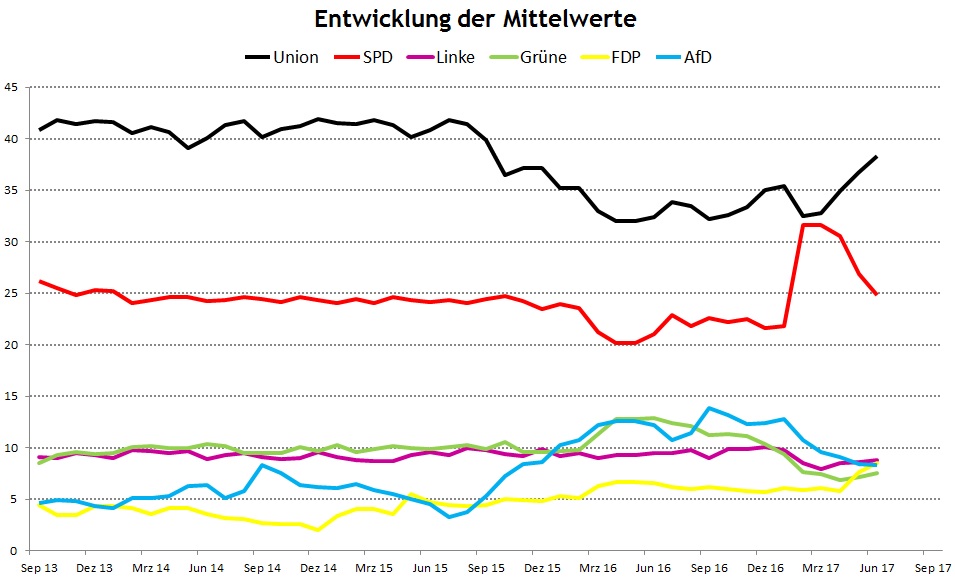
Anyone who now, like many media and political commentators, suggests that it is a party of the disenfranchised, shows that they have long since lost touch with reality in the country. Voter movements prove this: the AfD sucked voter nectar from every party; approximately 30 percent of CDU voters from 2013 now voted for the AfD, ten percent of SPD voters. Most of all, however, the “Alternative” benefited from non-voters, a development that should give the old established parties pause for thought.
How the AfD will develop in the Bundestag remains to be seen. There can be no talk of unity within this party. For now, party leader Frauke Petry, who won a direct constituency in Saxony, caused a stir at today’s press conference: she announced that she did not intend to join the AfD parliamentary group in the Bundestag.
Prognosis & Conclusion: It’s Getting Exciting Again!
My prognosis: The Chancellor will now try by all means to persuade the SPD to relent. Their leader Schulz and the probable parliamentary group leader Nahles will drive up the price. Should Merkel be unable or unwilling to pay this price due to CSU demands, she will – solely to remain in power – make all possible promises to both the FDP and the Greens in the coalition negotiations.
This will further prevent the Union from re-profiling itself to its core brand, and the dissatisfaction of its traditional clientele will continue to rise. That the content of the FDP and the Greens do not align is a truism. One is freedom-loving and market-oriented, the other statist. It will then entirely depend on the FDP’s steadfastness. Perhaps we can then also expect new elections in the near future.
In any case – and this alone is the good news from yesterday evening’s election – the consensus republic is now at an end. We can once again look forward to political debates.
Eva Demmerle is a historian, publicist, and PR manager. From 1995 to 2011, she was office manager, assistant, and press spokesperson for Otto von Habsburg. Her latest book, “Kaiser Karl, Mythos & Wirklichkeit” (Emperor Karl, Myth & Reality), was published in 2016 by Wiener Amalthea-Verlag.
Image credits: © By Petruz – Own work, CC-BY-SA 4.0, https://commons.wikimedia.org/w/index.php?curid=58112626



